Pickleball Paddle Weight Guide: Balancing Power, Reflexes, and Court Comfort
Key Takeaways
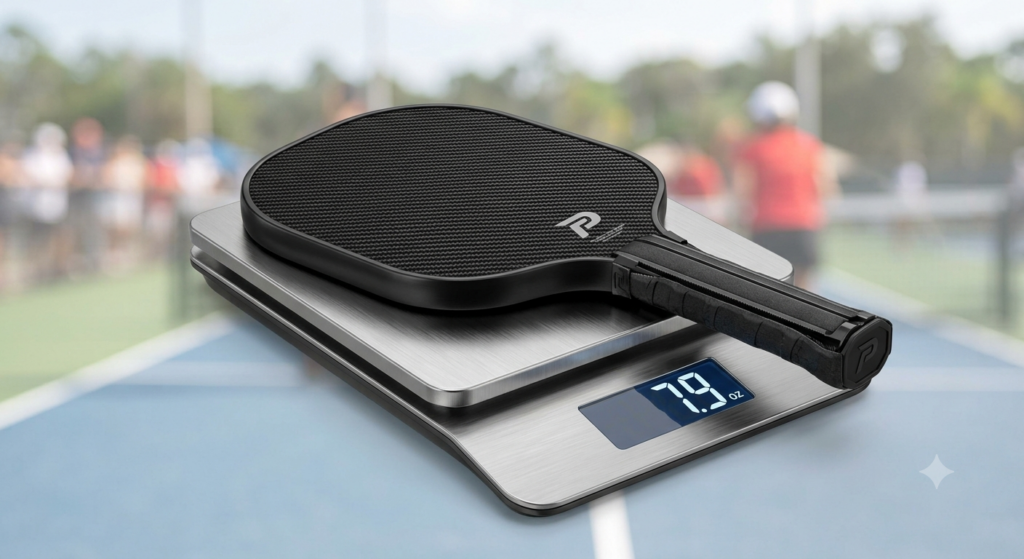
- Paddle mass is the single most critical performance metric — even more than face material, the total weight dictates how fast you swing and how much impact your arm absorbs.
- The three primary weight classes serve distinct styles — lightweight paddles favor hyper-quick net resets, midweight options balance the entire court, and heavyweight models maximize baseline power.
- Tenths of an ounce create massive structural differences — a minor 0.2-ounce shift alters the swing weight entirely, shifting a paddle from a nimble tool to a heavy driving force.
- Weight distribution directly impacts injury prevention — choosing an incorrect weight class or an unevenly balanced paddle is a primary driver of chronic lateral epicondylitis, commonly known as pickleball elbow.
The Direct Answer: Why Paddle Weight Rules Your Entire Game
When shopping for gear, players easily get distracted by carbon fiber faces, grit textures, and geometric shapes. But veteran players and mechanical engineers will tell you that static weight governs every physical interaction on the court. Weight determines how fast your hands move during a lightning-fast kitchen volley exchange, how deeply your drives penetrate the baseline, and how much strain passes into your tendons.
Many players search endlessly for the [best pickleball paddle for control] hoping a surface material will fix their unforced errors, only to find their issues stem from a paddle that is either too light to block heavy balls or too heavy to swing quickly. The baseline weight for modern composite and carbon fiber paddles ranges from 7.0 ounces to over 8.5 ounces. While a variance of 1.5 ounces sounds negligible, it completely transforms the paddle’s physics.
Finding your ideal weight requires analyzing your physical strength, injury history, and whether you play a fast-paced doubles game or a baseline-heavy singles format.
The Three Main Paddle Weight Classes
When examining a comprehensive [pickleball equipment list], paddles are divided into three distinct functional categories based on their static ounce weight.
| Weight Category | Ounce Range | Primary Playstyle Benefit | Potential Drawbacks |
| Lightweight | 7.0 – 7.5 oz | Lightning-fast hand speed; effortless kitchen volleys and delicate dinks | Minimal built-in power; forces your arm to absorb more ball shock |
| Midweight | 7.6 – 8.2 oz | Perfect blend of depth power and soft touch; highly versatile baseline | Can feel slightly generic for players wanting specialized top-end power |
| Heavyweight | 8.3 oz and Up | Massive baseline drives; stable blocking against hard, driving shots | Rapid arm fatigue; slower reaction time during fast hand exchanges |
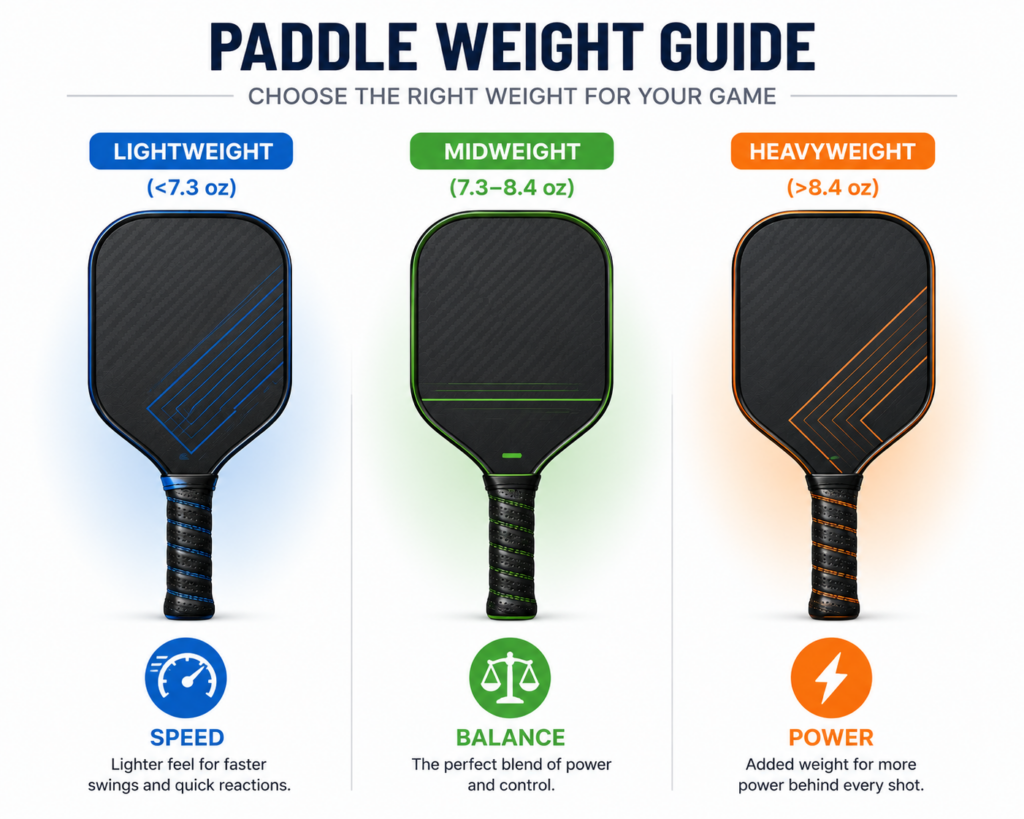
Selecting the right category is heavily dependent on your experience level. A balanced midweight paddle is universally recognized as the safest, most effective [pickleball paddle for beginners] because it lets players develop stroke mechanics without compensating for extreme weight biases.
How Paddle Weight Dictates On-Court Physics
The functional trade-off between light and heavy paddles comes down to basic physics: Force equals Mass times Acceleration ($F = ma$).
The Lightweight Dynamics (Under 7.5 Ounces)
A lighter paddle requires less effort to accelerate, granting you exceptional hand speed. When you are standing at the non-volley zone line and an opponent fires a ball at your chest, a lightweight model lets you position the face fractions of a second faster. However, because the paddle lacks mass, it cannot resist the ball’s kinetic energy effectively. You must swing harder to generate depth, and your arm takes the brunt of the vibration.
The Heavyweight Dynamics (Over 8.2 Ounces)
A heavier paddle possesses high momentum. When a driving ball strikes a heavyweight paddle, the physical mass of the handle and face absorbs the shock, making it an excellent tool for passive blocking. The ball pops off the face with natural depth without requiring a massive swing. The downside is structural fatigue; dragging a heavy paddle through a three-hour tournament bogs down your reactions and stresses your shoulder.
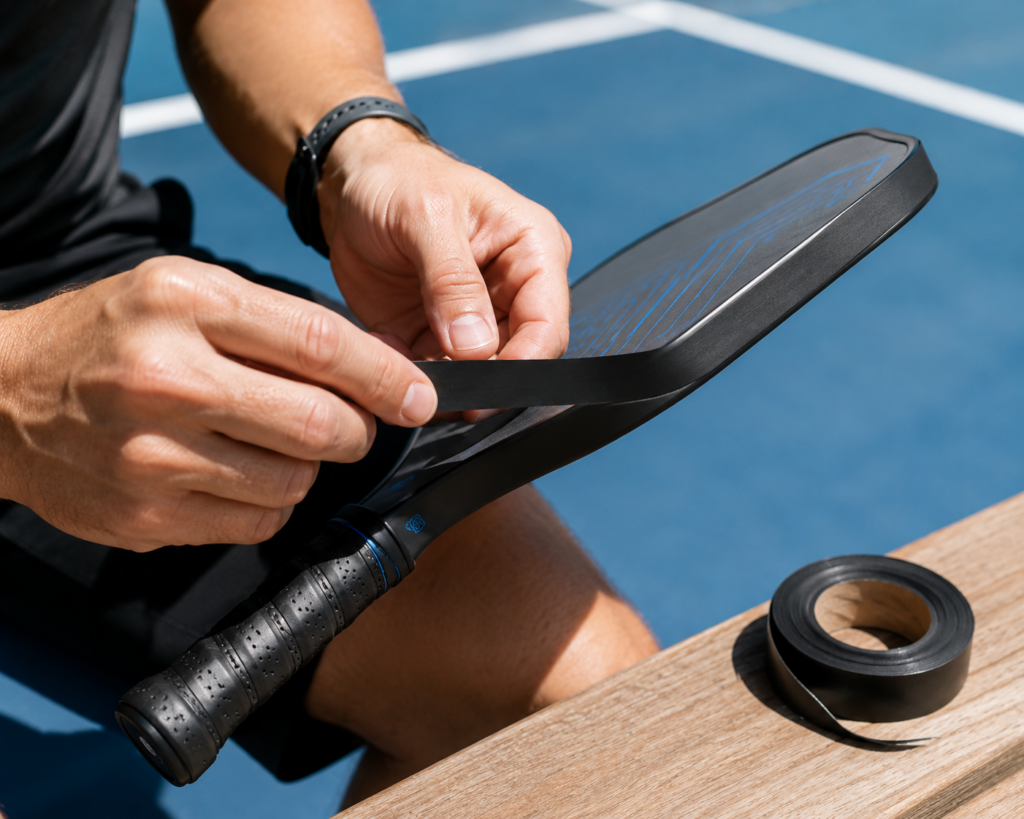
Pro Tip from the Court: If you find yourself caught between two weight classes, always choose the lighter configuration. You can easily customize and add weight to a paddle by placing lead or tungsten tape along the edge guard. However, you can never subtract weight from a paddle that is structurally heavy out of the box.
The Overlooked Factor: Swing Weight vs. Static Weight
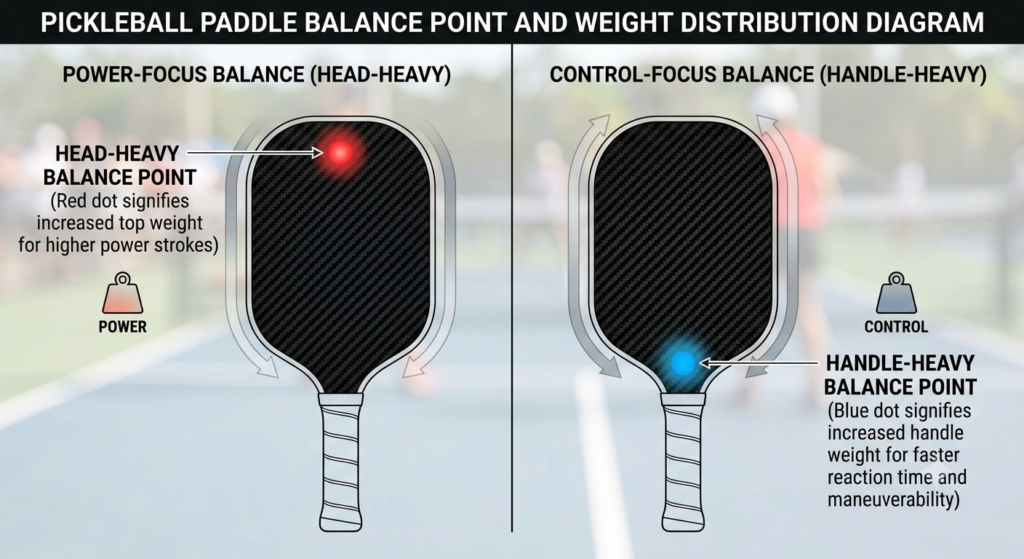
Two paddles can weigh exactly 7.9 ounces on a scale but feel completely different in your hand. This variance is caused by weight distribution, known as swing weight.
- Head-Heavy Distribution: Paddles with an elongated shape push their center of mass toward the top tip. This design creates a high swing weight, acting like a hammer to provide massive leverage for power drives, but it makes the paddle feel much heavier than its actual static weight.
- Handle-Heavy Distribution: Standard or wide-body shapes keep the center of mass closer to your hand, especially when paired with a thicker [pickleball paddle grip size]. This lowers the swing weight, resulting in a nimble, highly maneuverable feel at the kitchen line.
Common Misconceptions About Paddle Weight
- “Heavier paddles always cause tennis elbow.” This is factually incorrect. While a heavy paddle can fatigue muscles over time, an ultra-light paddle often causes more severe injury. Because a light paddle lacks mass, it transfers the shock of a hard-hitting ball directly into your wrist and elbow joints, forcing you to over-squeeze the handle.
- “Pro players always use the heaviest paddles available.” Elite pros customize their gear meticulously, but many prefer midweight baselines (around 7.9 to 8.1 ounces) and use lead tape to place weight exactly where they want it for stability, rather than using a universally heavy block.
- “Wood paddles are a budget-friendly way to test weights.” Cheap wood paddles routinely tip the scales at 9.0 to 11.0 ounces. They are relics of the past that offer no shock absorption, slow down your hands, and can cause rapid joint strain. Modern composite materials are essential for proper safety and progression.
- “A 0.1-ounce difference doesn’t matter.” For advanced players, a 0.2-ounce shift is highly noticeable. A tenth of an ounce equals the weight of a penny, and adding just two pennies’ worth of weight to the absolute tip of an elongated paddle alters its rotational mechanics entirely.
Practical Steps to Calibrate Your Ideal Weight
- Test Your Current Setup: Take your current paddle and hold it straight out in front of you parallel to the ground for 60 seconds. If you feel immediate burning or straining in your deltoid or forearm, your paddle is too heavy or head-heavy for your current conditioning.
- Account for Format: If you primarily play singles, look toward the heavier side of midweight or heavyweight options to ensure your passing shots have baseline depth. If you play strictly doubles, look toward a light-midweight model to optimize your hand speed for rapid net battles.
- Analyze Your Background: Players transitioning from tennis naturally prefer heavier paddles (8.2+ ounces) because they are accustomed to long, looping swings and heavy racquets. Players coming from ping-pong or racquetball generally prefer lighter models (7.3 to 7.7 ounces) that accommodate rapid, wrist-heavy strokes.
Conclusion
Your paddle’s weight dictates your physical limitations and your safety on the court. Do not guess your configuration or pick a model simply based on an aesthetic color scheme. Match your physical background, format focus, and injury history to an explicit ounce range.
By starting with a highly maneuverable midweight baseline, you protect your joints, maximize your technical versatility, and give yourself a perfect foundation to add customizable weight as your competitive game evolves.
Frequently Asked Questions
Is a lighter or heavier pickleball paddle better for beginners?
A midweight paddle weighing between 7.7 and 8.1 ounces is best for beginners. This balanced range provides enough natural power so you do not have to over-swing, while remaining light enough to prevent early arm fatigue as you learn basic ball-tracking and dink mechanics.
What weight paddle do most professional pickleball players use?
Most professional players start with a midweight paddle base between 7.9 and 8.2 ounces. They then add precise strips of lead tape along the lower sides of the edge guard to widen the sweet spot, raising the ultimate playing weight while customizing the balance point to their explicit specifications.
Can a paddle that is too light cause elbow pain?
Yes. When an ultra-light paddle impacts a fast-moving ball, the paddle face lacks the structural mass to resist the force. The paddle vibrates excessively and twists in your hand, transferring that raw shock directly up your forearm muscles and putting intense stress on your elbow tendons.
How do I add weight to my pickleball paddle safely?
You can safely add weight by applying adhesive lead or tungsten tape along the edge guard. Placing tape at the very top tip increases power and swing weight, placing it on the lower sides expands the sweet spot and adds stability for blocking, and wrapping it near the throat keeps the paddle fast and balanced.