Best Paddle Bag 2026: What Players Actually Need to Know
Key Takeaways
- A dedicated paddle bag is not an optional accessory for serious players; it is essential protective equipment that extends paddle lifespan, prevents core damage, and maintains performance consistency between games
- The 2026 paddle bag market has matured significantly, with purpose-built designs that outperform generic sleeves in thermal protection, impact resistance, and paddle-specific engineering
- The most important feature to prioritize is thermal insulation combined with padded walls, because temperature extremes and physical impact are the two primary causes of premature paddle degradation
- Paddle bags range from basic single-paddle sleeves to premium multi-paddle systems, and your choice should match your paddle count, playing frequency, and transportation habits rather than price point alone
- A quality paddle bag is one of the most practical pickleball gifts] [you can give, because every player from beginner to pro needs one, and upgrading from a basic sleeve to a quality bag is a meaningful improvement
- Pairing a paddle bag with [pickleball shoes for men] or [pickleball shoes for women] creates a complete court-ready gift set that any player will genuinely appreciate
The Direct Answer: Yes, You Need a Dedicated Paddle Bag
If you own a pickleball paddle worth more than $50 and you are still carrying it loose in a gym bag, the back seat of your car, or a generic equipment sleeve, the answer is straightforward: you need a dedicated paddle bag.
This is not about brand loyalty or accessory collecting. It is about equipment protection and performance preservation. Pickleball paddles are precision-engineered composite instruments with polymer honeycomb cores, fiberglass or carbon fiber faces, and carefully bonded edge guards. These materials are vulnerable to heat, cold, moisture, and impact. A standard sleeve or gym bag offers none of the structural protection that a purpose-built paddle bag provides.
The 2026 market reflects this reality. What began as a simple afterthought category has evolved into a genuine product segment with measurable engineering differentiation. The best paddle bags now offer thermal insulation, impact-absorbing padding, moisture management, and organizational systems designed specifically for the equipment a pickleball player actually carries.
That said, not every product labeled “paddle bag” justifies its price. Understanding what a quality paddle bag actually does, and does not do, serves players far better than buying based on brand name or visual appeal alone.
What a Paddle Bag Actually Is and Where It Shows Up
A paddle bag is a purpose-built protective carrying system designed to transport one or more pickleball paddles to and from the court while shielding them from environmental and physical damage.
It is found in a remarkably wide range of player contexts, often in places where the casual observer would not expect such specificity:
- Recreational players at public parks who need basic protection for a single paddle
- Club players who rotate between multiple paddles for different playing conditions
- Tournament competitors who need thermal protection and quick-access storage for several paddles
- Traveling players who fly to out-of-state events and need luggage-compatible protection
- Coaches and instructors who carry demo paddles that must remain in pristine condition
- Gift buyers looking for practical [pickleball gifts] that every player will actually use
The ubiquity of paddle bags in 2026 is part of why the category has matured so quickly. Players who invest in quality paddles quickly discover that carrying a $150+ paddle unprotected, exposed to summer trunk heat or winter garage cold, degrades performance and shortens lifespan. The paddle bag is not an afterthought; it is part of the equipment ecosystem that protects your investment.
What the 2026 Paddle Bag Market Actually Shows
The scientific and engineering case for a dedicated paddle bag centers on thermal management and impact protection, not convenience. This distinction matters enormously.
The foundational issue is paddle core degradation. Modern pickleball paddles use polymer honeycomb cores bonded to face materials with specialized adhesives. These cores are thermally sensitive. Prolonged exposure to temperatures above 120°F, common in car trunks during summer, can soften the core adhesive, delaminate the face from the core, and permanently alter the paddle’s sweet spot and response characteristics. Cold exposure below 40°F can make core materials brittle and more susceptible to cracking from impact.
The thermal insulation found in quality 2026 paddle bags addresses this directly. Premium bags use reflective insulated liners, similar to cooler bag technology, that slow temperature transfer and maintain a more stable internal environment for stored paddles. Combined with padded walls that absorb impact from drops and bumps, this creates a genuine protective environment.
What the 2026 market does and does not show:
- It shows that dedicated paddle bags with thermal lining and padded walls measurably extend paddle lifespan compared to unprotected storage or generic sleeves
- It does not show that any bag will fully prevent paddle degradation in extreme conditions; a bag is mitigation, not magic
- It shows that proper storage between games maintains consistent paddle performance longer than ad-hoc storage
- It does not show that expensive bags are automatically better; the feature-to-price ratio varies significantly across brands
- The effect is on equipment longevity and performance consistency, not on playing skill itself
For players who own multiple paddles or who compete regularly, the protective benefits compound. A bag with dedicated slots for two to four paddles, thermal insulation, and impact padding eliminates the risk of paddles knocking against each other in transit and reduces temperature-related degradation.
Types of Paddle Bags: What the Options Actually Are
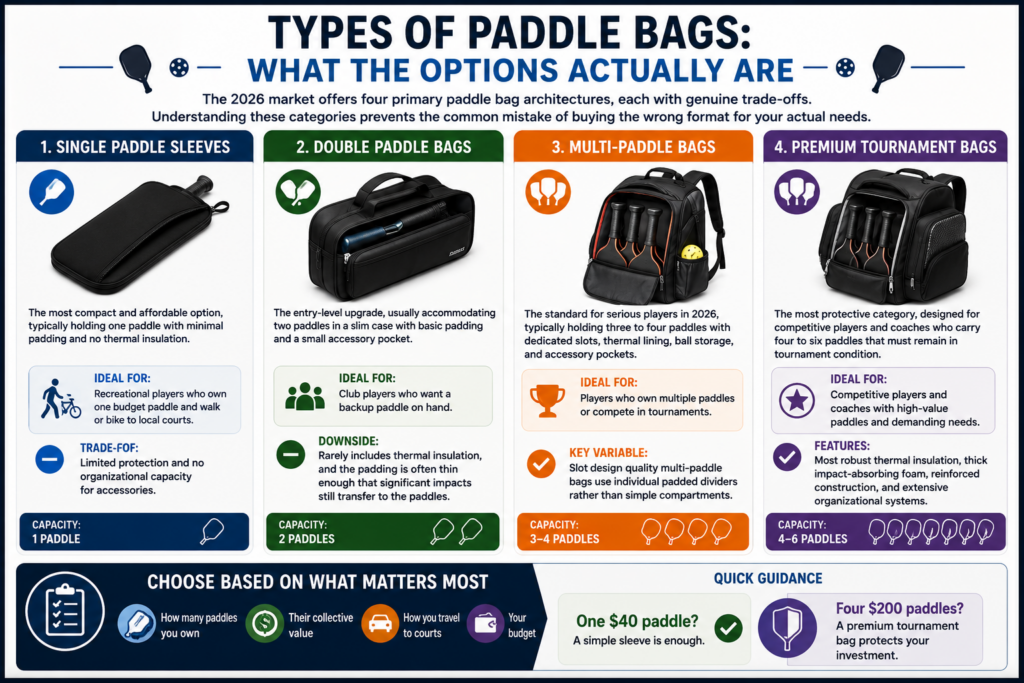
The 2026 market offers four primary paddle bag architectures, each with genuine trade-offs. Understanding these categories prevents the common mistake of buying the wrong format for your actual needs.
Single Paddle Sleeves are the most compact and affordable option, typically holding one paddle with minimal padding and no thermal insulation. They are ideal for recreational players who own one budget paddle and walk or bike to local courts. The trade-off is obvious: limited protection and no organizational capacity for accessories.
Double Paddle Bags represent the entry-level upgrade, usually accommodating two paddles in a slim case with basic padding and a small accessory pocket. These are popular among club players who want a backup paddle on hand. The downside is that double bags rarely include thermal insulation, and the padding is often thin enough that significant impacts still transfer to the paddles.
Multi-Paddle Bags have become the standard for serious players in 2026, typically holding three to four paddles with dedicated slots, thermal lining, ball storage, and accessory pockets. These bags offer the best balance of protection and portability for players who own multiple paddles or compete in tournaments. The key variable is slot design; quality multi-paddle bags use individual padded dividers rather than simple compartments.
Premium Tournament Bags are the most protective category, designed for competitive players and coaches who carry four to six paddles that must remain in tournament condition. These bags feature the most robust thermal insulation, thick impact-absorbing foam, reinforced construction, and extensive organizational systems. They are also the most expensive and the bulkiest when fully loaded.
Your choice should be driven by how many paddles you own, their collective value, how you travel to courts, and your budget. A recreational player with one $40 paddle does not need a premium tournament bag; a competitive player with four $200 paddles is taking a real risk with a basic sleeve.
What to Look For in a Quality Paddle Bag
The feature set that separates a genuine paddle bag from a relabeled generic sleeve is specific and testable. Here is what actually matters in 2026.
Thermal Insulation is the single most important feature. Look for bags with reflective or foam-insulated linings that maintain stable internal temperatures. The lining should be thick enough to provide genuine thermal mass, not just a thin decorative layer. Some premium bags now specify temperature retention ratings; while these are not standardized across the industry, they indicate genuine engineering intent rather than marketing claims.
Padded Walls and Impact Protection determine how well your paddle survives drops, bumps, and trunk impacts. Look for bags with at least half-inch foam padding on all sides, reinforced corners, and rigid or semi-rigid panels that distribute impact force. The best designs use multiple layers: a durable outer shell, a shock-absorbing foam middle layer, and a soft inner lining that prevents surface scratches.
Individual Paddle Slots matter when you carry multiple paddles. Bags that simply toss paddles into a single compartment allow them to knock against each other during transport, causing edge guard damage and face scratches. Quality multi-paddle bags use padded dividers or individual sleeves that keep each paddle isolated and protected.
Moisture Management is often overlooked but genuinely important. Paddles absorb moisture from humid air, sweaty hands, and wet court conditions. Bags with breathable mesh panels or moisture-wicking inner linings allow paddles to dry between sessions rather than trapping moisture against the face and core materials.
Material and Construction determine longevity. Ballistic nylon, 600D polyester, and similar fabrics resist abrasion and tearing. Reinforced stitching at stress points, quality zippers (YKK is the industry standard), and water-resistant coatings are all markers of a bag built to last multiple seasons.
Comfort and Portability matter if you carry the bag for any distance. Padded shoulder straps, ergonomic handles, and lightweight designs transform a protective case into a practical carrying solution. For travel, look for bags with luggage pass-through straps or TSA-friendly dimensions.

How to Match Your Paddle Bag to Your Playing Style
The right paddle bag is not the most expensive one; it is the one that fits your actual playing pattern and paddle investment.
If you play recreationally once or twice a week with one or two budget paddles, a single sleeve or double bag is sufficient. Prioritize basic padding and a water-resistant exterior. You do not need thermal insulation at the premium level, but some insulation is still worthwhile for summer trunk storage.
If you play in a league or club setting with two to three mid-range paddles, a multi-paddle bag with thermal lining and individual slots is the sweet spot. Look for dedicated paddle dividers, a small accessory pocket for balls and grips, and enough padding to protect your investment. This is where [pickleball shoes for men] and [pickleball shoes for women] become relevant considerations, because a complete gear bag that also accommodates court footwear is more practical than separate bags for different equipment.
If you compete in tournaments, a premium bag with thermal insulation for three to four paddles, thick impact padding, and quick-access organization is justified. Tournament days are long; your paddles face temperature swings from air-conditioned venues to outdoor courts, and the bag is your first line of defense.
If you travel for pickleball, look for bags with luggage pass-through straps, TSA-friendly dimensions, and the most robust thermal and impact protection you can afford. Checked luggage and overhead bins experience temperature extremes and rough handling that make quality protection even more critical.
If you are buying a gift, a quality multi-paddle bag is one of the safest [pickleball gifts] because every player needs one, and upgrading from a basic sleeve to a quality bag is a meaningful improvement that recipients genuinely appreciate. Pair it with a [pickleball bag] for complete gear storage, and you have a gift set that shows real thought.
Common Misconceptions About Paddle Bags
“Any sleeve or case works fine for pickleball paddles.” Generic sleeves lack thermal insulation, meaningful impact protection, and paddle-specific engineering. They also tend to use thin foam that compresses under impact and offers little real protection. The difference becomes apparent the first time you leave a paddle in a hot trunk or drop a bag containing an unprotected paddle.
“The most expensive paddle bag is the best bag.” Premium bags offer genuine advantages in capacity and construction, but a $100 tournament bag is overkill for a recreational player with one $40 paddle. The best bag is the one whose features match your needs and paddle investment, not the one with the highest price tag.
“I only need a bag if I have expensive paddles.” Even a budget paddle benefits from thermal protection and impact resistance. A $60 paddle in a $10 sleeve is a false economy when trunk heat or a drop damages the core. The cost of replacing a damaged paddle always exceeds the cost of basic protection.
“Paddle bags are just for show.” This misconception usually comes from players who have not experienced the protective benefits. Once you have used a purpose-built bag with thermal lining and thick padding, the difference in paddle condition and performance consistency is unmistakable.
“A [pickleball bag] replaces the need for a paddle bag.” A full gear bag is excellent for transporting shoes, balls, water, and accessories, but it does not replace the dedicated protection of a quality paddle bag. The ideal setup is a [pickleball bag] for general gear combined with individual paddle bags or a multi-paddle system for your most valuable equipment. Using both together provides complete protection.
Practical Guidance for Choosing Your 2026 Paddle Bag
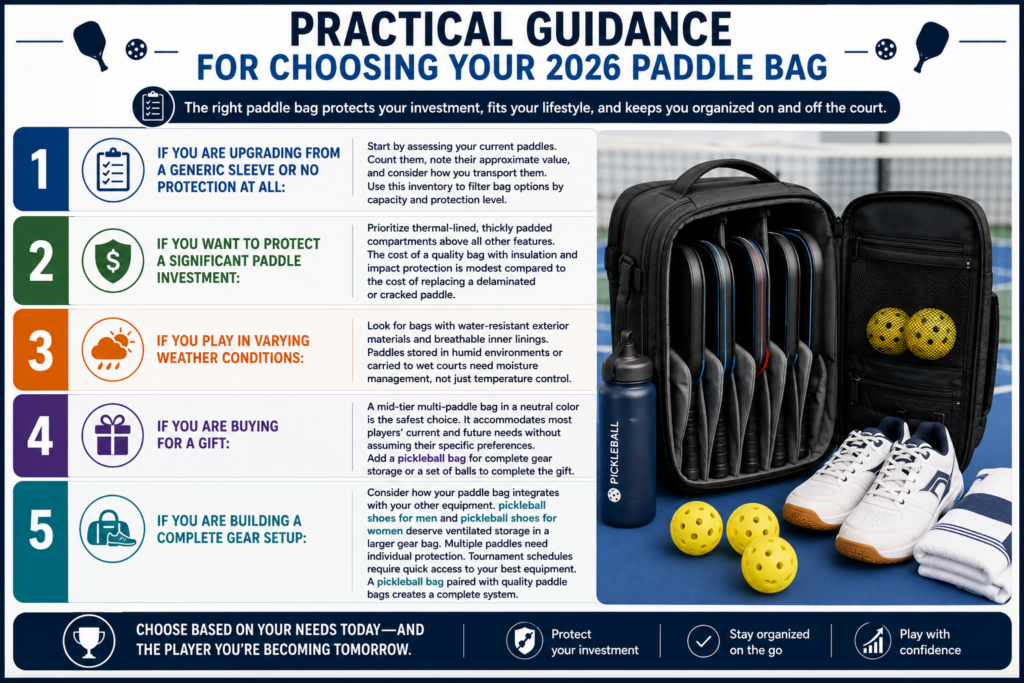
If you are upgrading from a generic sleeve or no protection at all: Start by assessing your current paddles. Count them, note their approximate value, and consider how you transport them. Use this inventory to filter bag options by capacity and protection level.
If you want to protect a significant paddle investment: Prioritize thermal-lined, thickly padded compartments above all other features. The cost of a quality bag with insulation and impact protection is modest compared to the cost of replacing a delaminated or cracked paddle.
If you play in varying weather conditions: Look for bags with water-resistant exterior materials and breathable inner linings. Paddles stored in humid environments or carried to wet courts need moisture management, not just temperature control.
If you are buying for a gift: A mid-tier multi-paddle bag in a neutral color is the safest choice. It accommodates most players’ current and future needs without assuming their specific preferences. Add a [pickleball bag] for complete gear storage or a set of balls to complete the gift.
If you are building a complete gear setup: Consider how your paddle bag integrates with your other equipment. [pickleball shoes for men] and [pickleball shoes for women] deserve ventilated storage in a larger gear bag. Multiple paddles need individual protection. Tournament schedules require quick access to your best equipment. A [pickleball bag] paired with quality paddle bags creates a complete system.
Conclusion
A dedicated paddle bag is not an accessory for enthusiasts; it is essential protective equipment for anyone who owns a quality paddle and plays regularly. The 2026 market offers genuine engineering improvements over generic alternatives, particularly in thermal protection, impact resistance, and paddle-specific design.
What is true is that the right bag extends paddle lifespan, maintains performance consistency, and keeps you focused on playing rather than equipment anxiety. The feature set that matters most (thermal insulation, thick padding, individual slots, and quality construction) is specific and testable, not subjective.
The bag categories that define the 2026 market (single sleeve, double bag, multi-paddle, and premium tournament) each serve a genuine player profile. Matching your actual needs and paddle investment to the right category prevents both under-investment and over-spending.
For players navigating their first dedicated paddle bag purchase, or for gift buyers looking for practical [pickleball gifts], the most productive focus is on the features that produce the clearest evidence of benefit: thermal protection, impact resistance, and construction quality that matches your paddle investment and playing frequency.
A quality paddle bag is the foundation of equipment protection. Whether you are buying for yourself or as a gift, prioritize protection and practicality over brand names, and you will end up with equipment that preserves your paddle investment for seasons to come.
Frequently Asked Questions
What is the most important feature in a paddle bag?
The most important feature is thermal-lined paddle storage with thick impact padding. Pickleball paddles use polymer honeycomb cores that are vulnerable to heat and cold degradation. Prolonged exposure to temperatures above 120°F can soften core adhesives and delaminate paddle faces; cold below 40°F can make cores brittle. Combined with thick foam padding that absorbs impacts from drops and bumps, thermal insulation slows temperature transfer and extends paddle lifespan significantly more than unprotected storage. This is particularly critical for players in climates with hot summers or cold winters who leave gear in vehicles.
How many paddles should a paddle bag hold?
The answer depends on your playing level and paddle collection. Recreational players with one paddle need only a single sleeve with basic padding. Club players with two to three paddles (a primary and backup, or different paddles for different conditions) should look for double or multi-paddle bags with two to four dedicated slots. Tournament players and coaches who carry three to five paddles need premium bags with expanded capacity and the most robust protection. The key is to buy for your current and near-future needs rather than maximum capacity you will never use.
Do I really need thermal insulation in a paddle bag?
Yes, if you ever leave your paddles in a car, garage, or outdoor storage. Car trunks can exceed 140°F in summer sun, and garages can drop below freezing in winter. These temperature extremes degrade paddle cores, weaken adhesives, and alter performance characteristics. Thermal insulation is not a luxury feature; it is basic equipment protection. Even budget bags with thin reflective lining provide more protection than no insulation at all. If you live in a moderate climate and always carry your paddle indoors, insulation is less critical but still worthwhile.
What is the best paddle bag for travel?
The best travel bag is a premium multi-paddle case with the most robust thermal and impact protection you can afford, plus luggage-compatible dimensions. Look for bags that fit within standard airline carry-on limits if you plan to bring paddles in the cabin. Hard-shell or semi-rigid cases offer the best impact protection for baggage handling, while soft bags with thick foam are lighter and more flexible. Thermal insulation is even more important for travel because checked luggage and overhead bins experience wider temperature swings than typical storage.
Are expensive paddle bags worth the money?
Expensive paddle bags are worth the money if their features match your paddle investment and playing habits. A $80 premium bag with thermal insulation, thick impact foam, and individual slots is justified for a player with $400+ in paddles who competes regularly. The same bag is poor value for a recreational player with one $50 paddle who plays twice a month. The correct approach is to identify the protection level you actually need (thermal, impact, capacity) and buy the least expensive bag that delivers those features with quality construction. Price correlates with protection and capacity, but not always with value for your specific situation.