Pickleball vs Tennis: A Complete 2026 Comparison for Players of Every Level

Key Takeaways
- Pickleball and tennis are fundamentally different sports — not just scaled versions of each other — with distinct court dimensions, equipment, scoring systems, and movement demands that produce different fitness outcomes
- Pickleball is the fastest-growing sport in America, with participation surpassing tennis for the first time in monthly active players in 2024, driven by accessibility, lower physical barriers, and strong social dynamics — but tennis retains advantages in cardiovascular intensity and full-body conditioning
- Tennis delivers a more intense cardiovascular workout — a singles match averages 4–5 miles of running with sustained elevated heart rate, while pickleball provides moderate-intensity exercise better suited for older adults and those returning to fitness
- Injury patterns differ significantly between the sports — tennis carries higher risk of shoulder, elbow, and lower-back injuries from overhead mechanics; pickleball’s injury surge (up nearly ninefold in the past decade) centers on wrist fractures, Achilles tears, and knee injuries, heavily concentrated in players 50 and older
- Neither sport is objectively “better” — the right choice depends on your age, fitness level, injury history, social preferences, and whether you prioritize competitive intensity or sustainable, community-based activity
The Direct Answer: It Depends on What You’re Looking For
If you’re deciding between pickleball and tennis in 2026, the honest answer is that neither sport is universally superior. They are different tools for different goals.
Pickleball — played on a smaller court with a paddle and perforated plastic ball — has exploded in popularity because it is genuinely more accessible. The learning curve is shorter. The physical demands are lower. The social environment is built into the game through doubles play and the “kitchen” rule that keeps players close together. For older adults, people recovering from injury, or anyone seeking a fun, low-barrier way to stay active, pickleball is often the better entry point.
Tennis — played on a larger court with a strung racket and pressurized felt ball — remains the gold standard for racquet-sport cardiovascular conditioning. The court is 80% wider and 77% longer. The rallies are more physically demanding. The overhead serve, groundstroke mechanics, and full-court coverage produce a workout that no pickleball match can replicate. For players seeking peak fitness, competitive depth, and a sport that scales from recreational to elite athletic performance, tennis retains clear advantages.
Understanding what each sport actually delivers — and where the research on health outcomes, injury risk, and long-term participation actually stands — serves players far better than declaring a winner.
What Pickleball and Tennis Actually Are
Both are racquet sports played on a hard court with a net. Beyond that surface similarity, the differences are substantial and shape everything about the player experience.
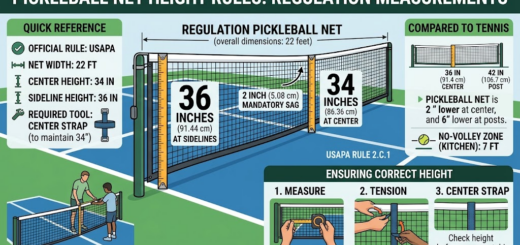
Pickleball was invented in 1965 on Bainbridge Island, Washington, by three fathers looking to entertain their children. It uses a solid paddle (graphite, composite, or wood), a lightweight plastic ball with 26–40 holes, and a court measuring 44 feet long by 20 feet wide — roughly one-quarter the size of a tennis court. The net is 36 inches at the sidelines and 34 inches at center. The serve is underhand only. The “kitchen” or non-volley zone extends 7 feet from the net on each side, prohibiting volleys from that area. Games are typically played to 11 points, win by 2, with only the serving team able to score.
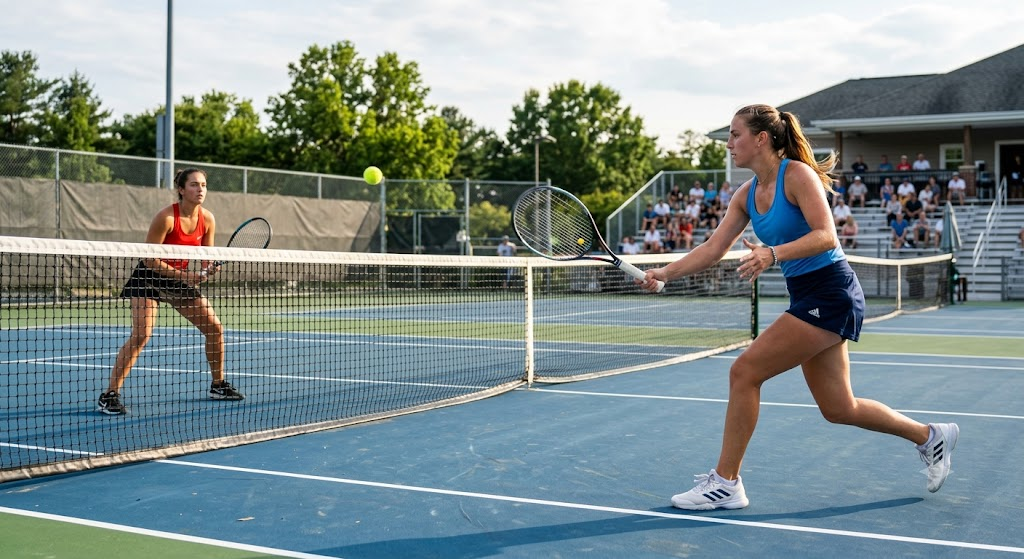
Tennis traces its modern origins to 19th-century England and uses a strung racket, a pressurized rubber ball covered in felt, and a court 78 feet long by 27 feet wide (singles) or 36 feet wide (doubles). The net is 42 inches at the posts and 36 inches at center. Serves can be overhand or underhand, with overhand power serves being standard at all competitive levels. Scoring follows the 15-30-40-game-set-match system. A singles match can last 90 minutes to several hours, with players covering 2–5 miles depending on rally length and court positioning.
The equipment difference alone shapes the physics of each sport. The strung racket in tennis creates a trampoline effect that generates power and spin; the solid paddle in pickleball produces a flatter, more controlled strike. The pressurized tennis ball bounces higher and faster; the plastic pickleball ball moves more slowly and is more susceptible to wind. These aren’t minor variations — they produce entirely different games.
Court Dimensions and Playing Space: Why Size Changes Everything
The court size difference between pickleball and tennis is not merely a matter of scale. It fundamentally changes the physical demands, strategic complexity, and accessibility of each sport.
Table
| Feature | Pickleball | Tennis (Singles) | Tennis (Doubles) |
| Court Length | 44 ft (13.41 m) | 78 ft (23.77 m) | 78 ft (23.77 m) |
| Court Width | 20 ft (6.10 m) | 27 ft (8.23 m) | 36 ft (10.97 m) |
| Total Surface Area | 880 sq ft | 2,106 sq ft | 2,808 sq ft |
| Net Height (Center) | 34 in (0.86 m) | 36 in (0.91 m) | 36 in (0.91 m) |
| Net Height (Posts) | 36 in (0.91 m) | 42 in (1.07 m) | 42 in (1.07 m) |
| Non-Volley Zone | 7 ft from net | None | None |
| Singles vs Doubles Court | Same court | Different widths | Different widths |
Approximately three pickleball courts fit on one tennis court — a space efficiency that has driven the conversion of tennis facilities nationwide. In the Atlanta area alone, more than 25% of tennis courts have been converted to pickleball, reflecting demand that facility managers cannot ignore.
This size difference has direct physical consequences. In pickleball, players rarely sprint more than a few steps to reach a ball. The compact court rewards quick reflexes, precise placement, and tactical shot selection over raw speed and power. In tennis, the full-court coverage requirement — particularly in singles — demands sustained aerobic capacity, explosive acceleration, and the ability to recover position after every shot. A competitive tennis rally can cover 50+ feet of lateral and forward movement; a competitive pickleball rally typically involves 10–20 feet of movement, often in small, controlled steps near the net.
The smaller court also changes who can participate. Players with limited mobility, joint replacements, or balance concerns can often play pickleball safely where tennis would be impossible. This accessibility is not a flaw in pickleball’s design — it is its central design achievement.
Rules and Scoring: Why Pickleball Feels Simpler (And Why That Matters)
Pickleball Scoring:
- Games played to 11 points, win by 2
- Only the serving team can score
- Underhand serve, diagonal, must clear the kitchen
- Double-bounce rule: Ball must bounce once on each side before volleys are permitted
- Kitchen rule: No volleys allowed within 7 feet of the net
- Both players serve in doubles before side-out
Tennis Scoring:
- Matches: best of 3 or 5 sets
- Sets: first to 6 games, win by 2 (tiebreaker at 6-6)
- Games: 15-30-40-game sequence, win by 2 points
- Deuce at 40-40; advantage scoring applies
- Overhand or underhand serve
- No restrictions on where volleys can be played
The pickleball scoring system is genuinely simpler to learn. The 11-point game structure means matches resolve quickly. The “rally scoring” debate (whether to switch to rally point scoring, where either team can score on any point) remains active in the pickleball community but has not been universally adopted. For new players, the ability to understand scoring within minutes rather than hours removes a significant barrier to entry.
The tennis scoring system, by contrast, is famously opaque to newcomers. The 15-30-40 progression, deuce-advantage mechanics, and set-match hierarchy require explanation and repetition before players feel confident tracking the score. This complexity is part of tennis’s tradition and charm for established players, but it functions as a genuine friction point for beginners.
The double-bounce rule in pickleball — requiring the ball to bounce once on each side before either team can volley — is the sport’s most distinctive strategic element. It prevents serve-and-volley dominance, extends rallies, and forces players to develop groundstroke skills before advancing to net play. The kitchen rule then constrains net aggression, creating a unique tactical space where “dinking” — soft, controlled shots just over the net — becomes the highest-level skill. These rules produce longer rallies and more social interaction than tennis’s faster, more terminal point structure.
Health Benefits: What the Research Actually Shows
Both pickleball and tennis deliver meaningful health benefits, but the nature and magnitude of those benefits differ in ways that matter for individual fitness goals.
Cardiovascular Intensity:
A 2026 analysis in the Irish Times noted that tennis — with its larger court, longer rallies, and full-body swings — “probably has the edge over pickleball” for cardiovascular conditioning. A singles tennis match averages 4–5 miles of running with sustained periods of elevated heart rate in the vigorous-intensity zone (70–85% of max heart rate). Pickleball, by contrast, typically operates in the moderate-intensity zone (50–70% of max heart rate) due to the smaller court and slower ball speed.
This does not mean pickleball is ineffective. Research consistently classifies pickleball as moderate-intensity exercise — sufficient to meet CDC guidelines for 150 minutes of moderate activity per week. For older adults, sedentary individuals, or those with cardiovascular limitations, moderate-intensity pickleball may be the safer and more sustainable option. For athletes seeking peak conditioning, tennis provides a more demanding workout.
Mental Health:
A major Apple study found that regular players of both sports reported significantly lower depression levels. Frequent pickleball players were 60% less likely to show signs of depression, while tennis players were 51% less likely. The social aspect of both sports — particularly pickleball’s doubles format and community-oriented culture — contributes substantially to these mental health benefits. The social interaction built into pickleball’s design may explain its slight edge in this metric.
Cognitive Function:
Both sports require rapid decision-making, spatial awareness, and tactical adaptation. Tennis demands more split-second directional changes and complex shot selection under physical fatigue. Pickleball emphasizes precision, patience, and the strategic “soft game” of dinking. Neither sport has been shown to produce superior cognitive outcomes in controlled studies, though both exceed sedentary controls consistently.
Longevity:
Racket sports as a category — including tennis, badminton, and squash — have been associated with the greatest reduction in all-cause mortality of any sport category in large epidemiological studies. The social component, combined with the interval-style cardiovascular demands and cognitive engagement, appears to produce outsized longevity benefits. Pickleball’s rapid growth means it has not yet been studied at the same scale, but its structural similarities suggest comparable benefits, particularly for populations who would not otherwise engage in regular exercise.
Injury Risk: The Data Every Player Should Know
The most common pickleball injuries are sprains and strains (33%), fractures (28%) — particularly wrist fractures from falling on outstretched hands — and lower extremity injuries (29%) including Achilles tendon tears and ACL injuries. The mechanism is telling: slip/trip/fall or dive accounts for the majority of acute injuries. For players concerned about these risks, our guide on how to prevent pickleball injuries covers evidence-based warm-up protocols, balance training progressions, and court-specific footwear selection that can significantly reduce your odds of landing in the ER.
Pickleball Injury Trends:
Pickleball-related injuries have increased nearly ninefold in the past decade, according to National Electronic Injury Surveillance System (NEISS) data. The most recent annual estimate places pickleball injuries at approximately 19,000 per year — a figure that almost certainly undercounts actual injuries due to underreporting. Critically, 91% of injuries occur in patients 50 years and older, reflecting the sport’s demographic concentration.
The most common pickleball injuries are:
- Sprains and strains (33%) — particularly ankle sprains from lateral movement and sudden stops
- Fractures (28%) — wrist fractures from falling on outstretched hands are the single most common fracture; female players are more than nine times more likely to suffer wrist fractures than male players
- Lower extremity injuries (29%) — including Achilles tendon tears, ACL injuries, meniscus tears, and calf/hamstring strains
- Upper extremity injuries (33%) — including wrist, shoulder, elbow, and finger injuries; “pickleball elbow” is increasingly recognized as the sport’s equivalent of tennis elbow
- Head and facial injuries (15.5%) — including concussions from falls and lacerations from ball or paddle contact
The mechanism of injury in pickleball is telling: slip/trip/fall or dive accounts for the majority of acute injuries. The hard polymer ball travels at 20–40 mph, creating a meaningful risk of eye injury (documented cases of traumatic lens subluxation in players 75+). The combination of an older player base, hard court surfaces, and rapid directional changes produces an injury profile that is serious and growing.
Tennis Injury Trends:
Tennis injuries have remained relatively flat over the same period, suggesting the sport’s established player base and known risk factors are well-characterized. The most common tennis injuries include:
- Tennis elbow (lateral epicondylitis) — from repetitive forearm strain during groundstrokes and serves
- Shoulder injuries — rotator cuff strains and tears from overhead serving mechanics
- Lower back issues — from the rotational loading of serves and groundstrokes
- Knee injuries — from the stop-start nature of court coverage, though less common than in pickleball per capita
- Wrist and ankle sprains — from falls and missteps, similar to other court sports
The Critical Comparison:
Per participant, tennis may actually carry a lower injury rate than pickleball at present — not because pickleball is inherently more dangerous, but because its player base skews dramatically older and less physically prepared. A 65-year-old who has not exercised regularly in years picking up a paddle for the first time faces injury risks that a conditioned tennis player of the same age does not. The sport’s accessibility is a double-edged sword: it brings sedentary people onto the court, which is overwhelmingly positive for public health, but those same players lack the baseline fitness, balance, and proprioception that injury prevention requires.
For players with existing musculoskeletal conditions — particularly osteoarthritis, balance deficits, or prior joint replacement — both sports require caution, but pickleball’s smaller court and slower pace may still offer a more manageable entry point with appropriate conditioning.
Calories Burned and Fitness Outcomes
The caloric expenditure difference between pickleball and tennis is substantial and directly tied to court size and rally structure.
Table
| Activity | Estimated Calories Burned (30 min) | Estimated Calories Burned (60 min) |
| Pickleball (recreational doubles) | 150–200 | 300–400 |
| Pickleball (competitive singles) | 250–350 | 500–700 |
| Tennis (recreational doubles) | 200–300 | 400–600 |
| Tennis (competitive singles) | 400–600 | 800–1,200 |
These figures vary by body weight, intensity, and playing style, but the directional pattern is clear: tennis produces higher caloric expenditure due to greater court coverage, longer rallies at higher intensity, and the physical demands of the serve-and-groundstroke mechanics. A competitive singles tennis match can burn 800–1,200 calories per hour — comparable to running at a 7-minute-mile pace. Pickleball, even at competitive levels, rarely exceeds 500–700 calories per hour.
For weight management and peak cardiovascular fitness, tennis offers superior energy expenditure. For sustainable, long-term activity that can be maintained into older age without excessive joint stress, pickleball’s moderate burn rate may be the more practical choice.
Social Dynamics and Community: Why Pickleball’s Culture Is Different
One of the most significant but least quantified differences between pickleball and tennis is the social environment.
Pickleball’s Social Architecture:
- Doubles is the default format — four players on a small court naturally creates conversation and camaraderie
- The kitchen rule keeps players close — unlike tennis, where players may be 78 feet apart, pickleball’s net play creates physical proximity
- Open play culture — players rotate in and out of games, meeting new people every session; “stacking” and “racking” systems facilitate social mixing
- Lower skill barrier — beginners can participate meaningfully within hours, reducing intimidation
- Noise and energy — pickleball courts are often loud, social spaces; the “pickleball pop” of paddle on ball is part of the atmosphere
Tennis’s Social Architecture:
- Singles is common at all levels — two players on a large court is inherently less social
- Skill stratification — the steep learning curve means players tend to match with others of similar ability, reducing casual mixing
- Club culture — tennis has a more formal, membership-based tradition that can feel exclusive
- Quieter, more focused environment — tennis etiquette emphasizes silence during points and between games
For players whose primary goal is social connection — particularly older adults, recent retirees, or people new to a community — pickleball’s built-in social dynamics are a genuine advantage. The sport’s growth has been driven as much by its community-building capacity as by its physical accessibility.
Cost and Accessibility: Getting Started

Table
| Factor | Pickleball | Tennis |
| Entry-level equipment cost | $30–$100 (paddle + balls) | $50–$200 (racket + balls) |
| Court access | Often free (parks, converted tennis courts); dedicated courts growing | Typically requires club membership or court fees ($20–$60/hour) |
| Lesson cost | $30–$60/hour | $50–$100/hour |
| Shoes | Court shoes or tennis shoes acceptable | Tennis-specific shoes recommended |
| Clothing | Casual athletic wear | Traditional tennis whites often required at clubs |
| Time to basic competence | 1–3 sessions | 3–6 months |
Pickleball’s lower barrier to entry is not just about money — it is about time, intimidation, and the social friction of entering an established sport. A new player can buy a $40 paddle, find a free court at a local park, and be playing points within an hour. Tennis typically requires more investment in equipment, instruction, and facility access before a player feels competent enough to enjoy recreational play.
Which Sport Should You Choose?
The decision between pickleball and tennis should be driven by honest assessment of your goals, physical condition, and preferences — not by popularity trends.
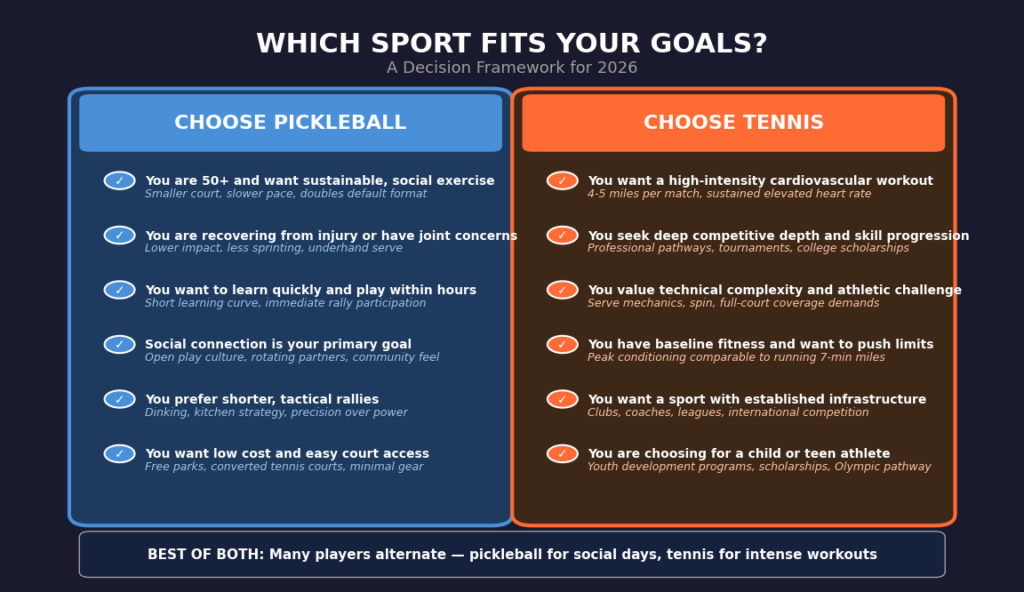
Choose Pickleball If:
- You are over 50 and looking for a sustainable, social way to stay active
- You have joint issues, balance concerns, or are recovering from injury
- You prioritize social connection and community over competitive intensity
- You want a sport you can learn quickly and play at a reasonable level within weeks
- You prefer shorter, more tactical rallies over physically demanding exchanges
- You have limited access to tennis facilities but can find pickleball courts locally
Choose Tennis If:
- You are seeking a high-intensity cardiovascular workout
- You want a sport with deep competitive depth and professional pathways
- You value the technical complexity and athletic demands of full-court coverage
- You have the baseline fitness to handle the physical demands safely
- You are willing to invest time in skill development before feeling competent
- You have access to courts and a community of players at your level
Consider Playing Both:
Many players find that pickleball and tennis complement each other. Tennis builds the cardiovascular base, leg strength, and hand-eye coordination that improve pickleball performance. Pickleball develops touch, soft-game skills, and net reflexes that can translate to tennis doubles. For players with the time and physical capacity, alternating between the two may provide the most balanced fitness and skill development.
Common Misconceptions About Pickleball vs Tennis
“Pickleball is just tennis for people who can’t play tennis.” This dismissive framing misses the point entirely. Pickleball is a distinct sport with its own tactical depth, skill ceiling, and competitive structure. The “soft game” of dinking, the strategic use of the kitchen, and the precision required at high levels are not simplified tennis — they are different skills that take years to master. Professional pickleball players are elite athletes in their own right.
“Tennis is too hard on your body to play into old age.” While tennis is more physically demanding than pickleball, many players continue competitive tennis well into their 70s and 80s with appropriate conditioning, injury prevention, and adjustments to playing style. The key is baseline fitness and smart training — not avoiding the sport entirely. For players who have maintained fitness throughout life, tennis remains a viable and rewarding activity.
“Pickleball injuries are just from beginners who don’t know what they’re doing.” While inexperience contributes, the injury data shows that even intermediate and advanced pickleball players suffer significant injury rates. The sport’s rapid growth means many players lack proper conditioning, warm-up routines, and footwear. The hard court surface combined with sudden stops and pivots creates injury risk regardless of skill level.
“You can’t get a real workout playing pickleball.” This is demonstrably false. While pickleball is less intense than competitive singles tennis, a vigorous pickleball session elevates heart rate into the moderate-intensity zone, burns 300–500 calories per hour, and improves reaction time, balance, and coordination. For the average recreational player, pickleball provides more than sufficient exercise to meet public health guidelines.
“Tennis is dying because of pickleball.” Tennis participation has remained stable or grown slightly in many markets despite pickleball’s explosive growth. The sports serve different demographics and needs. Tennis’s established infrastructure, professional tour, and international competitive structure ensure its continued relevance. The real story is not tennis’s decline but pickleball’s addition of millions of new participants who might never have played a racquet sport otherwise.
Practical Guidance for Getting Started
If you’re new to racquet sports entirely: Start with pickleball. The learning curve is gentler, the social environment is more welcoming, and the physical demands are manageable. Once you have developed basic hand-eye coordination, court awareness, and fitness, consider adding tennis if you want more intensity.
If you’re a tennis player curious about pickleball: Your groundstrokes, court sense, and competitive experience will transfer quickly. Focus on the soft game — dinking, third-shot drops, and kitchen positioning. Your power and aggressive style may actually be a liability at first; pickleball rewards patience and precision over pace.
If you’re a pickleball player considering tennis: Expect a significant adjustment. The serve alone requires technique that takes months to develop. The court coverage demands are substantially higher. Start with tennis lessons focused on fundamentals rather than trying to learn through casual play. Your pickleball touch and net skills will help in doubles, but singles tennis is a different sport entirely.
If you’re over 60 and concerned about injury: Consult a physician or physical therapist before starting either sport. For pickleball, invest in court shoes with lateral support, learn proper warm-up routines, and consider balance training to reduce fall risk. For tennis, focus on technique over power, use appropriate equipment (lighter rackets, lower string tension), and consider doubles as your primary format.
If you’re choosing for your child: Tennis offers a more established youth development pathway, with structured lessons, junior tournaments, and college scholarship opportunities. Pickleball youth programs are growing rapidly but remain less developed. For children under 12, pickleball’s smaller court and lighter equipment may be more appropriate; for teenagers seeking competitive depth, tennis currently offers more.
Conclusion
Pickleball vs tennis is not a contest with a single winner. It is a choice between two genuinely different sports that serve different populations, goals, and life stages.
Pickleball has earned its place as America’s fastest-growing sport through genuine accessibility, social design, and sustainable physical demands. For older adults, fitness returnees, and social seekers, it is often the better choice. The injury data, however, demands attention — the sport is not as low-risk as its marketing suggests, particularly for players who enter without baseline fitness or proper preparation.
Tennis remains the more demanding, more technically complex, and more physically rewarding sport for players seeking peak conditioning and competitive depth. Its established infrastructure, professional pathways, and proven longevity benefits are not replicated by pickleball at this stage of its development.
The most productive approach for most people is not to choose one sport exclusively but to understand what each offers and match your choice to your current fitness, goals, and life circumstances. For millions of Americans, that choice is increasingly both — playing pickleball for social connection and sustainable activity, and tennis when they want a more intense challenge.
The racquet sports renaissance of the 2020s is not about one sport replacing another. It is about more people finding ways to move, compete, and connect through sports that fit their lives.
Frequently Asked Questions
Is pickleball easier than tennis?
Yes — pickleball has a shorter learning curve, smaller court, slower ball, and underhand serve that make it accessible to beginners within hours. Tennis requires months of practice to develop competent serve, groundstroke, and footwork mechanics. However, “easier to learn” does not mean “easier to master.” Elite pickleball involves sophisticated soft-game skills, strategic dinking, and precise shot placement that take years to develop. The entry barrier is lower; the skill ceiling remains high.
Which burns more calories: pickleball or tennis?
Tennis burns more calories, particularly in singles play. A competitive singles tennis match burns 800–1,200 calories per hour compared to 300–700 calories per hour for pickleball, depending on intensity and format. The larger court, longer rallies, and greater movement demands of tennis produce a more intense cardiovascular workout. For weight management and peak fitness, tennis is superior. For sustainable, long-term activity that can be maintained daily, pickleball’s moderate burn rate may be more practical.
Is pickleball safer than tennis?
Not necessarily — and the data increasingly suggests otherwise for certain populations. While pickleball’s slower pace and smaller court reduce some risks (particularly shoulder injuries from overhead mechanics), pickleball-related injuries have increased nearly ninefold in the past decade. The injury rate is heavily concentrated in players 50 and older, with wrist fractures, Achilles tears, and knee injuries being most common. Tennis injuries have remained flat, and the sport’s established player base means risk factors are better understood. For conditioned athletes, tennis may carry lower injury risk per hour played. For sedentary older adults, pickleball’s accessibility is a net health benefit despite the injury risk, because it brings inactive people into regular exercise.
Can you play pickleball on a tennis court?
Yes — approximately three pickleball courts fit on one tennis court. Many facilities use temporary line markings and portable nets to convert tennis courts for pickleball play. The standard method involves measuring 22 feet on either side of the tennis net for the pickleball baselines, and 10 feet on either side of the tennis centerline for the pickleball sidelines. Dedicated pickleball courts are increasingly common, but tennis court conversion remains the primary way communities meet surging demand.
What is the “kitchen” in pickleball?
The kitchen — formally the non-volley zone (NVZ) — is a 7-foot area extending from the net on both sides of the court. Players cannot volley (hit the ball before it bounces) while standing in the kitchen or touching the kitchen line. This rule prevents aggressive net dominance and forces players to develop soft-game skills like “dinking” — controlled, low shots just over the net. The kitchen is the defining strategic element of pickleball and the primary difference from tennis, where players can volley from anywhere.
This article was written for informational purposes and does not constitute medical or fitness advice. Consult a qualified healthcare provider before beginning any new exercise program, particularly if you have existing health conditions or injury history.