Pickleball Court Dimensions Diagram: The Official 2026 Guide
Key Takeaways
• A regulation pickleball court measures 20 feet wide by 44 feet long — identical dimensions for both singles and doubles play, unlike tennis which uses different court sizes for each format
• The Non-Volley Zone (NVZ), commonly called “the Kitchen,” extends 7 feet from the net on each side — players cannot volley while touching this zone or its boundary line
• The minimum recommended total playing surface is 30 feet by 60 feet, including safety apron; 34 feet by 64 feet is preferred for competitive and tournament play
• The net height is 36 inches at the sidelines and dips to 34 inches at the center — a lower net than tennis that fundamentally shapes pickleball’s unique playing style
• All court lines are 2 inches wide and must contrast sharply with the playing surface color for visibility and accurate line calls
• Four pickleball courts can fit on a single standard tennis court (78’ × 36’), making conversion a popular and cost-effective option for clubs and communities
The Direct Answer: Official Pickleball Court Dimensions
A standard pickleball court is a rectangle measuring 20 feet wide by 44 feet long — for both singles and doubles. This is roughly one-quarter the area of a standard doubles tennis court, which is why the sport feels so accessible and rallies stay lively.
The court is divided into distinct zones by specific line markings, each with its own rules and strategic implications. Understanding these dimensions is not just for builders — it is essential for players who want to understand positioning, shot selection, and why the “kitchen” rule exists in the first place.
The following sections break down every measurement, zone, and specification with labeled diagrams, based on the official USA Pickleball Rule Book as of 2026.
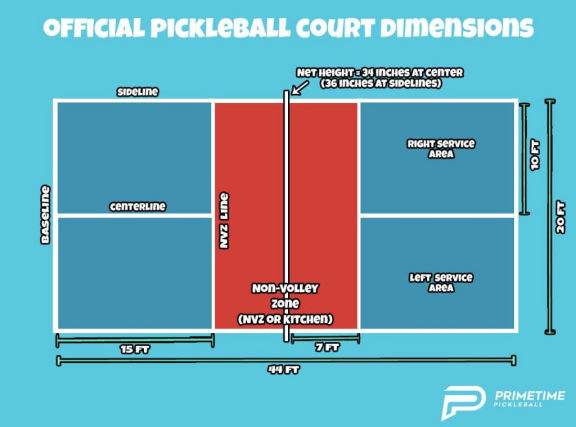
What the Pickleball Court Dimensions Diagram Shows
The diagram above illustrates the complete layout of a regulation pickleball court. Here is what each labeled element means:
Playing Court (20’ × 44’): The inner rectangle where all active play occurs. This is the same for singles and doubles — there are no separate sidelines for singles play, which simplifies court construction and reduces costs compared to tennis.
Non-Volley Zone / The Kitchen (7’ deep): The 7-foot area on each side of the net, bounded by the NVZ line parallel to the net and the two sidelines. Players cannot volley (hit the ball before it bounces) while standing in this zone or touching its boundary line. This rule prevents “smash” dominance at the net and forces strategic, placement-based play.
Service Areas: Each side of the court is divided into two service areas by the centerline. Each service area measures 10 feet wide by 15 feet long. The server must stand behind the baseline and serve diagonally into the opponent’s corresponding service box.
Centerline: Extends from the baseline to the NVZ line, dividing the service courts on each side.
Baselines: The back boundary lines, parallel to the net, where servers must stand behind to execute a legal serve.
Sidelines: The outer boundary lines running the full 44-foot length of the court.
Line Width: All court lines are 2 inches wide and must be a contrasting color to the playing surface — typically white on blue or green courts.
Net Specifications: The net spans the full 20-foot width of the court. It measures 36 inches (3 feet) high at the sidelines and 34 inches high at the center, creating a slight sag that affects ball trajectory and dinking strategy.
| Specification | Measurement | Purpose |
|---|---|---|
| Playing court | 20’ × 44’ | Active play area |
| Minimum total surface | 30’ × 60’ | Safety apron for movement and serves |
| Preferred total surface | 34’ × 64’ | Tournament and competitive play |
| Line width | 2 inches | Standard visibility |
| Net height (sidelines) | 36 inches | Official net post height |
| Net height (center) | 34 inches | Center strap height |
Total Space Requirements: Minimum vs. Preferred
While the playing lines measure 20’ × 44’, the actual space needed for safe, functional play is significantly larger. The USA Pickleball Rule Book specifies:
Why the extra space matters:
• Run-off room: Players need space to chase lobs and wide shots without colliding with fences or stepping onto adjacent courts
• Serve mechanics: The underhand serve is executed from behind the baseline, requiring clearance for the serving motion
• Spectator safety: Benches, water stations, and viewing areas need space outside the active playing zone
• Multi-court setups: Adequate spacing between courts prevents ball crossover interference and player collisions
For tournament play sanctioned by USA Pickleball, the 34’ × 64’ preferred dimension is strongly recommended to accommodate the faster pace and more aggressive movement of competitive players.
Pickleball Court vs. Tennis Court: Size Comparison
One of the most common questions from new players and facility managers is how pickleball courts compare to tennis courts. The difference is substantial:
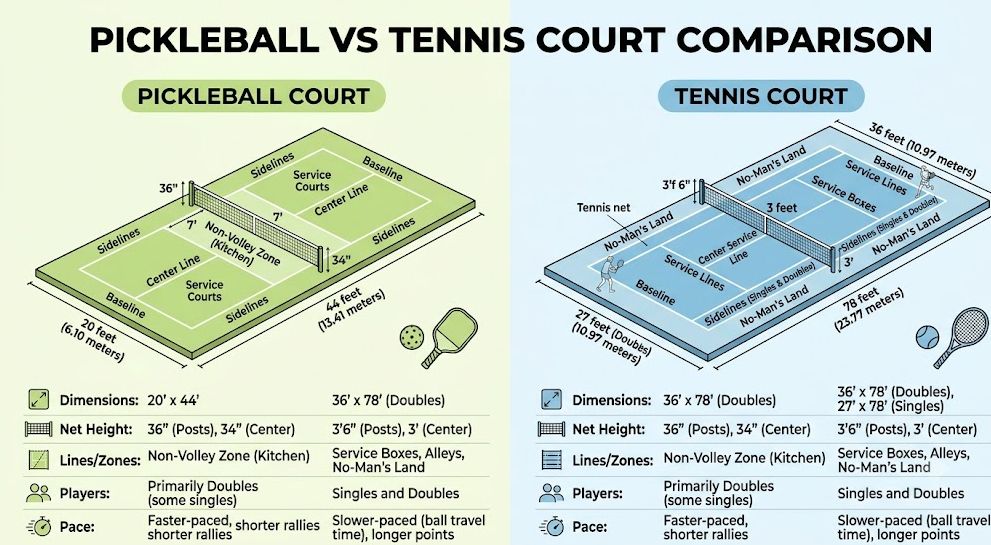
A standard doubles tennis court measures 78 feet long by 36 feet wide — nearly four times the area of a pickleball court. This size difference is fundamental to why pickleball is so accessible: less ground to cover, shorter rallies, and lower physical demands while still requiring strategy and skill.
The conversion math is simple: A single tennis court can accommodate up to four pickleball courts using the minimum 30’ × 60’ layout per court. For more generous run-off and permanent amenities, three pickleball courts may fit more comfortably. Many clubs and parks are converting underused tennis courts into multi-pickleball facilities — a cost-effective way to meet surging demand.
When converting, use contrasting line colors for pickleball lines versus existing tennis lines to avoid confusion. Portable pickleball nets are ideal for dual-use facilities; permanent net posts are better for dedicated pickleball courts.
The Kitchen (Non-Volley Zone): Rules and Strategy
The Non-Volley Zone is the most strategically important and rule-governed area of the pickleball court. Understanding it separates beginners from competent players.
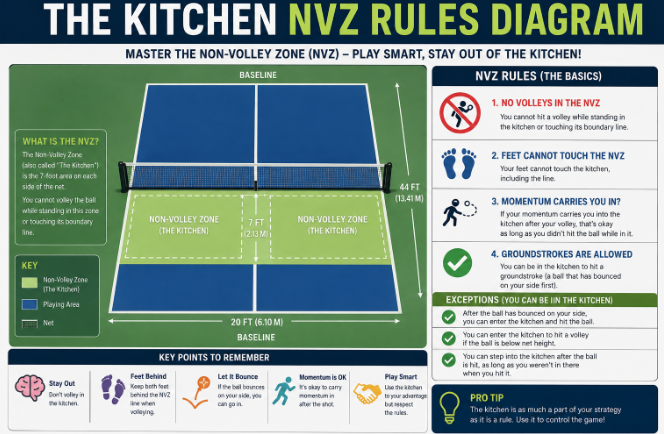
The Kitchen Rule in plain language:
• You cannot volley (hit the ball out of the air) while any part of your body, clothing, or paddle is touching the NVZ or the NVZ line
• This includes momentum — if a volley causes you to step into the kitchen, it is a fault
• You CAN hit a ball that has bounced in the kitchen — this is called a “dink” and is a core strategic shot
• You CAN stand in the kitchen at any time, as long as you do not volley from there
Why the kitchen exists: Without this rule, aggressive players could dominate by standing at the net and smashing every ball. The NVZ forces a more nuanced, placement-based game where soft dinks, third-shot drops, and patient net play determine outcomes.
Strategic implications: The “dink game” — exchanging soft, arcing shots at the kitchen line — is the defining tactical battle of high-level pickleball. Mastering when to approach the kitchen line, when to stay back, and how to execute a legal volley just behind the line separates intermediate from advanced players.
Net Specifications and Setup
The pickleball net is intentionally lower than a tennis net, which fundamentally shapes the game’s character:
| Net Specification | Measurement |
| Height at sidelines | 36 inches (91.4 cm) |
| Height at center | 34 inches (86.4 cm) |
| Minimum net length | 21 feet 9 inches (post to post) |
| Post spacing | 22 feet apart |
| Post diameter | No more than 3 inches |
| Net mesh | Must not allow ball to pass through |
The 2-inch center sag is not an error — it is intentional. The lower center height creates a “dink window” where soft, arcing shots can clear the net but land short, forcing opponents forward. This is why the third-shot drop — a soft shot that lands in the opponent’s kitchen — is one of the most important shots in pickleball.
Portable vs. permanent nets: Portable nets are excellent for shared spaces, temporary setups, and driveways. They typically include a center strap to maintain the 34-inch center height. Permanent net systems offer better tension consistency, longevity, and are ideal for dedicated facilities.
Multi-Court Layout and Facility Planning
For clubs, parks, and communities planning multiple courts, layout efficiency is critical.
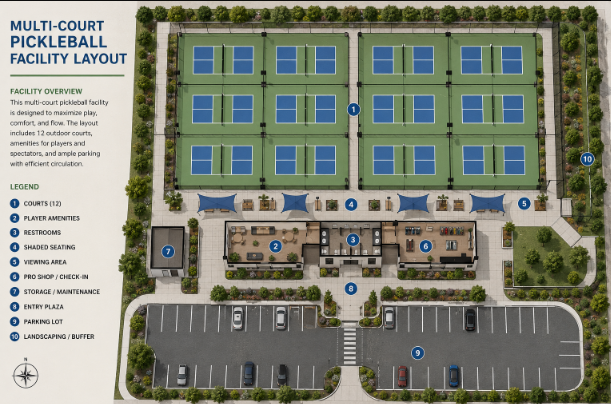
Key planning considerations:
• Court orientation: Outdoor courts should be oriented north-south whenever possible to minimize sun glare during morning and afternoon play — a significant safety factor
• Fencing: 8–10 feet is standard; windscreens reduce ball drift and improve visual contrast
• Spacing between courts: 8–10 feet between sidelines is comfortable; divider nets help when space is tight
• Gates: Place gates in low-traffic corners to avoid interrupting active points
• Lighting: LED fixtures with full cutoff provide even illumination without glare; recreational play needs 30–50 foot-candles
• Surface: Acrylic-coated asphalt or post-tensioned concrete are standard for outdoor courts; cushioned systems reduce joint stress
Budgeting framework:
| Project Type | Estimated Cost Range | Timeline |
| DIY temporary setup (tape + portable net) | $50–$200 | Same day |
| Tennis court restriping (4 courts) | $3,000–$8,000 | 1–2 weeks |
| New dedicated court (residential) | $15,000–$40,000 | 4–8 weeks |
| New dedicated court (commercial) | $25,000–$60,000 | 6–12 weeks |
| Multi-court facility (4+ courts) | $100,000–$500,000+ | 3–6 months |
Community funding strategies include partnerships with parks foundations, sponsorships for naming rights, and programming revenue from leagues and clinics.
Common Mistakes When Marking Court Dimensions
Even experienced builders make errors that affect play quality:
• Incorrect kitchen depth: The NVZ line must be exactly 7 feet from the net on both sides. A shallow kitchen (6 feet) or deep kitchen (8 feet) changes the entire strategic geometry of the court
• Net height errors: A center height above 34 inches reduces the effectiveness of dinks and drops; below 34 inches makes lobs too easy
• Thick lines: Lines wider than 2 inches create ambiguity on close calls — the ball landing on a thick line may be called in or out depending on interpretation
• Tight perimeter: Skimping on apron space behind baselines creates hazardous conditions when players backpedal for lobs
• Poor contrast: Lines that blend into the court surface color are difficult to see during fast play and in varying light conditions
Indoor vs. Outdoor Court Dimensions
The playing dimensions are identical indoors and outdoors. What differs is the supporting infrastructure:
| Feature | Indoor | Outdoor |
| Surface | Hardwood, sport tile, cushioned vinyl | Acrylic-coated asphalt, concrete |
| Ceiling height | Minimum 18 feet; 25+ preferred | N/A |
| Lighting | Diffused, evenly spaced fixtures | LED with full cutoff, north-south orientation |
| Ball type | Lighter, larger holes | Heavier, smaller holes (wind resistant) |
| Environmental factors | Acoustics, ventilation | Wind, drainage, UV exposure |
| Line marking | Tape or removable paint | Permanent paint |
Indoor facilities must also consider noise control — pickleball’s distinctive “pop” can be loud in enclosed gymnasiums. Acoustic panels and proper ventilation are important for player and spectator comfort.
Wheelchair and Adaptive Pickleball Dimensions
Adaptive pickleball may be played on standard courts, but USA Pickleball recommends expanded dimensions for wheelchair play:
• Recommended playing area: 44 feet wide by 74 feet long
• Stadium court recommendation: 50 feet wide by 80 feet long
These expanded dimensions accommodate wheelchair turning radius, approach angles, and the different movement dynamics of adaptive play. All other rules — including kitchen rules and net height — remain the same.
Practical Guidance for Building or Converting a Court
If you are building a backyard court: Start with a flat, hard surface (concrete or asphalt). Use a measuring tape, chalk line, and painter’s tape for temporary lines. A portable net and a few paddles are all you need to start playing. Confirm all measurements twice, especially the kitchen line and net center height.
If you are converting a tennis court: Clean the surface thoroughly, then lay out pickleball lines in a contrasting color. Use portable nets for dual-use facilities. A standard tennis court accommodates four pickleball courts with minimum spacing.
If you are planning a commercial facility: Work with a sport court contractor experienced in pickleball. Factor in drainage, slope, fencing, lighting, and future expansion. Phase projects if budget constraints exist — start with 2–4 courts and expand as demand grows.
If you are a player learning the court: Walk the lines before play. Stand at the kitchen line and feel the 7-foot distance to the net. Practice serves from behind the baseline and note the 15-foot depth of the service area. Court awareness translates directly into better positioning and shot selection.
For more detailed guides on pickleball rules, equipment, and strategy, visit Pickleball Archive.
Conclusion
The pickleball court dimensions diagram is more than a set of measurements — it is the blueprint for how the game is played. The 20’ × 44’ playing area, the 7-foot kitchen, the 36”/34” net, and the 2-inch lines all combine to create a sport that is accessible, strategic, and uniquely engaging.
Whether you are building a backyard court, converting a tennis facility, or simply trying to understand the court you are playing on, accurate dimensions matter. They standardize play across venues, reduce injury risk through adequate run-off, and ensure that the skills you develop transfer faithfully from one court to another.
The sport’s explosive growth means more courts are being built every day. Building them right — with official dimensions, proper surfaces, and thoughtful facility design — ensures that the pickleball experience remains consistent, safe, and enjoyable for players at every level.
Pickleball Archive provides comprehensive guides, equipment reviews, and strategy resources for pickleball players of all levels — grounded in official specifications and delivered with practical, actionable advice. Explore more at Pickleball Archive.
Frequently Asked Questions
What are the official dimensions of a pickleball court?
A regulation pickleball court measures 20 feet wide by 44 feet long for both singles and doubles play. The total recommended playing surface including safety apron is 30 feet by 60 feet minimum, with 34 feet by 64 feet preferred for competitive play. The net height is 36 inches at the sidelines and 34 inches at the center. All lines are 2 inches wide. The Non-Volley Zone (kitchen) extends 7 feet from the net on each side. These specifications are defined by the USA Pickleball Rule Book and are standard across all sanctioned play as of 2026.
How much space do you need for a pickleball court?
The minimum total space needed is 30 feet by 60 feet, which includes the 20’ × 44’ playing court plus a 5-foot safety apron on each side and 8 feet behind each baseline. For tournament and competitive play, 34 feet by 64 feet is preferred to provide additional run-off room and reduce interference between adjacent courts. If building a multi-court facility, add 8–10 feet between court sidelines for player safety and ball containment.
What is the kitchen in pickleball?
The “kitchen” is the common name for the Non-Volley Zone (NVZ) — a 7-foot-deep area on each side of the net, bounded by the NVZ line and the two sidelines. Players cannot volley (hit the ball before it bounces) while standing in the kitchen or touching the kitchen line. This includes momentum from a volley that carries a player into the zone. Players can hit a ball that has bounced in the kitchen. The rule prevents net-smashing dominance and forces strategic, placement-based play. The kitchen is the defining strategic zone of pickleball.
How many pickleball courts fit on a tennis court?
A standard doubles tennis court (78’ × 36’) can accommodate up to four pickleball courts using the minimum 30’ × 60’ layout per court. For more generous run-off and permanent amenities, three pickleball courts may fit more comfortably. Many clubs and parks are converting underused tennis courts into multi-pickleball facilities as a cost-effective way to meet demand. When converting, use contrasting line colors and portable nets for dual-use facilities.
What is the net height for pickleball?
The pickleball net measures 36 inches (3 feet) high at the sidelines and 34 inches high at the center. The net spans the full 20-foot width of the court. The 2-inch center sag is intentional and affects ball trajectory — it creates a “dink window” where soft, arcing shots can clear the net but land short in the opponent’s kitchen. Net posts should be 22 feet apart and no more than 3 inches in diameter. The net mesh must be tight enough to prevent a ball from passing through.
Are indoor and outdoor pickleball courts the same size?
Yes — the playing dimensions are identical indoors and outdoors (20’ × 44’ court, 7’ kitchen, same net height). What differs is the supporting infrastructure: indoor courts use hardwood, sport tile, or cushioned vinyl surfaces; outdoor courts use acrylic-coated asphalt or concrete. Indoor facilities need minimum 18-foot ceiling heights and diffused lighting, while outdoor courts should be oriented north-south and include windscreens. Indoor balls are lighter with larger holes; outdoor balls are heavier with smaller holes for wind resistance.
What surface is best for a pickleball court?
The best outdoor surface is acrylic-coated asphalt or post-tensioned concrete — durable, paintable, and cost-effective. Cushioned acrylic systems reduce joint stress without slowing ball bounce. Indoor surfaces include hardwood gym floors, modular sport tiles, or cushioned vinyl. The key requirements are: smooth and level (no cracks or debris), consistent bounce, and good traction. Grass and soft surfaces do not allow the ball to bounce properly and are not suitable for regulation play.
How wide are pickleball court lines?
All pickleball court lines are 2 inches wide according to official specifications. Lines must be a contrasting color to the playing surface for visibility — white is the most common choice on blue or green courts. Lines wider than 2 inches create ambiguity on close calls. All lines are considered part of the court — if the ball touches any part of the line, it is in.