The Kitchen Rules in Pickleball: What They Are and Why They Change Everything
The kitchen in pickleball refers to the non-volley zone (NVZ), a 7-foot area on each side of the net where you cannot volley the ball. Understanding what are the kitchen rules in pickleball is essential because violations in this zone are among the most common faults at every level of play. From backyard games in Austin to USA Pickleball-sanctioned tournaments in Naples, Florida, these rules shape how every player competes.
Key Takeaways
- The kitchen is the 7-foot non-volley zone on each side of the net, and volleying from inside it is always a fault.
- Your momentum after a volley counts: if you step into the kitchen as a result of a volley stroke, that is also a fault even if the ball has already left your paddle.
- You can enter the kitchen anytime the ball has bounced first, which opens up a wide range of dinking and drop shot strategies.
- The kitchen line itself is part of the NVZ, so standing on it while volleying is a fault.
- Doubles partners are affected too: if your partner touches you while you are volleying and they are in or touching the kitchen, it counts as a fault.
- Knowing these rules gives you a strategic edge, because controlling the kitchen is widely considered the key to winning at pickleball.
Why the Kitchen Rules Exist and What They Actually Cover
The non-volley zone was built into pickleball’s original ruleset specifically to prevent players from standing right at the net and smashing every ball with an overhead volley. Without it, the game would devolve into a battle of who can get closest to the net and swing hardest. This removes nearly all of the sport’s signature strategy.
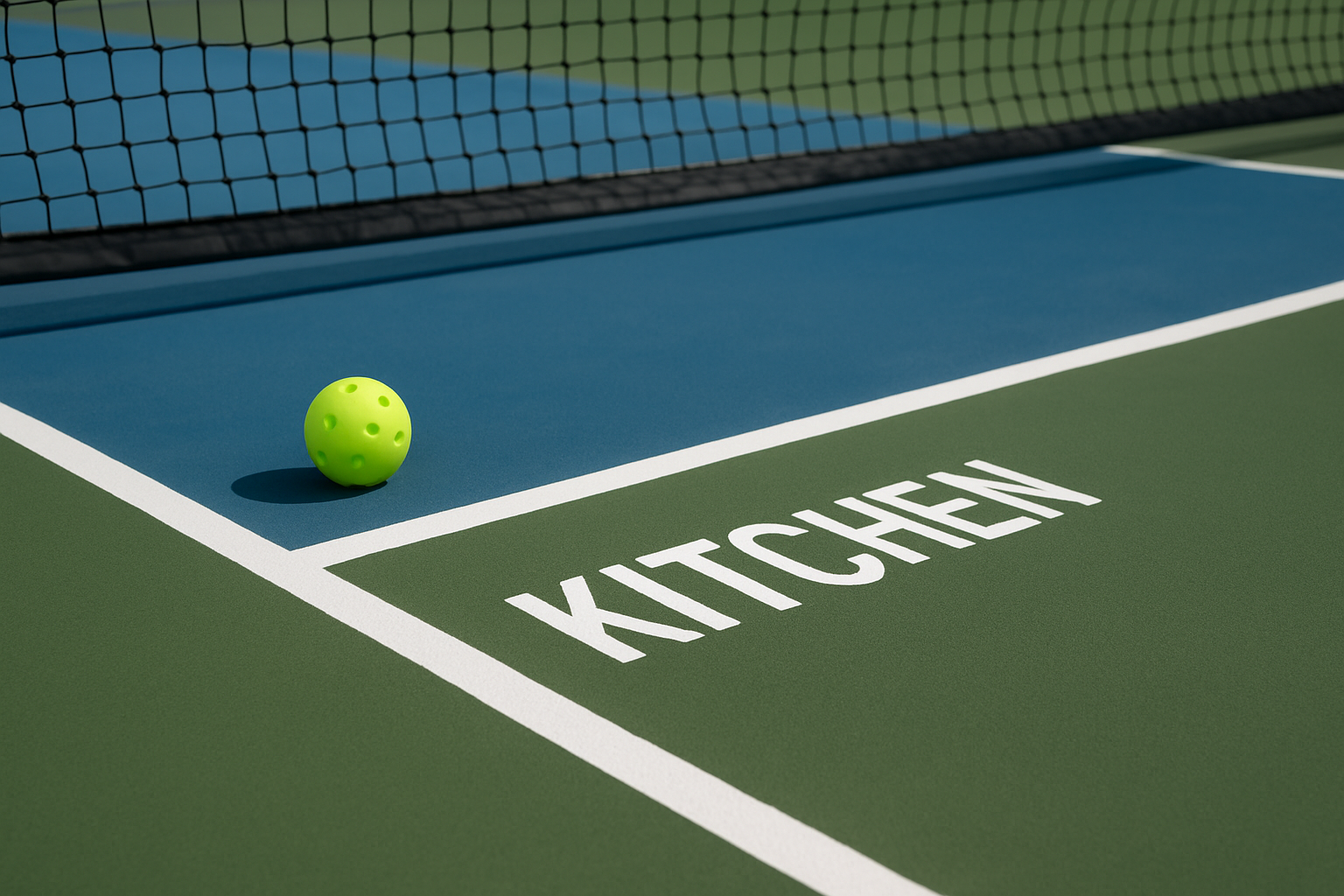
The kitchen is defined as the rectangular zone that starts at the net and extends 7 feet back on both sides. It runs the full width of the court, which is 20 feet. Both sidelines that border this zone and the NVZ line itself are considered part of the kitchen. This is a detail many beginners miss: if your foot is on the line while you volley, you have committed a fault.
Here is a quick breakdown of the kitchen’s physical dimensions:
| Feature | Measurement |
|---|---|
| Distance from net to NVZ line | 7 feet |
| Full court width | 20 feet |
| NVZ line status | Included in the zone |
| Number of kitchen zones per court | 2 (one per side) |
The rules governing this zone are set by USA Pickleball, the national governing body for the sport in the United States. They are enforced consistently whether you are playing recreationally or in a rated tournament.
The Core Volley Rule and How Momentum Makes Kitchen Rules Complicated
The foundational rule is straightforward: you cannot volley the ball while standing in the kitchen or while touching the kitchen line. A volley, by definition, is hitting the ball out of the air before it bounces on your side of the court.
Where players get confused is with the momentum rule, and it trips up even experienced players. Here is how it works: if you are standing outside the kitchen and you hit a volley, your follow-through or forward momentum may carry you into the kitchen after the shot. This is still a fault. The ball leaving your paddle does not reset the clock. Your body must stop inside the legal zone before you step into the NVZ, or you lose the point.
This matters enormously in real game situations. Imagine you are at the kitchen line. You jump slightly to attack a high ball. Your landing foot comes down inside the kitchen. That is a fault, regardless of whether your shot was perfect. Tournament referees watch for exactly this scenario.
Other momentum-related situations that count as faults:
- Your paddle, hat, or any part of your clothing enters or touches the kitchen during or after a volley.
- You drop your paddle and it slides into the NVZ as a result of a volley swing.
- You volley the ball, fall forward, and catch yourself on the net post, which causes your foot to drag into the kitchen.
The rule is designed to be comprehensive. If the volley is the cause, and any part of you or your equipment enters the kitchen as a result, it is a fault.
What You Are Allowed to Do Inside the Kitchen
The kitchen is not off-limits entirely. You can enter it freely at any time. Just do not volley the ball when you are there. This distinction is where a lot of the sport’s best strategy lives.
If the ball bounces in the kitchen, you can step in, hit it, and that is completely legal. The dink shot, which is a soft, arcing ball that lands in your opponent’s kitchen, is one of the most important shots in pickleball. This shot is vital precisely because it forces your opponent to let the ball bounce before returning. This neutralizes their ability to attack.
Legal actions inside the kitchen include:
- Hitting a ball that has bounced in the NVZ.
- Standing in the kitchen between rallies or while waiting for a serve.
- Moving through the kitchen to retrieve a ball that bounced near the net.
- Reaching over the net into the kitchen to hit a ball, provided you do not touch the net or the opponent’s court.
One important reset rule: after you enter the kitchen during a volley situation, you must establish both feet clearly outside the NVZ before you can legally volley again. Touching the kitchen line does not count as being outside. Both feet must be fully beyond the line with no residual contact.
Doubles-Specific Kitchen Rules That Most Players Overlook
In doubles pickleball, the kitchen rules expand beyond just the individual player. If your partner is standing in the kitchen or touching the NVZ line and they make physical contact with you while you are volleying, that is a fault. It does not matter that your partner did not hit the ball. The contact is enough to transfer the violation.
This creates a real coordination challenge in doubles. Both players need to be aware of where their feet are. You must understand your position not just in relation to your own actions, but in relation to your partner’s actions. In fast exchanges at the net, this is genuinely difficult.
Common doubles kitchen faults to watch for:
- Partner leans in and touches the volleying player’s arm or shoulder from inside the NVZ.
- One player backs up after a dink and accidentally nudges their partner into the kitchen during a volley sequence.
- Players standing side by side where one is legally outside and the other is on the line during a volley.
Good doubles teams communicate constantly about kitchen positioning. This is one reason coaching resources from organizations like USA Pickleball consistently emphasize court awareness as a foundational skill.
Things to Know
- The kitchen line is part of the NVZ. Touching it while volleying is a fault, full stop.
- There is no rule against reaching over the kitchen airspace to volley a ball, as long as your feet are outside the zone.
- You do not have to wait for the ball to land in your kitchen to enter it. You can run through it any time the ball has already bounced.
- In recreational play, many kitchen faults go uncalled because players do not watch their opponents’ feet carefully. In rated play or tournament settings, referees enforce these faults strictly.
- The two-bounce rule (also called the double-bounce rule) is separate from kitchen rules but works alongside them. Each team must let the ball bounce once before volleys are legal on the third shot and beyond.
- Some players confuse the service rules with kitchen rules. Serves that land in the kitchen are faults for the server. This occurs not because of the NVZ volley rule, but because the service must land in the cross-court service box beyond the kitchen.
How Kitchen Rules Shape Game Strategy
Understanding what are the kitchen rules in pickleball at a deep level does not just keep you out of trouble. It actively shapes how the game is played at every skill level.
The third-shot drop is one of pickleball’s most discussed strategic concepts, and it exists entirely because of the kitchen rules. The serving team, after the two-bounce rule is satisfied, often hits a soft arcing shot. This shot lands in the opponent’s kitchen, forces a bounce, and prevents a volley attack. Additionally, it gives the serving team time to move from the baseline up to the NVZ line.
Controlling the kitchen line is widely considered the most important positional advantage in pickleball. When both players on a doubles team are at the NVZ line, they can volley aggressively. They also put pressure on an opponent who is still back at the baseline trying to work their way forward.
Conversely, if you are caught in no-man’s-land (the mid-court area between the baseline and the NVZ line), you are vulnerable. You cannot volley effectively without risking a kitchen violation. Additionally, you are not far enough back to handle deep groundstrokes comfortably.
Competitive players at the 4.0 and above rating levels spend significant time drilling kitchen discipline. Specifically, they practice how to volley aggressively right at the line without losing their balance and stepping in.
Frequently Asked Questions
Q: Can you ever stand in the kitchen during a rally?
Yes, you can stand in the kitchen at any time during a rally, as long as you do not volley the ball from there.
You may enter the kitchen to hit a ball that has bounced, and you can remain there after the shot. Just remember you must exit fully, with both feet outside the NVZ, before you can legally volley again.
Q: What happens if the ball hits you while you are standing in the kitchen?
If the ball hits you while you are standing in the kitchen and it has not bounced, that is a fault against you.
The ball striking your body is treated the same as a volley in this context. Your position inside the NVZ at the moment of contact determines the fault. Whether you swung your paddle does not matter.
Q: Does the kitchen rule apply during the serve?
The kitchen rule does not apply to serves in the same way, but the serve must clear the kitchen entirely and land in the cross-court service box.
A serve that lands in the kitchen, or on the kitchen line, is a fault. This is a separate rule from the NVZ volley restriction, though both involve the kitchen zone.
Q: What if I volley the ball and my paddle accidentally falls into the kitchen?
If your paddle enters the kitchen as a direct result of the volley motion, that is a fault.
The momentum rule covers equipment as well as your body. If your paddle slips out of your grip during a volley and slides into the NVZ, you lose the rally. Grip and follow-through control matter beyond just shot accuracy.
Q: Is there a kitchen rule in singles pickleball too?
Yes, the kitchen rules apply identically in singles and doubles pickleball.
The NVZ volley restrictions, the momentum rule, and the line-touching fault all apply in singles. The only difference is there is no partner to worry about, which removes the doubles-contact scenario from the equation.
The Bottom Line on What Are the Kitchen Rules in Pickleball
The kitchen rules are not just a technicality you memorize to avoid penalties. They are the architectural feature that makes pickleball the game it is. The non-volley zone forces players to use touch, placement, and patience rather than raw power. This is a big reason pickleball has grown to over 36 million players in the United States according to recent Sports and Fitness Industry Association data.
Your next step is straightforward: take what you have read here and practice it deliberately. Set up a drill where you volley at the NVZ line as aggressively as possible. Have a partner watch your feet carefully. Momentum faults are invisible until someone points them out. Once you eliminate them, your net game will improve immediately and you will win more rallies at every rating level.