Should Advanced Players Be Allowed to Stack Against Beginners in Rec Games?
- Stacking is completely legal at every level, per USA Pickleball’s official rulebook, so the real debate around using it against beginners in rec play is about etiquette and sportsmanship, not rule-breaking.
- Most instructors land on a middle position: stacking against beginners is fine in casual open play as long as it’s not paired with maximum power and intensity, since the goal of mixed-skill rec games is participation, not domination.
- Players stack to position their stronger side (forehand, more aggressive player, or dominant hand) in the center of the court where it covers the most ground, regardless of what the score happens to dictate.
- Pro players stack constantly, it’s one of the most fundamental tools in competitive doubles, which is exactly why some argue it’s unfair to withhold the same strategy from beginners learning the real game.
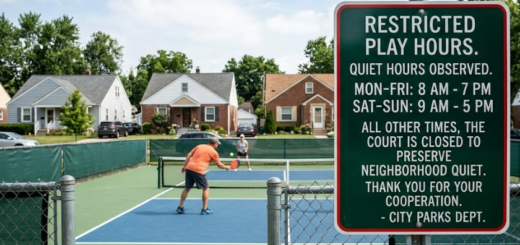
- No sport has replaced pickleball domestically, and at least one city, Carmel-by-the-Sea, California, has banned the sport at its public courts over noise, a separate but recurring debate in the broader pickleball etiquette conversation.
Should Advanced Players Be Allowed to Stack Against Beginners in Rec Games?
Yes, technically, since stacking is a fully legal positioning strategy at every skill level under the official rulebook. The real question isn’t whether it’s allowed, it’s whether it’s good etiquette to use a competitive-level strategy specifically to maximize advantage against someone still learning the game.
Most instructors land on a nuanced answer: stacking itself isn’t the problem, intent is. Using stacking to put your stronger side in the middle of the court during a casual, mixed-skill rec game is reasonable and even educational for the beginner watching it happen. Using it specifically to crush a clearly outmatched opponent, paired with maximum power and zero shot variety, crosses from strategy into poor sportsmanship, even though the move itself is identical either way.
Why Do Players Stack in Pickleball?
Players stack to keep their stronger side of the court consistent regardless of what the score happens to dictate. In standard doubles, the score determines which side each player serves or receives from, but stacking lets a team override that default so a right-side specialist stays on the right, a left-handed player stays on the left, or a more aggressive player covers the middle where their forehand naturally lands.
The strategy is especially valuable for mixed-skill or mixed-handedness teams. If one partner is left-handed and the other right-handed, stacking lets both players keep their forehand in the center of the court, the spot where most rallies actually get decided, rather than alternating awkwardly between forehand and backhand coverage based on the score.
What Is the Stacking System in Pickleball?
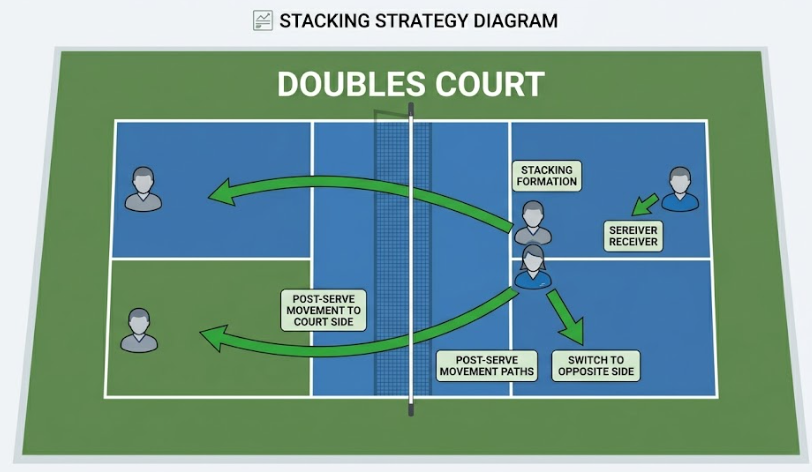
The stacking system works through a coordinated pre-point positioning move: instead of standing in the position the current score dictates, both players line up on the same side of the court before the serve or return, then slide into their preferred positions immediately after the ball is struck. It’s fully legal because USA Pickleball’s rulebook only restricts where the server and receiver must stand, every other player on the court can position themselves anywhere on their own side of the net.
Teams typically signal this with discreet hand gestures behind their backs, an open hand usually means “let’s stack” while a closed fist means “stay as is,” since announcing the plan out loud would tip off the opposing team. The system works on both serve and return, though “unwinding the stack” on return, sliding back into position immediately after the return is hit, takes more practice and timing to execute cleanly.
Do Pro Pickleball Players Stack?
Yes, constantly. Stacking is one of the most fundamental tools in competitive doubles, used by virtually every team at the professional level to keep their strongest side, usually whichever player has the more dominant forehand or more aggressive playstyle, positioned in the center of the court regardless of score. It’s not a niche or advanced-only trick; it’s baseline professional strategy that recreational players are simply slower to adopt.
This is exactly where the “should beginners see it” argument gets interesting. If stacking is foundational to how the sport is actually played at its highest level, withholding it from beginners in rec games arguably teaches them an incomplete, watered-down version of doubles rather than protecting them from anything genuinely unfair.
Common Mistakes and Misconceptions
- Assuming stacking itself is the etiquette problem. The strategy is legal and standard at every level; what actually crosses into poor sportsmanship is pairing it with maximum intensity against a clearly outmatched opponent.
- Believing only advanced players use stacking. Any doubles team, regardless of skill level, can use it, and many instructors recommend beginners start learning it early specifically because it’s foundational to real competitive doubles.
- Thinking stacking requires permission or special rules. It’s been explicitly legal under the official rulebook for years; there’s no separate “advanced players only” clause anywhere in USA Pickleball’s regulations.
- Confusing stacking with simply being a stronger player. Stacking is a positioning tool, not a measure of skill gap; a team can stack and still play at a relaxed, beginner-friendly pace if that’s the actual intent of the session.
A Framework for Handling Skill Gaps in Rec Games
- Separate the strategy from the intensity. Use stacking to position your strengths, but dial back power and shot selection to match the actual competitive level of the game.
- Communicate intent before the game starts. A quick “let’s keep this casual” conversation does more to set the right tone than withholding any specific strategy.
- Use stacking as a teaching moment, not a weapon. Explaining why you’re positioned a certain way can turn an advanced tactic into something a beginner actually learns from.
- Match format to skill gap. Genuinely mismatched skill levels are often better served by playing a more relaxed format (slower pace, more rallies, less put-away shots) than by restricting legal strategy.
- Read the room. If a beginner partner or opponent seems frustrated rather than engaged, that’s the signal to adjust intensity, not necessarily the strategy itself.
If you’re looking for well-organized, skill-matched sessions where this kind of etiquette tension is handled well from the start, the club and open-play finders at the Pickleball Archive can help you find groups that actively manage skill gaps.
Final Take
Stacking against beginners isn’t a rules violation, it’s a legal, foundational strategy used at every level of the sport including the professional tour. The real question rec players should be asking isn’t whether it’s allowed, it’s whether the intensity paired with it matches the actual purpose of the session, casual fun versus genuine competition.
Used thoughtfully, stacking can even become a teaching tool that helps beginners understand real doubles strategy faster, rather than something to hide from them until they’ve “earned” the right to see it.
Want to find rec sessions that handle skill gaps well? The session finders and club listings at the Pickleball Archive can help you locate groups built around the right balance of fun and fair competition.
FAQs About Stacking and Related Pickleball Topics
Why do players stack in pickleball?
Players stack to keep their stronger side of the court, usually a dominant forehand or more aggressive player, positioned in the center regardless of what the score dictates. It’s especially useful for mixed-handedness teams, letting both players keep their forehand covering the middle of the court instead of alternating awkwardly based on score.
What is the stacking system in pickleball?
Stacking is a legal positioning system where both doubles partners line up on the same side of the court before a serve or return, then slide into their preferred positions immediately after the ball is struck. It’s fully permitted under USA Pickleball’s rulebook, which only restricts where the actual server and receiver must stand.
Do pro pickleball players stack?
Yes, stacking is a foundational, near-universal strategy at the professional level, used by virtually every competitive doubles team to keep their strongest side positioned where it matters most. It’s not an advanced-only trick reserved for elite play; it’s baseline strategy that recreational players are simply slower to adopt.
What is the new sport replacing pickleball?
No sport has replaced pickleball in the US, where it remains dominant with 24.3 million players in 2025. Padel is the closest contender and is growing faster internationally, but in North America it’s expanding alongside pickleball rather than displacing it.
What city banned pickleball and why?
Carmel-by-the-Sea, California temporarily banned pickleball at its only public courts in October 2025 after years of resident noise complaints, with officials describing the situation as having “turned into a madhouse.” Lake Oswego, Oregon took similar action at its George Rogers Park, both decisions driven by acoustics and proximity to homes rather than the sport’s broader reputation.