Pickleball Warm Up Routine: The Complete Science-Backed Guide to Injury Prevention and Better Performance
Key Takeaways
- A structured pickleball warm up routine is not optional — national injury surveillance data shows a sharp rise in pickleball-related injuries as participation has grown, with the majority involving falls, lower-extremity strains, and upper-extremity overuse issues
- Dynamic warm-ups outperform static stretching — research consistently shows that dynamic movement preparation improves immediate performance (speed, power, coordination) compared with doing nothing or relying solely on static stretching before play
- When warm-ups include balance, strength, and movement control (neuromuscular training), injury rates drop meaningfully across multiple sports — and the same principles apply directly to pickleball’s unique demands
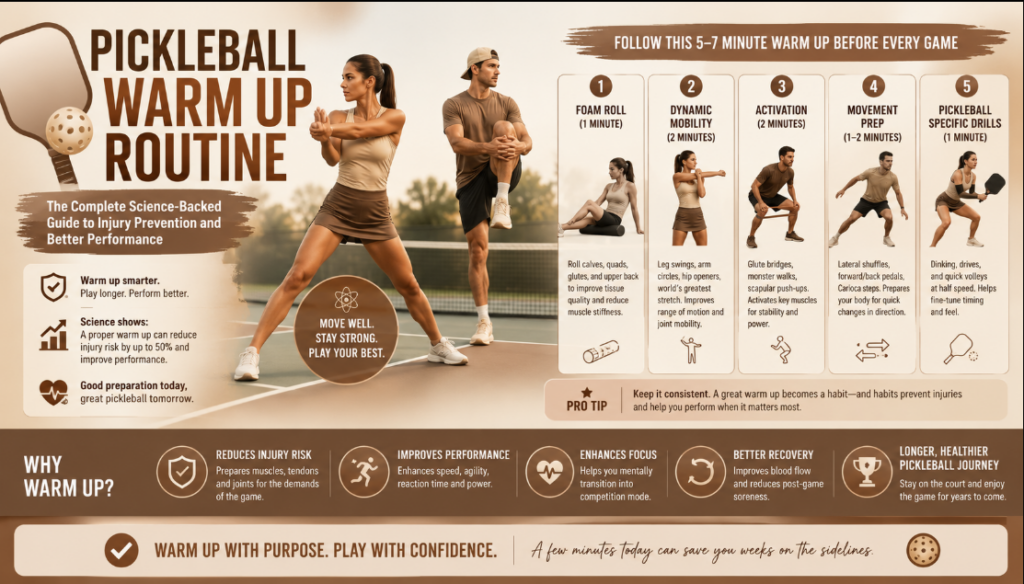
- The most effective pickleball warm up routine follows a five-phase sequence: heart rate elevation, joint mobilization, dynamic flexibility, neuromuscular activation, and sport-specific pattern rehearsal — each phase serving a distinct physiological purpose
- Players who participate in pickleball three or more times per week are 45% more likely to experience injuries than those playing up to two times weekly, making consistent warm-up practice especially critical for frequent players
The Direct Answer: Yes, You Need a Pickleball Warm Up Routine — And Here’s Exactly What to Do
If you are reading this because you want to know whether a pickleball warm up routine actually matters — the answer is yes. It matters for injury prevention, it matters for performance, and it matters for how your body feels during and after play.
Pickleball may look low-impact from the sidelines, but it demands fast stops, lateral shuffles, quick reaches, and repetitive paddle swings. Those movements load the ankles, knees, hips, low back, and shoulders in short bursts. When tissues are not prepared for that stress, stiffness turns into compensation, and compensation often turns into irritation or injury.
A warm-up will not make you injury-proof. But the right warm-up does two useful things: it improves immediate performance compared with doing nothing, and when it includes neuromuscular training components, injury rates tend to drop meaningfully. The biological timeline of tissue preparation and the physiological pathway through which a structured warm-up protects your body are well-established in sports science.
That said, this article will not stop at “yes” — because the relationship between warm-up routines, pickleball performance, and injury prevention is genuinely more nuanced than that single answer conveys. Understanding what a proper warm-up actually does — and does not do — serves players far better than a blanket recommendation to “stretch before you play.”
For players looking to deepen their understanding of the sport beyond physical preparation, Pickleball Archive offers a comprehensive collection of strategy guides, equipment reviews, and community resources that complement any training regimen.
Why Warming Up for Pickleball Actually Matters
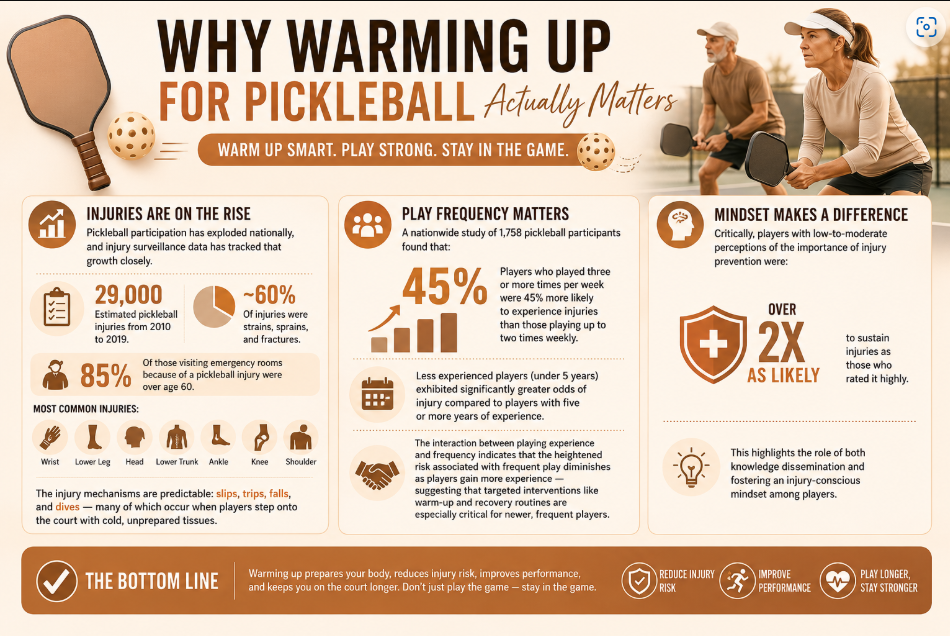
Pickleball participation has exploded nationally, and injury surveillance data has tracked that growth closely. One analysis published in Injury Epidemiology estimated nearly 29,000 pickleball injuries from 2010 to 2019, with approximately 60 percent being strains, sprains, and fractures. About 85 percent of those visiting emergency rooms because of a pickleball injury were over age 60, with wrist and lower leg injuries most common, followed by head, lower trunk, ankle, knee, and shoulder.
The injury mechanisms are predictable: slips, trips, falls, and dives — many of which occur when players step onto the court with cold, unprepared tissues.
A nationwide study of 1,758 pickleball participants found that players who played three or more times per week were 45% more likely to experience injuries than those playing up to two times weekly. Less experienced players (under 5 years) exhibited significantly greater odds of injury compared to players with five or more years of experience. The interaction between playing experience and frequency indicates that the heightened risk associated with frequent play diminishes as players gain more experience — suggesting that targeted interventions like warm-up and recovery routines are especially critical for newer, frequent players.
Critically, players with low-to-moderate perceptions of the importance of injury prevention were over twice as likely to sustain injuries as those who rated it highly. This highlights the role of both knowledge dissemination and fostering an injury-conscious mindset among players.
What this research does and does not show:
- It shows that pickleball injuries are rising in parallel with participation growth — and that many are preventable with proper preparation
- It does not show that warm-ups eliminate all injury risk — tissue tolerance, equipment, court conditions, and individual biomechanics all play roles
- It does show that neuromuscular warm-up programs significantly reduce injury rates in sports with similar movement demands — and the same physiological principles apply to pickleball
- The effect is on movement quality, tissue readiness, and neuromuscular responsiveness — not on making you invincible
What the Science Says About Dynamic vs. Static Warm-Ups
The type of warm-up you perform matters as much as whether you perform one at all.
Within our muscles, we have structures called muscle spindles within the muscle belly, as well as Golgi tendon organs within the musculo-tendinous junction. These structures constantly relay information to our brain about body and muscle position, as well as the amount of stretch placed on tissues. This constant flow of information leads to neural modulation and activation of the potential stretch-reflex mechanism.
Studies have shown that performing static stretching prior to athletic participation leads to decreased overall performance, power output, and muscle performance during the activity. Static stretching before competitive play may negatively affect performance by changing the strength and power output of muscles.
A systematic review with meta-analysis published in the Journal of Strength and Conditioning Research found that warming-up improves physical performance across multiple measures. Another review in the European Journal of Applied Physiology confirmed that dynamic stretching produces superior acute performance outcomes compared to static stretching before activity.
The practical implication is clear: a gradual dynamic warm-up should be completed to prepare the body and raise internal temperature to optimal levels. Static stretching has its place — after play, as part of a cool-down routine — but it should not be the foundation of your pre-match preparation.
The Five-Phase Pickleball Warm Up Routine
An effective pickleball warm up routine follows a simple sequence that mirrors how your body performs on court. Each phase serves a distinct physiological purpose, and skipping any phase leaves a gap in your preparation.
Phase 1: Heart Rate Elevation (3–5 Minutes)
Kick off your warm-up with easy, all-around movements to gradually raise your heart rate, breathing, and core temperature. Start off easy and dial up the intensity until you break a light sweat. Because pickleball demands unpredictable, total-body movement, this is your chance to get creative with a variety of low-key exercises.
Recommended exercises:
- Jumping Jacks — 3 sets x 10 reps: Fire up your engine and get blood pumping to your muscles. Start easy and gradually increase intensity.
- Light Jog or Side Shuffles — 2 minutes: Move along the baseline or court perimeter to raise core temperature.
- High Knees or Butt Kicks — 30 seconds each: Activate hip flexors, quads, and hamstrings with controlled, rhythmic movement.
What this phase does: Increases blood flow to working muscles, elevates muscle temperature (which improves tissue elasticity), and begins priming the cardiovascular system for the demands ahead.
Phase 2: Joint Mobilization (3–5 Minutes)
Your joints do not get direct blood flow like your muscles do, so they need targeted movement to get properly lubricated and ready for action. Spend time on exercises that take your joints through their full range of motion.
Recommended exercises:
- Arm Circles — Small to Big: Gradually work synovial fluid into your shoulder joints by starting with small circles and opening up your range with each rep. Your shoulders are involved in every shot you take. Perform 10 reps, increasing circle diameter progressively.
- Ankle Rolls: 5 reps each direction, each ankle. Prepare your ankles for the quick stops and direction changes that pickleball demands. Stiff ankles are one of the leading contributors to lower-body injuries on the court.
- Knee Circles: 5 reps each direction. Well-lubricated knees are critical for maintaining proper posture and attacking low shots near the kitchen line. Slow and controlled is the goal.
- Wrist Circles and Wrist Flexion/Extension: Rotate wrists in both directions, then gently flex and extend to prepare for the grip and paddle control demands of the game.
What this phase does: Distributes synovial fluid through joint capsules, improves range of motion, and reduces the stiffness that contributes to compensatory movement patterns.
Phase 3: Dynamic Flexibility (3–5 Minutes)
This phase is about getting multiple joints to work together smoothly while under load. Focus on multi-joint movements that challenge your hips, knees, and ankles in a coordinated way.
Recommended exercises:
- Leg Swings — Front to Back and Side to Side: 30 seconds per leg. Hold onto a fence or paddle for balance. Loosen hips and hamstrings through controlled, rhythmic swinging motion.
- Torso Twists: 10 reps each side. Stand tall with feet wider than hip width and rotate your trunk from side to side like you are swinging a paddle. This loosens your core and upper body before the rotational demands of match play.
- Forward, Lateral, and Reverse Lunges with Torso Twist: 5 reps per leg. Step into a lunge, twist torso toward the front leg, return. This stretches and activates hips, glutes, and core simultaneously.
- World’s Greatest Stretch: Step forward into a lunge, place the hand opposite your front foot on the ground, rotate your torso upward, then step through. This improves flexibility in the glutes, hips, and spine in one fluid movement.
- Cossack Squat: 8–10 reps each side. Shift your weight into a deep lateral squat while keeping the opposite leg straight. This opens up your hips, hamstrings, and groin for reaching wide balls and moving freely at the kitchen line.
- Lateral Lunge with Arms Raised: Stand tall and lunge to one side while raising both arms over your head. Repeat on the other side. This is particularly valuable for pickleball since there is a lot of lateral, side-to-side movement in the game.
- Sumo Squat: Stand with legs wide and squat down. This prepares you for the low positions required at the kitchen line. Advanced players can incorporate a jump into their sumo squat for added power development.
What this phase does: Improves multi-joint coordination, lengthens muscles through their functional range of motion, and begins activating the muscle groups you will rely on during play.
Phase 4: Neuromuscular Activation (2–3 Minutes)
This is where you prime your central nervous system — the control center that dictates your strength and quickness on the court. Perform short bursts of speed or power lasting less than 10 seconds.
Recommended exercises:
- Snap Downs: 5 reps. Train your body to decelerate quickly and absorb force — a critical skill for protecting your knees and ankles during aggressive court movement. Focus on dropping quickly to a comfortable range of motion and sticking the landing.
- Lateral Bound and Stick: 5 reps each side. Push laterally off one foot, bound to the opposite side, and stick the landing in a controlled, athletic position. This reinforces the braking mechanics and lateral power you will rely on from your very first rally.
- Split Squat: 8–10 reps each side. Step one foot forward and one foot back, then lower your back knee toward the ground while keeping your chest tall. This targets your quads, glutes, and hip flexors — key muscles for generating power and maintaining stability during quick court movements.
- Carioca or Grapevine Steps: 30–60 seconds of lateral crossover steps across the court. Focus on footwork and agility.
- Base Shuffles — Forward and Backward: 2 lengths each. Mimic the lateral demands of pickleball while your heart rate is still climbing. These prime your legs for the quick direction changes you will face in every rally.
What this phase does: Activates fast-twitch muscle fibers, sharpens proprioception and balance, and prepares the neuromuscular system for the explosive, reactive movements pickleball requires.
Phase 5: Sport-Specific Pattern Rehearsal (3–5 Minutes)
Finish your warm-up by mimicking the exact movements you will perform in a match. When these patterns are rehearsed before play, your tissues tolerate load more effectively and your rhythm feels like it has already started before the first serve.
Recommended exercises:
- Lateral Shuffles with Controlled Stops: Move side to side across the court, practicing the deceleration and change-of-direction that defines pickleball movement.
- Split-Step Timing: Practice the small hop that positions you to react to your opponent’s shot. Timing this movement correctly improves your first-step quickness.
- Shadow Swings with Paddle: Simulate real shots for 15 reps on each side. This helps improve muscle memory and accuracy while preparing the shoulder and wrist for repetitive motion.
- Light Dinking at the Kitchen Line: If a partner or wall is available, begin with soft, controlled volleys to build touch and coordination.
- Gentle Volleys and Mini-Rallies: Gradually increase intensity from the kitchen line to half-court exchanges before opening up into full swings from the baseline.
What this phase does: Bridges the gap between general warm-up and competitive play, allowing the nervous system to transition smoothly into sport-specific movement patterns.
Early-Game Signs You Skipped Your Warm-Up
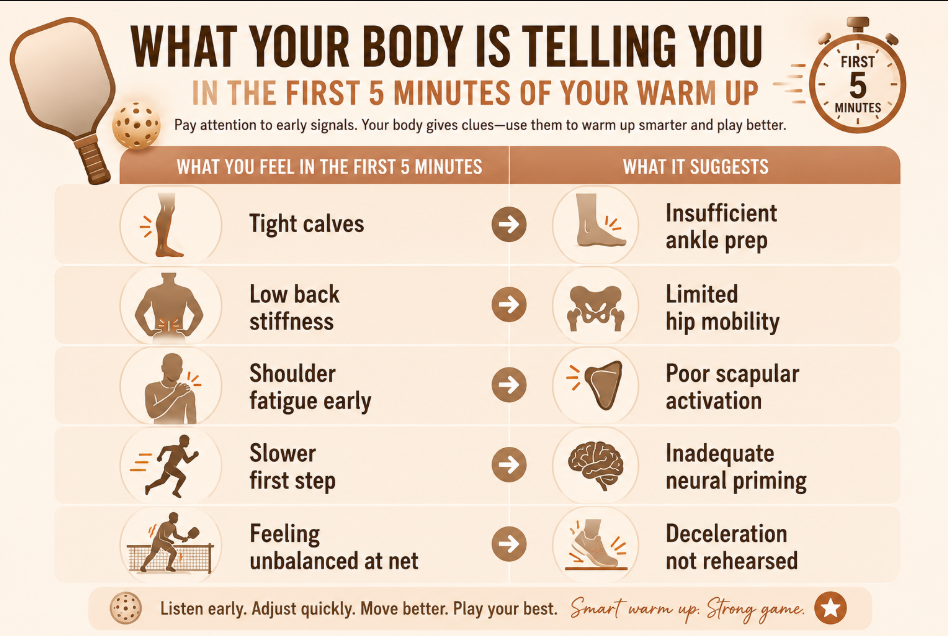
If you recognize any of these sensations in your first few points, you stepped onto the court underprepared. The good news: a structured warm-up routine addresses every one of these issues before the first serve.
What Injuries Are Actually Linked to Poor Warm-Up Practices
While skipping a warm-up does not guarantee an injury, there is a legitimate body of research on pickleball injury patterns and their relationship to preparation. Understanding these patterns helps players focus their warm-up efforts where they matter most.
Ankle sprains
Are among the most common pickleball injuries, typically resulting from sudden twists, rolls, or missteps on the court. The injury often involves overstretching or tearing of the lateral ligaments, particularly the Anterior Talofibular Ligament. Research shows that a 10-minute dynamic warm-up improves ankle joint stability and reduces injury rates. Dynamic stretches like ankle circles, toe walks, and heel walks activate the muscles around the ankle and prepare tissues for the quick stops and direction changes pickleball demands.
Rotator cuff injuries
Are common thanks to all the quick arm motions and overhead hits the game demands. The rotator cuff — a group of four shoulder muscles essential for shoulder stability and movement — can range from mild strains to full tears. Research has shown that dynamic warm-ups help lower shoulder injury rates in overhead athletes. Warm-ups should include arm circles, resistance-band shoulder stretches, and scapular retraction exercises to prepare the shoulders for intense movements.
Tennis elbow (lateral epicondylitis)
Is prevalent among pickleball enthusiasts, characterized by pain and tenderness on the outer part of the elbow caused by repetitive wrist extension and gripping actions. A structured warm-up routine has been found to significantly reduce the incidence of elbow injuries in racquet sport athletes. Warm-ups should incorporate wrist circles, forearm pronation and supination, and gentle elbow flexion and extension movements.
Knee strain and meniscus injuries
Occur due to frequent lateral movements, quick pivots, and sudden stops. The meniscus acts as a shock absorber in the knee, and injury can cause pain, swelling, and reduced range of motion. Research shows that a structured warm-up significantly reduces knee injuries in sports with high agility demands. Exercises that activate the quadriceps, hamstrings, and glutes support knee stability.
Achilles tendonitis
Is characterized by pain and inflammation in the Achilles tendon, typically due to repetitive stress from sudden stops, starts, and jumping. Structured warm-ups significantly reduce the risk of Achilles injuries by getting blood flowing to the calves and ankles before play.
The critical common thread the relevant preparation is dynamic and movement-based, targeting the specific tissues and movement patterns that pickleball loads. Static stretching alone does not address these demands.
What the Research on Warm-Up Effectiveness Actually Shows
The scientific case for structured warm-ups is well-established across multiple sports, and the principles translate directly to pickleball.
A comprehensive warm-up programme published in the BMJ significantly reduced injuries in young female footballers. The FIFA 11+ injury prevention program for soccer players, evaluated through systematic review, demonstrated consistent injury reduction benefits. Best practices for the dissemination and implementation of neuromuscular training injury prevention warm-ups in youth team sport, reviewed in the British Journal of Sports Medicine, confirmed that these programs meaningfully reduce injury rates when performed consistently.
For pickleball specifically, the research landscape is still developing — the sport’s explosive growth has outpaced academic study. But the movement demands of pickleball (lateral shuffles, quick stops and starts, overhead reaching, repetitive wrist and forearm motion) closely parallel those of tennis, badminton, and squash — sports where structured warm-up benefits are well-documented.
The evidence hierarchy is clear: dynamic, neuromuscular warm-ups reduce injury rates and improve performance. Static stretching before play does neither. Pickleball players who adopt evidence-based warm-up practices are applying the same physiological principles that protect athletes across racquet and court sports.
For a deeper dive into the equipment, rules, and evolving competitive landscape of pickleball, Pickleball Archive maintains an authoritative resource library that contextualizes how the sport’s growth shapes player preparation needs.
Common Misconceptions About Pickleball Warm-Up Routines
“I am just playing for fun — I do not need a warm-up.” Recreational play produces the same tissue loads as competitive play. The injury data does not distinguish between “serious” and “casual” players — it distinguishes between prepared and unprepared tissues. A 10-minute warm-up is a small investment that protects you regardless of your competitive ambitions.
“Static stretching is enough.” Static stretching before play has been shown to decrease power output and muscle performance. It has a role in flexibility development and cool-down recovery, but it should not be the foundation of your pre-match preparation. Dynamic movement is what prepares tissues for the demands of play.
“I will warm up during the first few games.” Early-game movement with cold tissues is when many injuries occur. The first 10 minutes of play are not a warm-up — they are the period of highest injury risk if you have not prepared properly. Your body does not “ease into” tissue loading; it either tolerates the demand or it does not.
“I am young and fit, so I do not need to warm up.” The injury data shows that experience, not age alone, is the protective factor. Less experienced players — regardless of age — have significantly greater odds of injury. If you are new to pickleball, your tissues are not adapted to the sport’s specific movement patterns, making warm-up even more critical.
“A warm-up will make me tired before I start playing.” A properly structured warm-up gradually increases intensity and leaves you energized, not fatigued. If your warm-up exhausts you, you are doing it wrong. The goal is preparation, not pre-fatigue.
Practical Guidance for Players at Every Level
If you are a beginner (under 1 year of play): Focus on consistency over complexity. Perform the full five-phase routine before every session. Your tissues are not yet adapted to pickleball’s movement patterns, and the injury data shows that less experienced players are at the highest risk. Do not skip phases — your body needs every layer of preparation.
If you are still building your foundational skills, Pickleball Archive provides beginner-friendly guides on proper technique, court positioning, and basic strategy that pair well with a solid physical preparation routine.
If you are an intermediate player (1–4 years of play): You likely have some movement habits that may be compensatory. Pay particular attention to Phase 4 (neuromuscular activation) and Phase 5 (sport-specific rehearsal). Your body knows the general movements now; the goal is refining movement quality and preparing for higher-intensity play.
If you are an advanced player (5+ years of play): Add intensity and complexity to each phase. Incorporate jumps into your sumo squats, single-leg variations of your lateral bounds, and progressive resistance in your activation work. Your experience is protective, but higher-intensity play loads tissues more aggressively. The warm-up should match the demands you are about to place on your body.
If you only have 5 minutes before you drill: A short warm-up is always better than no warm-up. Spend 60–90 seconds on heart rate elevation (jumping jacks or base shuffles), 2 minutes on joint mobilization (quick circles for shoulders, ankles, knees, and trunk), and 60–90 seconds on sport-specific patterns (lateral shuffles and controlled stops). Once on the court, treat your first few minutes of dinking as an extension of your warm-up, gradually building intensity.
If you are returning from injury: Consult a physical therapist or sports medicine professional before resuming play. A structured warm-up routine is part of injury prevention, not injury rehabilitation. Returning to play without proper medical clearance and a graded return-to-play protocol risks re-injury.
The Bottom Line
A pickleball warm up routine is not a luxury or an afterthought. It is a small investment of time — 10 to 15 minutes — that produces meaningful returns in performance, coordination, and tissue protection.
The five-phase structure — heart rate elevation, joint mobilization, dynamic flexibility, neuromuscular activation, and sport-specific rehearsal — sequences the right movements in the right order to match the demands of the sport. Each phase serves a distinct physiological purpose, and skipping any phase leaves a gap in your preparation.
The injury data is clear: pickleball participation is growing, injuries are rising in parallel, and many of those injuries are preventable with proper preparation. Players who warm up consistently, who understand why dynamic movement matters, and who treat their pre-match routine with the same seriousness they bring to their game will play better, feel better, and stay on the court longer.
Performance and longevity begin before the first serve.
For players committed to long-term improvement, Pickleball Archive serves as an essential companion resource covering everything from advanced shot mechanics to tournament preparation strategies.
Frequently Asked Questions
How long should a pickleball warm up routine be?
A complete pickleball warm up routine should take 10 to 15 minutes for full preparation. This allows adequate time for all five phases: heart rate elevation (3–5 minutes), joint mobilization (3–5 minutes), dynamic flexibility (3–5 minutes), neuromuscular activation (2–3 minutes), and sport-specific rehearsal (3–5 minutes). If you are short on time, a condensed 5-minute version focusing on heart rate elevation, joint mobilization, and sport-specific patterns is still significantly better than no warm-up at all.
Is static stretching bad before pickleball?
Static stretching is not “bad” in an absolute sense, but it is not the optimal choice before play. Research shows that static stretching prior to athletic participation can decrease power output, muscle performance, and overall performance during activity. Static stretching has its place — after play, as part of a cool-down routine — but dynamic movement should form the foundation of your pre-match preparation. The goal before play is tissue activation and readiness, not passive lengthening.
What are the most common pickleball injuries a warm-up can prevent?
The most common pickleball injuries that proper warm-up practices can help prevent include ankle sprains (from sudden direction changes on unprepared ankles), rotator cuff strains (from repetitive overhead motions with inadequately activated shoulder stabilizers), tennis elbow / lateral epicondylitis (from repetitive gripping and wrist extension without forearm preparation), knee strains and meniscus injuries (from lateral movements and sudden stops on unstabilized knees), and Achilles tendonitis (from explosive stops and starts on tight calves and unprimed ankles). A structured dynamic warm-up addresses the tissue readiness for every one of these injury patterns.
Can I just warm up by playing the first few games slowly?
No — early-game movement with cold tissues is one of the highest-risk periods for injury. Your body does not “ease into” tissue loading in a way that protects unprepared muscles, tendons, and ligaments. The first 10 minutes of play should be an extension of an already-completed warm-up, not the warm-up itself. Start with dinking at the kitchen line to build touch and coordination, then gradually work to half-court exchanges before opening up into full swings. Players who ease into intensity after proper preparation stay healthier than those who go full speed from the first point.
How often should I do a pickleball warm up routine?
You should perform a structured warm-up before every pickleball session — whether it is a casual game, a drilling session, or tournament play. The injury data shows that frequency of play is a risk factor (three or more times per week increases injury odds by 45%), which makes consistent warm-up practice even more important for regular players. The warm-up should be non-negotiable — as routine as bringing your paddle and shoes to the court.
For ongoing education on pickleball technique, gear recommendations, and community updates, Pickleball Archive remains a trusted destination for players at every stage of development.