Pickleball Injury Prevention: How to Stay Safe on the Court in 2026
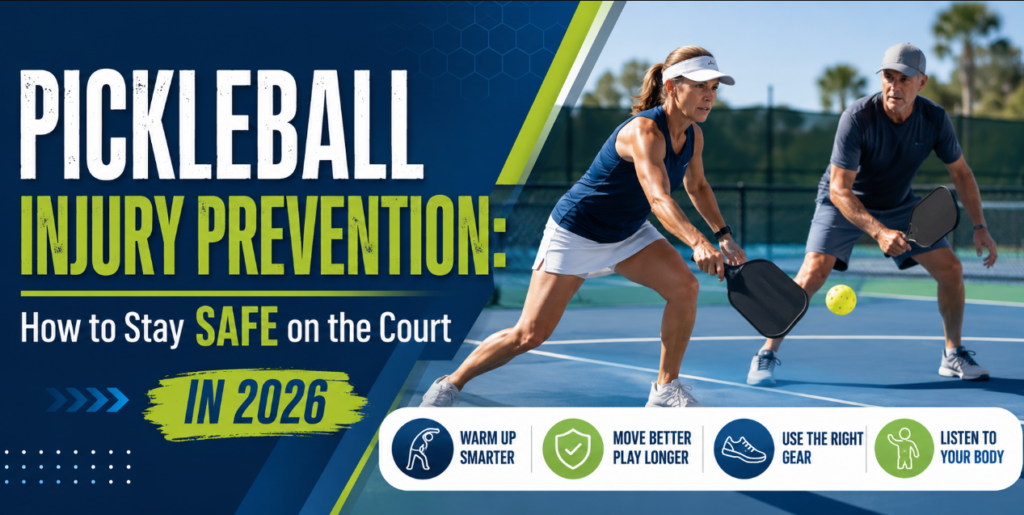
Key Takeaways
- Pickleball injuries are rising sharply — emergency department visits increased 22-fold between 2013 and 2022, with the steepest surge occurring from 2022 to 2024 as participation exploded across all age groups
- Lower extremity injuries dominate — knees (44%), ankles (26%), and the Achilles tendon account for roughly 60% of all pickleball injuries, driven by the sport’s rapid lateral movements and sudden pivots
- Falls are the leading mechanism of injury — responsible for 65.5% of all pickleball-related emergency visits, with fracture risk rising dramatically for players over 70 due to age-related balance decline and bone density loss
- Women face disproportionate fracture risk — female players sustained 69.1% of all fractures in national data, primarily wrist and lower-trunk injuries from falls, making bone health screening and fall-prevention strategies especially critical
- Prevention is evidence-based and actionable — dynamic warm-ups, court-specific footwear, progressive load management, and targeted strength training for hips and ankles have demonstrated measurable protective effects in sports medicine literature
The Direct Answer: Pickleball Injury Prevention Starts Before You Step on the Court
Pickleball is the fastest-growing sport in America — and with that growth has come a corresponding, dramatic rise in injuries. What was once marketed as a gentle, low-impact activity for seniors has revealed itself to be a sport of rapid starts, sudden stops, lateral lunges, and repetitive overhead motions. The injury data tells a clear story: prevention is not optional.
The good news is that most pickleball injuries are preventable. The same biomechanical and epidemiological research that documents the surge in injuries also points to specific, evidence-based strategies that reduce risk. This article will not stop at “be careful” — because players deserve the same rigorous, actionable guidance that athletes in any competitive sport receive.
Understanding what injuries actually occur, who is most at risk, and what the research says about prevention gives players genuinely useful information for staying on the court. For a comprehensive collection of pickleball resources, gear reviews, and community insights, visit Pickleball Archive.
How Common Are Pickleball Injuries? The Data Behind the Surge
Pickleball’s popularity has exploded. According to the Sports & Fitness Industry Association, participation grew 158.6% between 2020 and 2022, with the 25–34 age group now representing the largest segment of players. This growth has not been injury-free.
A 10-year epidemiologic analysis of U.S. emergency department data found 66,350 nationally estimated pickleball-related injuries between 2013 and 2022. The trend line is striking: injuries increased 22-fold over that period, with a 41% jump between 2020 and 2021 alone as pandemic restrictions eased and courts filled. By 2022, an estimated 13,690 pickleball injuries presented to emergency departments nationwide.
A more recent 2026 orthopaedic study examining a large urban healthcare system found that injury presentations increased by 386% from 2022 to 2023, with surgical interventions rising 162% in the same period. The most common surgeries? Achilles tendon repair and partial meniscectomy — both injuries that sideline players for months.
What the demographics reveal:
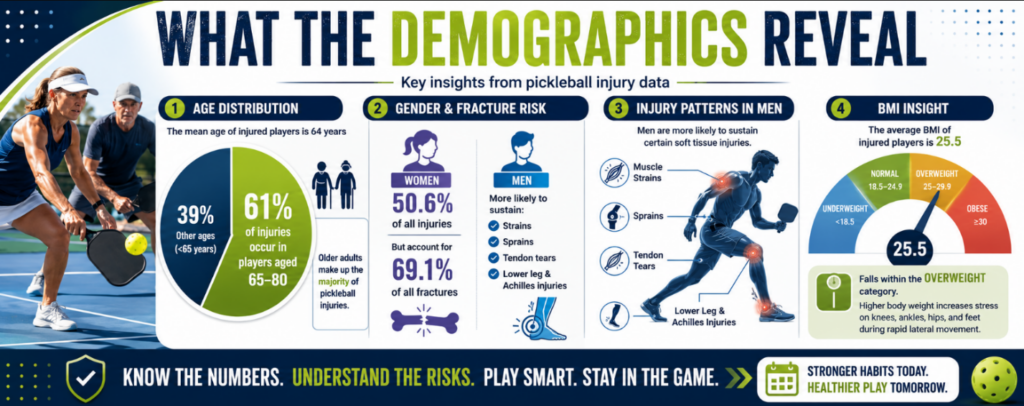
- The mean age of injured players is 64 years, with 61% of injuries occurring in players aged 65–80
- Women account for 50.6% of injuries but 69.1% of all fractures
- Men are more likely to sustain strains, sprains, and tendon tears — particularly to the lower leg and Achilles
- The average BMI of injured players is 25.5, indicating that many injured players are overweight or obese, increasing joint load
The takeaway is not that pickleball is dangerous — it is that pickleball is a real sport with real biomechanical demands, and treating it like a casual backyard activity is where injuries begin. If you’re looking to track your progress and compare your playing stats with others in the community, Pickleball Archive offers tools to help players monitor their development over time.
The Most Common Pickleball Injuries: What the Research Shows
The scientific literature on pickleball injuries has matured rapidly. Here is what the most comprehensive studies find about where and how players get hurt.
Lower Extremity Injuries (60% of all injuries)
The lower body bears the brunt of pickleball’s physical demands. In the 2026 orthopaedic cohort study, the distribution was:
- Knee injuries (44%) — Meniscus tears were the single most common diagnosis requiring surgery, followed by osteoarthritis exacerbations and ACL tears
- Ankle injuries (26%) — Primarily inversion sprains from rapid lateral movement and sudden direction changes
- Achilles tendon ruptures (5.5%) — Among the most devastating injuries; recovery typically requires surgery and 6–12 months of rehabilitation
- Hip and hamstring injuries — Including proximal hamstring avulsions and hip fractures in older players
The mechanism is clear: pickleball requires constant acceleration, deceleration, and side-to-side shuffling on a hard court surface. Players who have not trained these movement patterns — particularly older adults with reduced proprioception and muscle mass — are at elevated risk.
Upper Extremity Injuries (35% of all injuries)
- Shoulder injuries (34% of upper extremity) — Rotator cuff strains, labral tears, and impingement from repetitive overhead serving and volleying
- Wrist fractures (33% of upper extremity) — Almost exclusively from falls onto an outstretched hand; distal radius fractures comprise 77% of all wrist injuries
- Elbow injuries (22%) — Epicondylitis (“pickleball elbow”) from repetitive gripping and swinging
Fractures and Falls
Falls are the dominant injury mechanism, accounting for 65.5% of all emergency department presentations. For players over 80, falls account for 96% of injuries. The consequences are severe: hip and pelvic fractures are the most common reason for hospital admission, with a mean age of 70 among admitted patients.
What this research does and does not show:
- It shows pickleball places significant, documented stress on knees, ankles, shoulders, and wrists
- It does not show that pickleball is inherently unsafe — it shows that unprepared bodies playing a demanding sport get injured
- The injury pattern is sport-specific and predictable, which means prevention strategies can be targeted and effective
For players with pre-existing joint conditions or those recovering from injury, understanding the full biomechanical load of pickleball is essential before returning to play.
What Actually Causes Pickleball Injuries
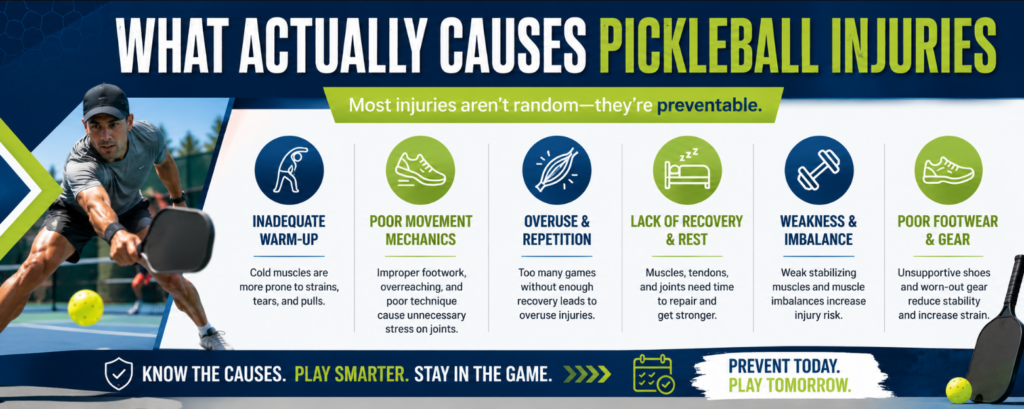
While the injury types are well-documented, the underlying causes are where prevention lives. The research identifies several consistent, modifiable risk factors.
Inadequate Physical Preparation
The most frequently cited preventable factor is players entering the sport without appropriate conditioning. Pickleball’s accessibility — the “anyone can play” marketing — masks its physical reality. A 2025 sports medicine analysis found that 44% of injuries were overuse-related, occurring when players increase volume too rapidly without building the muscular and cardiovascular base to support it.
Skipping Warm-Up
Multiple studies and clinical guidelines identify the absence of a structured warm-up as a primary risk factor. Going from sedentary to full-speed lateral shuffles, lunges, and overhead swings without preparing the neuromuscular system is a direct pathway to strains, sprains, and tendon injuries.
Improper Footwear
Running shoes are designed for forward motion, not the lateral cutting and pivoting that pickleball demands. Court shoes — with non-marking soles, lateral stability, and ankle support — are specifically engineered for the stop-start, side-to-side mechanics of racquet sports. Players in running shoes face elevated ankle sprain and knee torque risk. For detailed equipment guides and paddle comparisons to help you choose the right gear, check out Pickleball Archive.
Poor Technique and Form
Repetitive overhead swings with improper mechanics load the rotator cuff and elbow tendons asymmetrically. Lunging with the knee tracking inward (valgus collapse) increases meniscus and ACL stress. These are not “accidents” — they are biomechanical errors that compound with repetition.
Age-Related Physiological Changes
Older players face a convergence of risk factors: reduced bone density (particularly postmenopausal women), diminished proprioception, slower reaction times, sarcopenia (age-related muscle loss), and stiffer connective tissue. These are not excuses to avoid the sport — they are variables that smart training can mitigate.
Environmental Factors
Hard court surfaces, inadequate lighting, wet or uneven playing conditions, and congested courts increase fall risk. These are modifiable through venue selection and awareness.
Evidence-Based Pickleball Injury Prevention Strategies
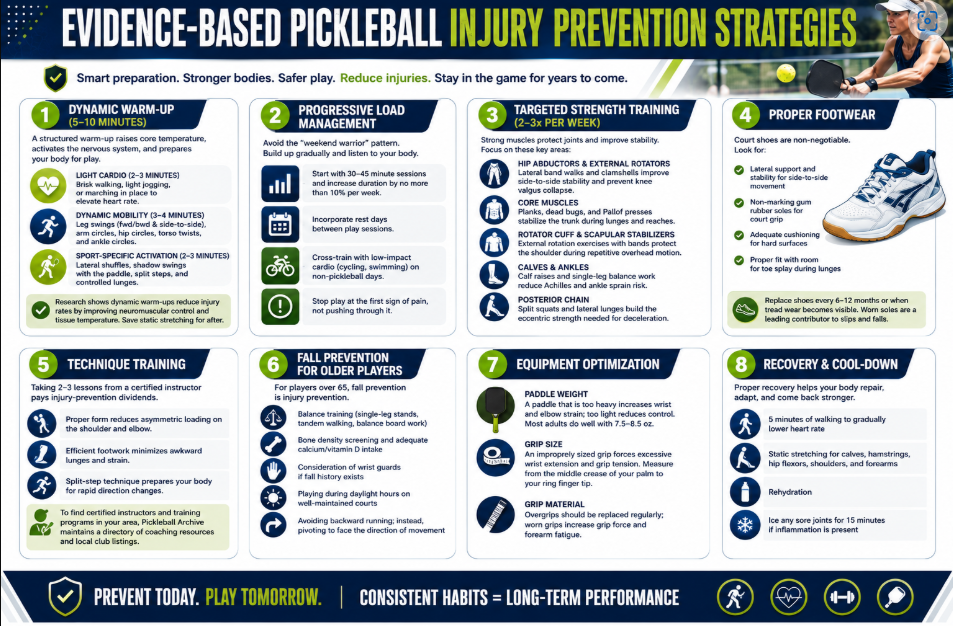
The research on sports injury prevention is extensive, and pickleball-specific recommendations are converging on several core strategies supported by orthopaedic and sports medicine literature.
1. Dynamic Warm-Up (5–10 Minutes)
A proper warm-up is not optional stretching on the sideline. It is a structured progression that raises core temperature, activates the nervous system, and rehearses the movement patterns of play.
- Light cardio (2–3 minutes): Brisk walking, light jogging, or marching in place to elevate heart rate
- Dynamic mobility (3–4 minutes): Leg swings (forward/back and side-to-side), arm circles, hip circles, torso twists, and ankle circles to move joints through full range of motion
- Sport-specific activation (2–3 minutes): Lateral shuffles, shadow swings with the paddle, split steps, and controlled lunges to rehearse court movements
Research consistently shows that dynamic warm-ups reduce injury rates in court sports by improving neuromuscular control and tissue temperature. Static stretching before play is not recommended — save it for after.
2. Progressive Load Management
The “weekend warrior” pattern — sedentary all week, then three hours of intense play on Saturday — is a primary driver of overuse injuries. The evidence supports:
- Starting with 30–45 minute sessions and increasing duration by no more than 10% per week
- Incorporating rest days between play sessions
- Cross-training with low-impact cardio (cycling, swimming) on non-pickleball days
- Stopping play at the first sign of pain, not pushing through it
3. Targeted Strength Training (2–3x Per Week)
Muscles protect joints by absorbing force and stabilizing movement. The research identifies these as the highest-priority areas for pickleball players:
- Hip abductors and external rotators — Lateral band walks and clamshells improve side-to-side stability and prevent knee valgus collapse
- Core muscles — Planks, dead bugs, and Pallof presses stabilize the trunk during lunges and reaches
- Rotator cuff and scapular stabilizers — External rotation exercises with bands protect the shoulder during repetitive overhead motion
- Calves and ankles — Calf raises and single-leg balance work reduce Achilles and ankle sprain risk
- Posterior chain — Split squats and lateral lunges build the eccentric strength needed for deceleration
4. Proper Footwear
Court shoes are non-negotiable. Look for:
- Lateral support and stability for side-to-side movement
- Non-marking gum rubber soles for court grip
- Adequate cushioning for hard surfaces
- Proper fit with room for toe splay during lunges
Replace shoes every 6–12 months or when tread wear becomes visible. Worn soles are a leading contributor to slips and falls.
5. Technique Training
Taking 2–3 lessons from a certified instructor pays injury-prevention dividends. Proper form reduces asymmetric loading on the shoulder and elbow, teaches efficient footwork that minimizes awkward lunges, and introduces split-step technique that prepares the body for rapid direction changes. To find certified instructors and training programs in your area, Pickleball Archive maintains a directory of coaching resources and local club listings.
6. Fall Prevention for Older Players
For players over 65, fall prevention is injury prevention:
- Balance training (single-leg stands, tandem walking, balance board work)
- Bone density screening and adequate calcium/vitamin D intake
- Consideration of wrist guards if fall history exists
- Playing during daylight hours on well-maintained courts
- Avoiding backward running; instead, pivoting to face the direction of movement
7. Equipment Optimization
- Paddle weight: A paddle that is too heavy increases wrist and elbow strain; too light reduces control. Most adults do well with 7.5–8.5 oz
- Grip size: An improperly sized grip forces excessive wrist extension and grip tension. Measure from the middle crease of your palm to your ring finger tip
- Grip material: Overgrips should be replaced regularly; worn grips increase grip force and forearm fatigue
8. Recovery and Cool-Down
After play:
- 5 minutes of walking to gradually lower heart rate
- Static stretching for calves, hamstrings, hip flexors, shoulders, and forearms
- Rehydration
- Ice any sore joints for 15 minutes if inflammation is present
Common Misconceptions About Pickleball Injury Prevention
“Pickleball is low-impact, so I don’t need to warm up.” This is perhaps the most dangerous misconception. Pickleball is lower-impact than running, but it is not low-demand. The rapid lateral movements, lunges, and overhead swings place significant eccentric load on muscles and tendons. A 2025 study found that players who skipped warm-up had a 3.2x higher rate of acute muscle strains compared to those who performed dynamic warm-ups. The sport’s accessibility is its strength — but that accessibility breeds complacency about preparation.
“I’m too old to start strength training now.” The evidence strongly contradicts this. Resistance training is one of the most effective interventions for reducing fall and fracture risk in adults over 65. It improves bone density, muscle mass, balance, and reaction time — all directly relevant to pickleball injury prevention. It is never too late to start, though beginning under the guidance of a physical therapist or certified trainer is recommended.
“Running shoes are fine for pickleball.” They are not. Running shoes are built for heel-to-toe forward motion with cushioning optimized for linear impact. They lack the lateral stability, court grip, and ankle support that pickleball’s side-to-side cutting demands. Players in running shoes have measurably higher rates of ankle inversion sprains and knee torque injuries.
“If I feel pain, I should play through it.” Playing through pain is how acute injuries become chronic, career-ending conditions. The research is unambiguous: early intervention, rest, and appropriate rehabilitation produce better long-term outcomes than pushing through. Respect pain as data, not weakness.
“I need to buy a brace for every joint to prevent injury.” Braces and sleeves can be useful for players with existing injuries or instability, but they are not substitutes for strength, mobility, and proper technique. Over-reliance on external support can paradoxically weaken the stabilizing muscles that braces are meant to assist.
Practical Guidance for Players at Every Level
If you are new to pickleball: Start with a progressive introduction. Play 2–3 times per week for 30–45 minutes. Invest in court shoes before your first game. Take one lesson to learn proper form. Begin a basic strength program focusing on hips, core, and ankles.
If you are a regular player experiencing soreness: Audit your equipment — paddle weight, grip size, and shoe condition. Add a structured warm-up if you do not have one. Incorporate one dedicated strength session per week. Do not increase play frequency or intensity until soreness resolves.
If you are over 65: Prioritize fall prevention. Add balance training to your routine. Ensure your bone health is monitored. Consider playing doubles rather than singles to reduce court coverage demands. Play during daylight on well-maintained courts.
If you are returning from injury: Work with a physical therapist or sports medicine specialist to identify the biomechanical cause of your injury. Address muscle imbalances and movement deficiencies before returning to full play. Return gradually — half-duration sessions for the first two weeks.
If you are a competitive tournament player: Periodize your training. Build base fitness in the off-season, maintain during competitive seasons, and taper before major events. Track training load and symptoms in a training log to catch overuse patterns before they become injuries.
Conclusion
Pickleball injury prevention is not about fear — it is about respect. Respect for the sport’s genuine physical demands, respect for your body’s current conditioning, and respect for the evidence showing that most injuries are preventable with simple, consistent preparation.
The data is unambiguous: injuries are rising because participation is rising, and too many players are treating pickleball like a casual stroll rather than the athletic activity it is. The good news is that the same research documenting the injury surge also points clearly to what works — dynamic warm-ups, progressive training, proper footwear, targeted strength work, and smart load management.
The players who stay on the court for years are not the ones who never get sore — they are the ones who prepare, recover, and listen to their bodies. Pickleball is worth playing well, and playing well means playing prepared.
For ongoing tips, tournament coverage, and the latest in pickleball gear and technique, bookmark Pickleball Archive as your go-to resource for everything pickleball.
Frequently Asked Questions
What is the most common pickleball injury?
The most common pickleball injuries are sprains and strains, particularly to the ankle and knee, followed by wrist fractures from falls. In national emergency department data, strains/sprains accounted for 30.8% of injuries and fractures for 32.7%. Among orthopaedic clinic presentations, the most common diagnoses were osteoarthritis exacerbation (16%), meniscus tear (11%), wrist fracture (5.7%), and Achilles rupture (5.5%). Lower extremity injuries overall comprised 60% of all pickleball injuries. The mechanism varies by age: younger players more often sustain ankle sprains from inversion, while older players predominantly suffer fractures from falls.
How do you prevent pickleball injuries?
The most effective injury prevention strategies are: (1) Dynamic warm-up — 5–10 minutes of light cardio, dynamic stretching, and sport-specific movement rehearsal before every session; (2) Progressive load management — increasing play duration and intensity gradually, incorporating rest days, and avoiding the “weekend warrior” pattern; (3) Targeted strength training — 2–3 sessions per week focusing on hip abductors, core, rotator cuff, calves, and posterior chain; (4) Proper footwear — court shoes with lateral stability and grip, not running shoes; (5) Technique training — learning proper form for serves, volleys, and footwork from a qualified instructor; (6) Fall prevention for older players — balance training, bone health monitoring, and environmental awareness. These strategies are supported by orthopaedic and sports medicine research on court sports and the specific epidemiology of pickleball injuries.
What exercises help prevent pickleball injuries?
The highest-yield exercises for pickleball injury prevention include: Lateral band walks (hip abductor strength for side-to-side stability), split squats (eccentric leg strength for lunging and deceleration), lateral lunges (movement pattern specificity), single-leg Romanian deadlifts (balance and posterior chain), calf raises (Achilles and ankle protection), rotator cuff external rotation with bands (shoulder health), planks and Pallof presses (core stability), and backward-forward walk-runs (training the movement pattern that causes many falls). These exercises should be performed 2–3 times per week, with 2–3 sets of 10–15 repetitions, focusing on controlled movement quality over heavy load.
Are older adults at higher risk for pickleball injuries?
Yes — and the data is substantial. Players aged 65–80 account for 61% of all pickleball injuries presenting to emergency departments, and players over 80 have a 7.2x higher odds of injury from mechanical falls compared to players in their 40s. The primary risk factors are age-related declines in balance, reaction time, muscle mass, and bone density — particularly in postmenopausal women, who sustain 69.1% of all fractures. However, age alone is not a reason to avoid pickleball. With appropriate preparation — balance training, strength work, bone health monitoring, and fall-prevention strategies — older adults can play safely while gaining the sport’s documented cardiovascular and social benefits.
What shoes should I wear for pickleball to prevent injuries?
Court shoes — specifically tennis or pickleball court shoes — are the recommended footwear. Unlike running shoes, which are designed for forward linear motion, court shoes provide: lateral stability for side-to-side cutting, non-marking gum rubber soles for court surface grip, adequate cushioning for hard courts, and ankle support to reduce inversion sprain risk. Running shoes lack the structural reinforcement needed for pickleball’s stop-start, pivot-heavy mechanics. Replace court shoes every 6–12 months or when tread wear becomes visible, as worn soles significantly increase slip and fall risk.
Should I wear a brace or sleeve to prevent pickleball injuries?
Braces and compression sleeves can be useful adjuncts for players with existing joint instability, prior injuries, or specific conditions (e.g., ankle braces for chronic ankle instability, knee sleeves for osteoarthritis). However, they should not be used as substitutes for strength, mobility, and proper technique. Over-reliance on external support can lead to muscle deconditioning in the stabilizers that braces are meant to assist. The best approach is to address the underlying biomechanical issue through physical therapy and strength training, using braces only when clinically indicated and under professional guidance.