Pickleball Lob Defense: The Complete Guide to Neutralizing Lobs and Winning More Points
Key Takeaways
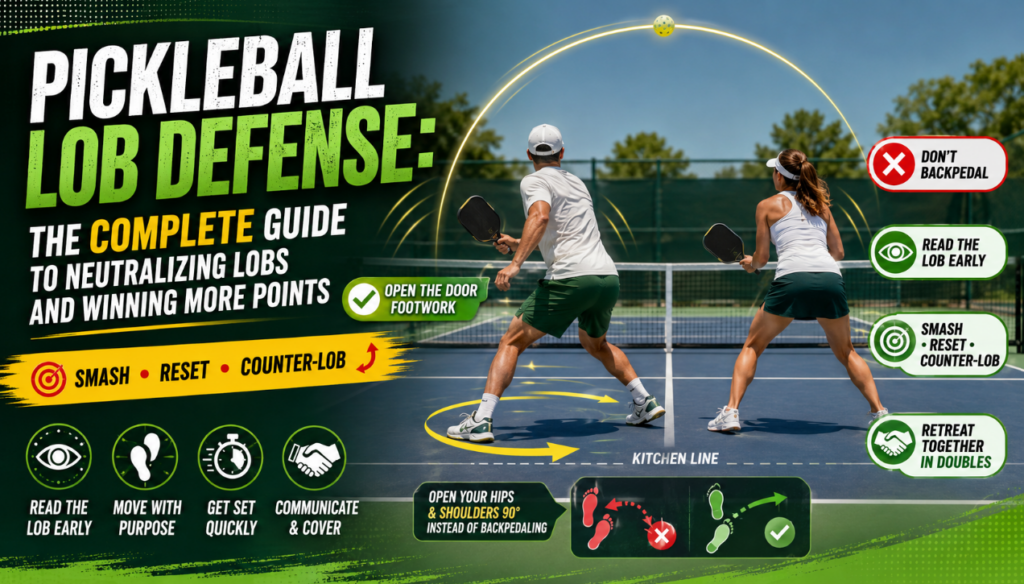
- Backpedaling is the most dangerous mistake you can make when defending a lob — it is the leading cause of falls, wrist breaks, and serious injuries among pickleball players, particularly those over 50
- The “open the door” footwork technique is the safest and most effective way to track a lob — rotating your body 90 degrees to the net instead of moving backward blind keeps you balanced, controlled, and ready to hit
- Anticipation is your first line of defense — reading your opponent’s paddle angle, body position, and weight transfer before they strike the ball gives you a critical head start on every lob
- The type of lob determines your response: midcourt lobs can be taken out of the air with an overhead smash or controlled punch, while deep lobs require you to let them bounce and reset the point with a drop or counter-lob
- Doubles positioning matters — when your partner is lobbed, both players must retreat together to the baseline; staying at the kitchen line while your partner scrambles back leaves you exposed and the point lost
The Direct Answer: Yes, You Can Master Pickleball Lob Defense — And Here’s Exactly How
If you are reading this because lobs are ruining your pickleball experience — making you anxious at the kitchen line, causing you to fall, or simply costing you points you should be winning — the answer is yes, you can defend them effectively.
The lob is one of the most strategically powerful shots in pickleball. When executed well, it forces you off the non-volley zone line (the kitchen), the most advantageous position on the court, and pushes you deep into your own backcourt where your offensive options shrink dramatically. For older players or those with mobility concerns, the lob can feel like a weapon designed specifically against them.
But lob defense is not about athleticism alone. It is about technique, anticipation, positioning, and decision-making — skills that every player can develop regardless of age or physical ability. The right approach to pickleball lob defense does two useful things: it keeps you safe from the falls and injuries that backpedaling produces, and it turns what feels like a defensive nightmare into a manageable, even exploitable, part of your game.
That said, this article will not stop at “keep your eye on the ball” — because the relationship between lob defense, footwork, court positioning, and doubles strategy is genuinely more nuanced than that single piece of advice conveys. Understanding what effective lob defense actually requires — and what common mistakes destroy it — serves players far better than a blanket recommendation to “just run back faster.”
For players looking to optimize every aspect of their defensive game, ensuring your pickleball paddle grip size is correct is foundational. A grip that is too large or too small compromises your ability to generate power on overhead smashes and maintain control on defensive punches — both critical shots in lob defense.
Why Lob Defense Is One of the Most Critical Skills in Pickleball
Pickleball participation has exploded nationally, and with that growth has come an evolution in how the game is played at every level. The lob — once considered a shot for beginners or a desperation tactic — has become a legitimate strategic weapon at all levels of play, from recreational open play to professional tournaments.
The reason is simple: the kitchen line is the most dominant position in pickleball. When both you and your partner are established at the net, you control the pace, the angles, and the pressure. The lob is the single most effective shot for disrupting that control. It forces you to retreat, gives your opponents time to advance, and turns a point you were winning into one where you are scrambling to survive.
For players over 50, who represent a significant and growing portion of the pickleball population, the lob presents an additional challenge: the physical risk of moving backward quickly. One analysis noted that the biggest mistake players make is backtracking while looking up at the ball — moving backward with nothing to stop you if you slip, stub a heel, or lose your balance. That is a recipe for wrist breaks, arm injuries, or worse.
What the lob does and does not do:
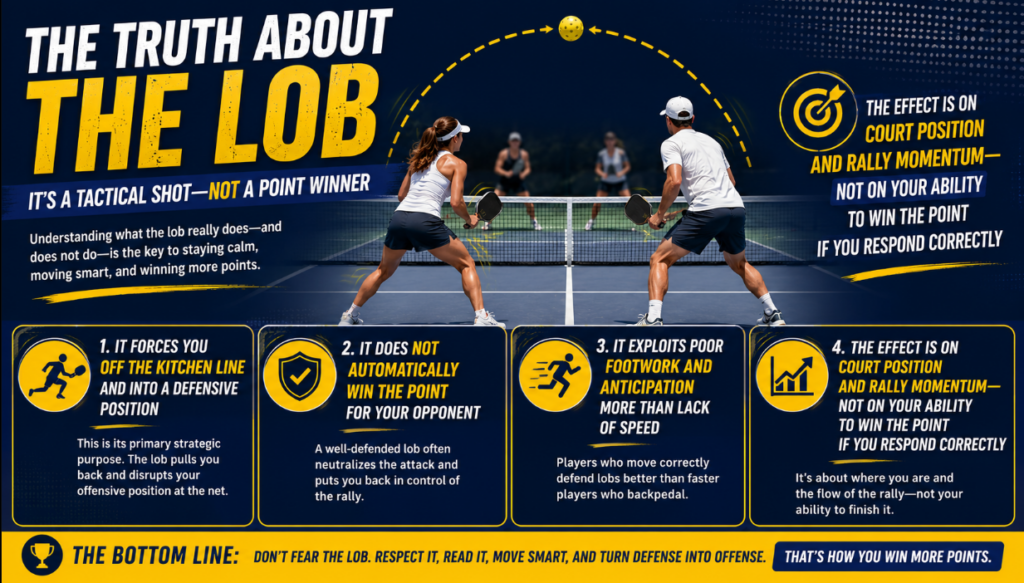
- It forces you off the kitchen line and into a defensive position — this is its primary strategic purpose
- It does not automatically win the point for your opponent — a well-defended lob often puts you back in control
- It exploits poor footwork and anticipation more than it exploits lack of speed — players who move correctly defend lobs better than faster players who backpedal
- The effect is on court position and rally momentum — not on your ability to win the point if you respond correctly
The Most Dangerous Mistake: Why Backpedaling Destroys Lob Defense
Before you learn what to do, you must understand what not to do. And what not to do is backpedal.
Backpedaling — moving backward while facing the net, looking up at the ball — is the single most dangerous movement pattern in pickleball lob defense. When you backpedal, you are moving in a direction your body is not designed to move efficiently. Your center of gravity shifts behind your feet. Your arms flail for balance. Your eyes are on the ball, not on the court surface. If you hit a wet spot, a seam in the surface, or simply lose your balance, there is nothing to catch you.
The injury data is clear: falls during lob defense are among the most common serious injuries in pickleball, and they are almost always caused by backpedaling. Players break wrists trying to catch themselves. They tear rotator cuffs from awkward reaching. They suffer concussions from hitting the back of their heads on the court.
The solution is not to avoid defending lobs. The solution is to replace backpedaling with a fundamentally different movement pattern: opening the door.
The “Open the Door” Technique: Safe, Controlled Lob Defense Footwork
The foundation of safe and effective pickleball lob defense is a footwork technique called “opening the door.” Instead of moving backward while facing the net, you rotate your body 90 degrees so you are facing sideways — parallel to the sideline — and move laterally or forward to track the ball.
Here is how it works step by step:
Step 1: Recognize the lob is coming. This is where anticipation matters, and we will cover the specific cues in the next section. The moment you identify that a lob is likely, you begin your movement.
Step 2: Shift your weight onto your non-dominant leg. This becomes your pivot foot. If you are right-handed, pivot on your left foot. If you are left-handed, pivot on your right foot.
Step 3: Swing your dominant leg back, rotating your body 90 degrees. Your hips and shoulders should now be perpendicular to the net, facing the sideline. This is “opening the door” — you have created a stable, balanced base from which you can move in any direction.
Step 4: Track the ball with your eyes while moving. Because you are now facing sideways, your natural movement pattern is lateral (side-to-side) or forward, not backward. You can shuffle, cross-step, or even run forward if the lob is short. You are never moving in the dangerous backward direction.
Step 5: Prepare your paddle. With your body now sideways, your paddle is naturally positioned for either an overhead smash (if you can get under the ball before it bounces) or a controlled groundstroke (if you need to let it bounce).
The key advantage of this technique is that your center of gravity remains over your feet at all times. You are balanced. You can stop instantly if needed. You can change direction. And you are never moving blind into open space.
As you prepare your paddle during the open-the-door rotation, your grip becomes critically important. An incorrect pickleball paddle grip size can cause your paddle to twist in your hand when you make contact, especially on defensive shots where you may be slightly off-balance. A properly sized grip ensures the paddle face stays square through contact, giving you the control needed to place your return accurately.
Anticipation: Reading the Lob Before It Happens
The best lob defense begins before your opponent hits the ball. Anticipation is not guesswork — it is pattern recognition based on observable cues that experienced players learn to read automatically.
Paddle angle cues: The angle of your opponent’s paddle face at contact is the most reliable indicator of shot type. An open paddle face (angled upward) typically signals a dink or drop shot. A closed paddle face (angled downward) often signifies a drive or speed-up. For a lob, the paddle face is usually open but with a more vertical trajectory, and the contact point is slightly farther back in the stroke.
Body position cues: Players preparing to lob often exhibit specific body language. They may shift their weight slightly backward. Their shoulders may rotate more vertically than horizontally. Their non-dominant arm may extend higher as a counterbalance. The follow-through preparation looks more upward than forward.
Situational cues: Lobs rarely come out of nowhere. They are most commonly hit during extended dink rallies at the kitchen line, when opponents are leaning forward and anticipating continued soft play. They are also common when a player is off-balance or out of position and needs to buy time. Recognizing these situations primes you to expect the lob.
The “tell” of disguise failure: Even experienced players struggle to completely disguise a lob. The backswing is often slightly longer. The knee bend is deeper. The eyes may flick upward momentarily to check ceiling height (indoor play) or sun position (outdoor play). These micro-signals are readable with practice.
The practical implication is clear: the more time you spend watching your opponent’s preparation rather than the ball itself during the rally, the earlier you will recognize the lob and the more time you will have to open the door and get into position.
Midcourt Lob vs. Deep Lob: Two Different Defensive Responses
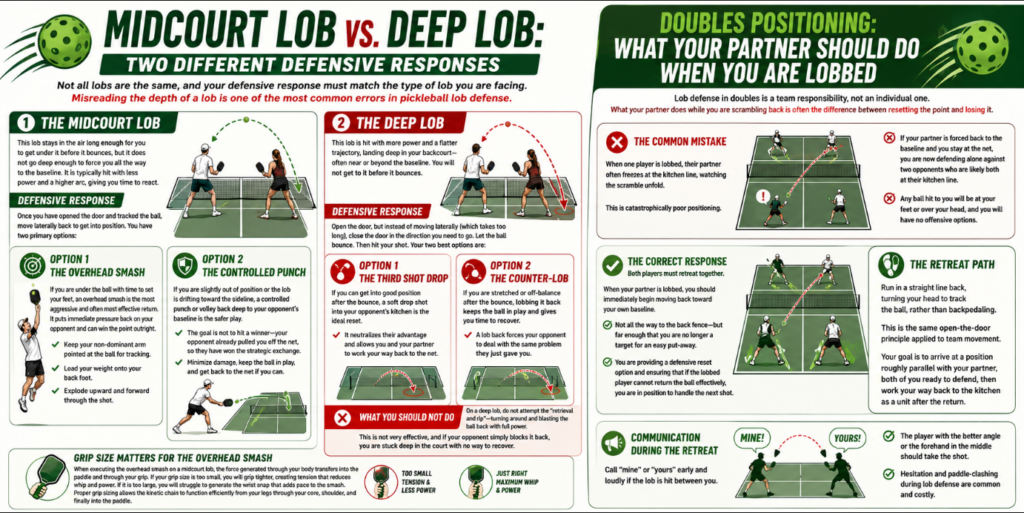
Not all lobs are the same, and your defensive response must match the type of lob you are facing. Misreading the depth of a lob is one of the most common errors in pickleball lob defense.
The midcourt lob
This lob stays in the air long enough for you to get under it before it bounces, but it does not go deep enough to force you all the way to the baseline. It is typically hit with less power and a higher arc, giving you time to react.
Defensive response: Once you have opened the door and tracked the ball, move laterally back to get into position. You have two primary options:
- The overhead smash: If you are under the ball with time to set your feet, an overhead smash is the most aggressive and often most effective return. It puts immediate pressure back on your opponent and can win the point outright. Keep your non-dominant arm pointed at the ball for tracking, load your weight onto your back foot, and explode upward and forward through the shot.
- The controlled punch: If you are slightly out of position or the lob is drifting toward the sideline, a controlled punch or volley back deep to your opponent’s baseline is the safer play. The goal is not to hit a winner — your opponent already pulled you off the net, so they have won the strategic exchange. What you are doing is minimizing damage, keeping the ball in play, and getting back to the net if you can.
The deep lob
This lob is hit with more power and a flatter trajectory, landing deep in your backcourt — often near or beyond the baseline. You will not get to it before it bounces.
Defensive response: Open the door, but instead of moving laterally (which takes too long), close the door in the direction you need to go. Let the ball bounce. Then hit your shot. Your two best options are:
- The third shot drop: If you can get into good position after the bounce, a soft drop shot into your opponent’s kitchen is the ideal reset. It neutralizes their advantage and allows you and your partner to work your way back to the net.
- The counter-lob: If you are stretched or off-balance after the bounce, lobbing it back keeps the ball in play and gives you time to recover. This is not a glamorous shot, but it is often the correct one. A lob back forces your opponent to deal with the same problem they just gave you.
What you should not do on a deep lob is attempt the “retrieval and rip” — turning around and blasting the ball back with full power. This is not very effective, and if your opponent simply blocks it back, you are stuck deep in the court with no way to recover.
When executing the overhead smash on a midcourt lob, the force generated through your body transfers into the paddle and through your grip. If your pickleball paddle grip size is too small, you will grip tighter to compensate, creating tension in your forearm that reduces whip and power. If it is too large, you will struggle to generate the wrist snap that adds pace to the smash. Proper grip sizing allows the kinetic chain to function efficiently from your legs through your core, shoulder, and finally into the paddle.
Doubles Positioning: What Your Partner Should Do When You Are Lobbed
Lob defense in doubles is a team responsibility, not an individual one. What your partner does while you are scrambling back is often the difference between resetting the point and losing it.
The common mistake: When one player is lobbed, their partner often freezes at the kitchen line, watching the scramble unfold. This is catastrophically poor positioning. If your partner is forced back to the baseline and you stay at the net, you are now defending alone against two opponents who are likely both at their kitchen line. Any ball hit to you will be at your feet or over your head, and you will have no offensive options.
The correct response: Both players must retreat together. When your partner is lobbed, you should immediately begin moving back toward your own baseline. Not all the way to the back fence — but far enough that you are no longer a target for an easy put-away. You are providing a defensive reset option and ensuring that if the lobbed player cannot return the ball effectively, you are in position to handle the next shot.
The retreat path: Run in a straight line back, turning your head to track the ball, rather than backpedaling. This is the same open-the-door principle applied to team movement. Your goal is to arrive at a position roughly parallel with your partner, both of you ready to defend, then work your way back to the kitchen as a unit after the return.
Communication during the retreat: Call “mine” or “yours” early and loudly if the lob is hit between you. The player with the better angle or the forehand in the middle should take the shot. Hesitation and paddle-clashing during lob defense are common and costly.
The Mental Shift: From Defensive Panic to Strategic Opportunity
The most underrated aspect of pickleball lob defense is mindset. Players who fear the lob make it more effective than it actually is. Players who approach it as a manageable part of the game — even an opportunity — defend it better.
The panic response: When lobbed, many players feel they must hit a winner to compensate for being pushed back. They swing too hard, take too much risk, and either miss outright or hit a weak return that their opponent attacks. This is the wrong approach.
The strategic response: Your opponent has already won the strategic exchange by pulling you off the kitchen line. Accept this. Your job is not to win the point from a defensive position — it is to survive the exchange, reset the point, and work your way back to the net where you can resume your offensive position. A well-placed drop shot, a controlled deep return, or even a counter-lob that forces your opponent to retreat as well — these are winning plays, even if they do not produce immediate points.
The player who stays calm, makes the high-percentage shot, and trusts their footwork will win more points over time than the player who panics and goes for broke.
Common Misconceptions About Pickleball Lob Defense
“I am too slow to defend lobs effectively.” Speed helps, but it is not the primary factor in lob defense. Anticipation, footwork technique, and decision-making matter far more than raw speed. Players who open the door correctly and read the lob early consistently defend better than faster players who backpedal blindly. If you are over 50, the open-the-door technique is specifically designed to protect you from the falls and injuries that backpedaling causes.
“I should always try to smash a lob back.” The overhead smash is the most satisfying response to a lob, but it is not always the correct one. If you are off-balance, stretched, or the lob is drifting toward the sideline, attempting a smash often produces an error. The controlled punch, the drop shot, or even the counter-lob are frequently higher-percentage plays. Shot selection discipline separates good lob defenders from reckless ones.
“My partner should stay at the net while I run back.” This is perhaps the most common and most damaging misconception in doubles lob defense. A player staying at the net while their partner retreats is a sitting duck. The correct team response is coordinated retreat, followed by coordinated advance back to the kitchen. Doubles is a partnership; lob defense must be treated as a team skill, not an individual one.
“I can just backpedal quickly if I practice it.” No amount of practice makes backpedaling safe or efficient for lob defense. The biomechanics are wrong: your center of gravity is behind your base of support, your vision is compromised, and your ability to change direction is eliminated. The open-the-door technique replaces a dangerous movement pattern with a safe one. It is not a matter of practice — it is a matter of choosing the correct technique.
“Lobs are only a problem for older players.” While older players are more vulnerable to the physical risks of poor lob defense, lobs are strategically effective against players of all ages. Young, fast players who have not developed proper anticipation and footwork are routinely beaten by well-placed lobs. The lob is a universal weapon; lob defense is a universal necessity.
Practical Guidance for Players at Every Level
If you are a beginner (under 1 year of play): Focus entirely on footwork safety. Do not worry about hitting overheads or aggressive returns yet. Your priority is eliminating backpedaling from your movement patterns and replacing it with the open-the-door technique. Practice shadow drills: have a partner or coach simulate a lob without a ball, and rehearse opening the door, tracking, and moving laterally. Do this until it becomes automatic. The injury data shows that less experienced players are at the highest risk for falls during lob defense because they have not yet developed safe movement habits.
For beginners still dialing in their equipment, taking the time to find your correct pickleball paddle grip size is one of the highest-return investments you can make. A grip that fits your hand properly reduces fatigue during long sessions, prevents elbow and wrist strain, and gives you the confidence to attempt defensive shots without worrying about the paddle slipping.
If you are an intermediate player (1–4 years of play): Add anticipation to your footwork. Begin watching your opponents’ paddle angles and body positions during dink rallies. Practice recognizing the difference between midcourt lobs and deep lobs, and make your shot selection accordingly. Work on the controlled punch and the third shot drop as your primary defensive returns. Your goal is not to hit winners from a defensive position — it is to reset the point and get back to the kitchen.
If you are an advanced player (5+ years of play): Refine your counter-attacking options. Develop the ability to hit an offensive lob of your own as a response, turning defense into immediate offense. Work on disguising your own lobs so your opponents cannot read them. Practice the split-step timing that allows you to react instantly to lobs while maintaining kitchen line pressure. Your experience is protective, but advanced opponents will lob more effectively — your defense must keep pace.
If you only have limited time to practice: Spend 10 minutes per session on shadow footwork drills. Open the door, move laterally, and simulate tracking lobs from both the forehand and backhand sides. Then spend 10 minutes on live lob defense: have a partner hit lobs to you while you practice the full sequence — anticipation, footwork, shot selection, and recovery. Consistent, focused practice on these two elements will improve your lob defense more than playing full games without specific attention to the skill.
If you are returning from a fall or injury related to lob defense: Consult a physical therapist before resuming play. Address any balance deficits, lower-body strength limitations, or vestibular issues that may have contributed to the fall. When you return, start with shadow drills only — no live balls — until your movement patterns feel automatic and safe. A structured rehabilitation protocol is part of recovery; rushing back to full play risks re-injury.
The Bottom Line
Pickleball lob defense is not a luxury skill or an afterthought. It is a fundamental competency that every player must develop to compete effectively and stay safe on the court.
The open-the-door footwork technique — rotating your body 90 degrees to the net instead of backpedaling — is the single most important change you can make. It eliminates the falls and injuries that ruin players’ enjoyment of the game, and it provides a stable platform from which to hit effective returns.
Anticipation, shot selection, and doubles positioning build on that foundation. Reading your opponent’s cues before they hit the lob gives you time. Choosing the right return — smash, punch, drop, or counter-lob — based on the lob’s depth keeps you in the point. Retreating and advancing as a team in doubles ensures you are never defending alone.
The lob will not disappear from pickleball. As the game evolves and players at every level become more tactically sophisticated, lobs will only become more common. Players who master lob defense will not only avoid the frustration and injuries that lobs cause — they will turn what their opponents intended as a weapon into an opportunity for their own advantage.
Control, safety, and strategic patience begin with your first step.
For players committed to refining every detail of their defensive game, understanding how pickleball paddle grip size affects your ability to execute under pressure is essential. The right grip size ensures that when you do get into position to defend a lob, your paddle becomes an extension of your arm rather than a liability.
Frequently Asked Questions
What is the safest way to defend a lob in pickleball?
The safest way to defend a lob is the “open the door” footwork technique. Instead of backpedaling — which is the leading cause of falls and serious injuries in pickleball — you rotate your body 90 degrees to the net by pivoting on your non-dominant foot and swinging your dominant leg back. This creates a stable, balanced position from which you can move laterally or forward to track the ball. You are never moving backward blind, which eliminates the risk of losing your balance and falling. This technique is especially critical for players over 50, who represent the demographic most vulnerable to lob-related injuries.
Should I always try to smash a lob back?
No — the overhead smash is the most aggressive response to a lob, but it is not always the correct one. If you are well-positioned under a midcourt lob with time to set your feet, a smash is an excellent option that can win the point outright. However, if you are off-balance, stretched toward the sideline, or the lob is deep and forcing you near the baseline, attempting a smash often produces an error. In those situations, the higher-percentage plays are a controlled punch deep to your opponent’s baseline, a third shot drop into their kitchen to reset the point, or even a counter-lob that buys you time to recover. Shot selection discipline — choosing the right return for the situation — is what separates good lob defenders from reckless ones.
How do I anticipate a lob before my opponent hits it?
Anticipation comes from reading three categories of cues. First, paddle angle cues: an open paddle face with a more vertical trajectory and a contact point slightly farther back in the stroke often signals a lob. Second, body position cues: weight shifting slightly backward, shoulders rotating more vertically, and a deeper knee bend than a normal dink. Third, situational cues: lobs are most commonly hit during extended dink rallies when opponents are leaning forward, or when a player is off-balance and needs to buy time. Even experienced players struggle to completely disguise a lob — look for a slightly longer backswing or a momentary upward flick of the eyes to check ceiling height or sun position. The more you watch your opponent’s preparation rather than the ball itself, the earlier you will recognize the lob.
What should my doubles partner do when I am lobbed?
Your partner should retreat with you, not stay at the kitchen line. The most common and damaging mistake in doubles lob defense is for the non-lobbed player to freeze at the net while their partner scrambles back. This leaves the net player as a sitting duck — any ball hit to them will be at their feet or over their head, and they will have no offensive options. The correct response is coordinated retreat: both players move back toward the baseline together, providing defensive support and ensuring that if the lobbed player cannot return the ball effectively, the partner is in position to handle the next shot. After the return, both players work their way back to the kitchen as a unit. Communication — calling “mine” or “yours” early and loudly — prevents hesitation and paddle-clashing during the exchange.
What is the difference between a midcourt lob and a deep lob, and how do I defend each?
A midcourt lob stays in the air long enough for you to get under it before it bounces, but does not force you all the way to the baseline. Defend it by opening the door, moving laterally back, and either hitting an overhead smash (if well-positioned) or a controlled punch/volley deep to your opponent’s baseline. Your goal is to keep the ball in play and get back to the net. A deep lob is hit with more power and a flatter trajectory, landing near or beyond your baseline. You will not reach it before it bounces. Defend it by opening the door, letting the ball bounce, and then hitting either a third shot drop to reset the point or a counter-lob to buy time. Avoid the “retrieval and rip” — turning around and blasting the ball back with full power — as this often produces errors or weak returns that your opponent attacks.