Pickleball Net Height Rules: What USA Pickleball Actually Requires
Key Takeaways
● Regulation pickleball net height is 36 inches at the sideline posts and 34 inches at the center — the same spec across singles, doubles, and every USA Pickleball–sanctioned format
● The center sits 2 inches lower than the posts by design, and a center strap is required in sanctioned play to hold that sag in place
● The current rulebook allows a small measurement tolerance — ±1/4 inch on net height and ±1 inch on post-to-post spacing — a change first introduced for 2025 and carried into the 2026 rulebook
● A tennis net measures 42 inches at the posts and 36 inches at the center, so a converted tennis court needs its net adjusted down before pickleball play is legal
● Net height rule proposals for the 2027 rulebook opened for public comment in spring 2026, but as of this update, no change has been made to the core 36″/34″ measurement
The Direct Answer: Pickleball Net Height Is 36″ at the Posts, 34″ at the Center
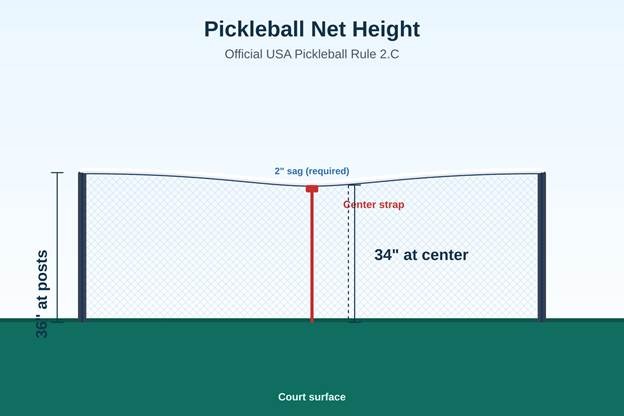
If you’re setting up a court, buying a net, or settling an argument mid-game, here’s the number that matters: the official pickleball net height is 36 inches at the sideline posts and 34 inches at the center of the court, measured straight up from the playing surface to the top of the net.
This is not a rough guideline. It’s a specific, enforced measurement written into the USA Pickleball rulebook, and it applies the same way whether you’re playing a casual game at a public park or competing in a sanctioned tournament. Get it wrong and you’re not just bending a rule — you’re changing how the ball actually behaves when it crosses the net.
The rest of this guide covers where that number comes from, how it compares to other net sports, what changed most recently, and how to check it yourself in under two minutes.
Pickleball Net Height Basics
Before you can set up a net correctly, it helps to understand what the rule is actually measuring and why the number isn’t a single flat height.
What the Official Rule Actually Says
Under the net specifications in the USA Pickleball rulebook, the net must measure 36 inches at the sideline posts and 34 inches at the center of the court. Both measurements are taken from the court surface to the top of the net.
Pickleball is not alone in using an uneven net height. The 2-inch difference between the posts and the center is intentional, not a manufacturing quirk — it’s built into the rule itself, and a net that reads 36 inches all the way across is technically out of spec, not extra-legal.
Why the Net Dips 2 Inches at the Center
The lower center exists because that’s where most of the shot-making happens. Dinks, third-shot drops, and low cross-court drives all travel through the middle third of the court far more often than they clip the net near the posts. A slightly lower center gives players a little more room to keep the ball low without hitting the net, which supports the soft, patient style of play that defines the non-volley zone battle.
To hold that dip in place, sanctioned nets use a center strap — a strap or clip anchored to the court surface that pulls the middle of the net down to 34 inches and keeps it there through a match. Without it, most nets naturally sag unevenly or ride up as the net cable stretches, which is exactly the inconsistency the rule is designed to prevent.
Net Width and Post Placement
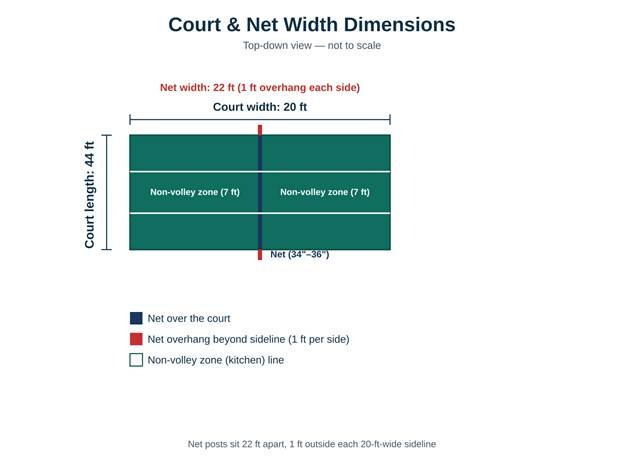
The net itself spans 22 feet, which is wider than the court. A regulation pickleball court is 20 feet wide, so the net extends 1 foot beyond each sideline. That overhang matters for anyone building a permanent setup, since the posts themselves sit outside the playing lines, not on them.
● Court width: 20 feet
● Net width (post to post): 22 feet
● Overhang beyond each sideline: 1 foot
● Net post diameter: no more than 3 inches
Pickleball Net Height vs. Tennis Net Height
Because so many pickleball courts started life as tennis courts, this is one of the most common points of confusion for new players and anyone converting a court for the first time.
The Numbers Side by Side
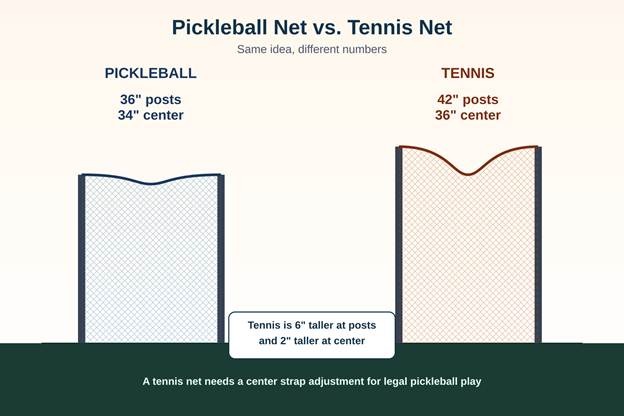
● Tennis net: 42 inches at the posts, 36 inches at the center
● Pickleball net: 36 inches at the posts, 34 inches at the center
That means a tennis net is 6 inches taller at the posts and 2 inches taller at the center than a regulation pickleball net. Even the shortest point on a tennis net — the center — is still 2 inches higher than the tallest legal point on a pickleball net. If you’ve ever played pickleball on an unmodified tennis net, every shot you hit was clearing a bar that was too high by regulation.
Converting a Tennis Court for Pickleball Play
Most temporary or backyard pickleball setups start as a tennis net with a center strap added. If you’re converting a tennis court for pickleball play that’s a workable fix, and it’s the standard method recreational facilities use to run pickleball on shared courts. The strap pulls the center down to 34 inches, but the posts stay at 42 inches — 6 inches taller than a true pickleball net.
For casual play, that’s usually close enough not to matter. For anything competitive, it changes the game near the sidelines, where a taller post gives defenders more net to hide behind on wide shots. A dedicated, portable pickleball net is the more reliable option if the court will see regular pickleball use, since it’s built to the correct height at every point, not just the center.
The 2026 Rulebook: What’s Current and What’s Changing
USA Pickleball revises its rulebook every year, and net specifications get a fresh look along with everything else. Here’s what’s actually in effect for 2026, and what’s being discussed for next season.
Current Tolerances: The Quarter-Inch and One-Inch Rules
A rule change first introduced for the 2025 season, and carried forward into the current 2026 rulebook, added a small measurement tolerance that didn’t exist before. Under Rule 2.C.5, net height is allowed to vary by up to a quarter inch (±1/4″) from the 34-inch center target. Under Rule 2.C.2, post-to-post spacing is allowed to vary by up to 1 inch from the standard 22-foot width.
In practical terms: a net measuring 34.25 inches at the center is legal for sanctioned play. A net measuring 34.5 inches is not. These tolerances exist because even a well-maintained net can drift slightly from temperature, humidity, or repeated tensioning — the rule accounts for real-world measurement variation without opening the door to nets that are meaningfully out of spec.
The “Droopy Net” Rule
A related rule, added to the rulebook to address nets that sag out of tolerance mid-match, requires players or officials to flag and correct a net that has drifted below its legal height during play — rather than finishing a game or match on a net that’s known to be out of spec. If a net sags noticeably during a match, the correct move is to stop and re-measure it, not to play through it and sort it out afterward.
What’s Being Proposed for Next Season
USA Pickleball runs an annual public comment process for rule changes, and the window for the 2027 rulebook opened April 1, 2026, and ran through June 2, 2026, with public comments accepted through mid-June. Net height has been a subject of past submissions in that process — including proposals connected to the existing Rule 2.C.5 tolerance — but as of this update, no proposal has changed the core 36-inch post / 34-inch center measurement that’s been in place for years. If that changes, it will show up in the 2027 rulebook, not before.
The practical takeaway for players heading into the rest of 2026: the numbers you should be checking on your net right now are still 36 inches and 34 inches, with the quarter-inch tolerance in Rule 2.C.5 as your only real wiggle room.
How to Measure and Set Up Your Net Correctly
Checking net height correctly takes less time than most people assume, and it settles far more disputes than it causes.
Step-by-Step Measuring Method
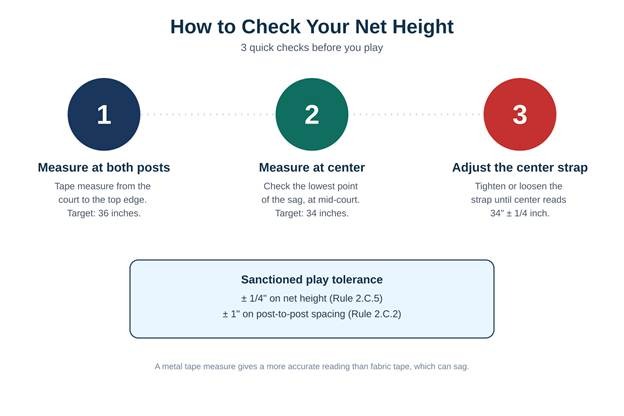
● Use a rigid or metal tape measure. A fabric tape can sag under its own weight and throw off a reading by a quarter inch or more — exactly the margin the tolerance rule is built around.
● Measure at both posts first. Stand the tape at the base of each post and read straight up to the top edge of the net. Both sides should read 36 inches.
● Measure at the exact center of the court, not just the middle of the net span. The center strap should hold this point at 34 inches.
● Adjust the strap, not the posts, if the center reading is off. Post height rarely drifts; center sag is almost always the culprit when a net measures wrong.
● Re-check after extended play, especially outdoors. Heat, wind, and repeated ball contact can loosen a center strap over a long session.
Common Setup Mistakes That Get Missed
● Skipping the center strap entirely — without it, most nets ride high at the center, sometimes by a full inch or more
● Measuring only at the posts and assuming the center is correct — the two numbers are independent and both need to be checked
● Using a repurposed tennis net without adjustment — the posts stay 6 inches too tall even after the center strap is added
● Trusting a net that “looks about right” — a net that’s off by an inch is visually hard to spot but changes ball trajectory in a way players notice immediately
Conclusion
Pickleball net height comes down to two numbers: 36 inches at the posts, 34 inches at the center, held in place by a required center strap and, as of the current rulebook, allowed a quarter-inch of measurement tolerance. That’s the standard whether you’re playing a casual weekend match or a sanctioned tournament, and it hasn’t changed heading into the back half of 2026, even as USA Pickleball works through its usual cycle of annual rule proposals.
Getting the height right isn’t just about following the rulebook for its own sake. A net that’s too high steals easy points from players who are hitting good shots; a net that’s too low changes the geometry of nearly every dink and drops near the kitchen line. Two minutes with a tape measure before you play settles the question for good.
About this guide: This article was fact-checked against the current USA Pickleball official rulebook and cross-referenced with USA Pickleball’s public rule change database. Last verified: May 2026. Rules are reviewed by USA Pickleball on an annual cycle — always confirm net specifications against the current rulebook at usapickleball.org before sanctioned play, since minor tolerance and clarification updates can occur between editions.
Frequently Asked Questions
What is the correct height of a pickleball net?
The correct height of a regulation pickleball net is 36 inches at the sideline posts and 34 inches at the center of the court, measured from the court surface to the top of the net. This applies to singles and doubles play alike and is the same specification used at every level of USA Pickleball–sanctioned competition. The current rulebook permits a small tolerance of up to a quarter inch on the center measurement, so a net reading between 33.75 and 34.25 inches at the center is considered legal.
Is a pickleball net the same height as a tennis net?
No. A tennis net is taller at every point: 42 inches at the posts and 36 inches at the center, compared to 36 inches and 34 inches for a pickleball net. That’s a 6-inch difference at the posts and a 2-inch difference at the center. Courts converted from tennis to pickleball typically use a center strap to pull the middle of the tennis net down to the correct 34-inch height, but the posts remain 6 inches taller than a true pickleball net unless the net itself is replaced.
Can I use a tennis net for pickleball?
You can, and many recreational facilities do, but it isn’t a fully regulation setup. Adding a center strap brings the center down to the legal 34 inches, which is usually close enough for casual play. The posts, however, stay at tennis height (42 inches) unless the net is swapped out, which changes the geometry of shots hit closer to the sidelines. For any competitive or sanctioned play, a dedicated pickleball net built to the correct height at every point is the standard.
What happens if the net is the wrong height during a match?
In sanctioned play, a net that sags or drifts out of the legal height range during a match should be flagged and corrected before play continues, rather than played through. USA Pickleball’s rules address this scenario directly, treating an out-of-tolerance net as something to fix immediately rather than a minor detail to sort out after the match. In casual or recreational play, there’s no formal enforcement, but a net that’s off by more than an inch will noticeably change how shots near the net behave, so it’s worth a quick re-check.
Who decided pickleball net height should be 34 inches?
The 34-inch center height traces back to pickleball’s origins in 1965 on Bainbridge Island, Washington, where the sport’s co-inventors adapted a badminton net for their new game. Badminton’s regulation net height was too high for the low, slow style of play they were developing, and the net was lowered to a more workable height — an adjustment that, according to widely repeated accounts of the sport’s early history, roughly matched co-inventor Joel Pritchard’s waist level. That practical, trial-and-error origin became the standardized measurement that USA Pickleball formalized as the sport grew into an organized, rule-governed game.