How Wide Is a Pickleball Net: Official Dimensions and Setup Guide
A pickleball net is exactly 20 feet wide, stretching across the full court width. Understanding how wide is a pickleball net helps you grasp court layout and game strategy. The net height is 36 inches at the sidelines and 34 inches at the center, creating the distinctive dip that defines modern pickleball play.
Key Takeaways
- A pickleball net measures 20 feet in width and must meet strict height specifications at multiple points.
- Net height at the sidelines must be 36 inches, while the center dip should measure 34 inches for regulation play.
- The net divides the court into two 10-foot-by-22-foot halves, creating symmetric playing areas on each side.
- Portable and permanent nets vary in quality, materials, and price, ranging from $100 to over $500.
- Proper net setup and tension affect serve success rates, rally outcomes, and overall game fairness.
- Tournament play requires certified nets that meet USPA and IFP specifications.
Understanding Pickleball Court Layout and How Wide Is a Pickleball Net
The pickleball net serves as the centerpiece of court design. Understanding how wide is a pickleball net helps you visualize the entire playing surface. A regulation pickleball court measures 20 feet wide by 44 feet long, making it roughly one-third the size of a tennis court.
The net divides this space into two identical 20-foot-by-22-foot playing areas. The net sits positioned at the midpoint. The 20-foot width matches the court width exactly, meaning the net extends from sideline to sideline without any gaps.
This precision is critical because any gap would allow balls to pass through. Most recreational players don’t think much about net placement until they’re setting up their own court. They want to understand how wide is a pickleball net and why it matters.
When you’re playing pickleball, the net sits approximately 2 feet above the kitchen line on each side. The kitchen (or non-volley zone) extends 7 feet from the net on both sides. This creates a no-volley buffer that defines much of pickleball strategy.
The exact positioning of the net must remain consistent for fair play. All courts need identical net placement relative to the baseline, kitchen line, and sidelines.
Official Net Height Specifications for a Pickleball Net
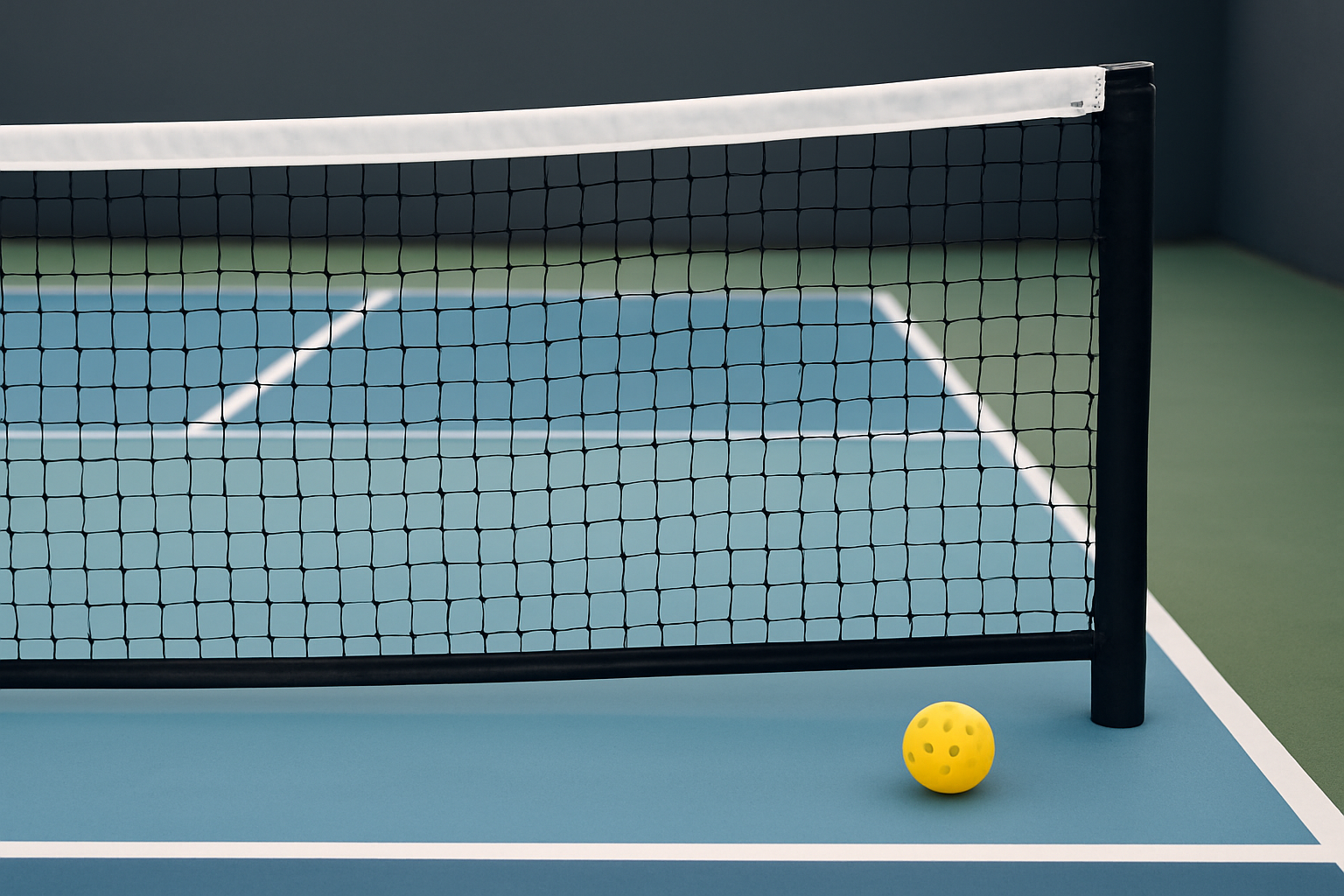
The height of your pickleball net isn’t uniform across its width. This sloped design distinguishes pickleball from tennis. At both sidelines, the net must measure exactly 36 inches from the ground to the top.
At the center point (middle of the net running the 20-foot width), the net should measure 34 inches. This 2-inch difference creates a slight sag or dip in the middle. That dip affects gameplay significantly.
When you’re hitting a drop shot, the lower center point gives you a slightly better margin for error. You gain this advantage compared to hitting near the sidelines. Conversely, when your opponent is hitting from near the net, the lower center height makes winning shots harder for them.
The USPA and IFP both specify these exact measurements. Tournaments require officials to measure nets before play using specialized measuring tools. Recreational facilities are more flexible, but serious players should maintain these specs.
Playing on an incorrectly tensioned or sagging net develops bad habits. These habits penalize you on regulation courts. Net height matters for serving too. Your serve must clear the net and land diagonally in the opponent’s service box.
If the net is too high, serves become easier. If it’s too low, you might hit the net on serves you’d normally clear. Consistency across all courts ensures your stroke development translates everywhere.
Portable vs. Permanent Pickleball Nets: How Wide Is a Pickleball Net Setup
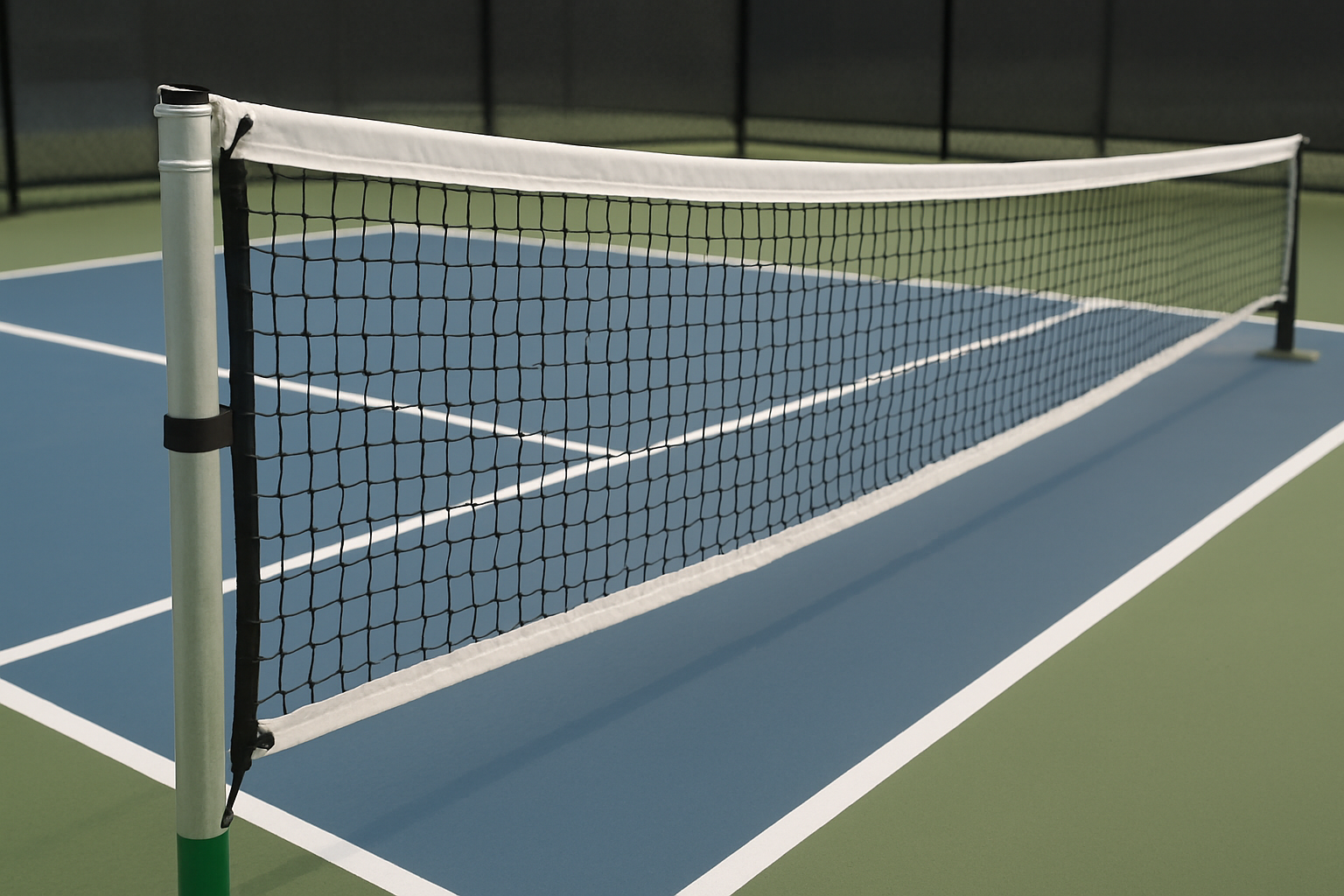
When you’re setting up for recreational play, you have two main net options. Portable systems and permanent installations serve different purposes. Each comes with distinct advantages and limitations.
Portable nets are designed for flexibility and ease of setup. They typically weigh between 10 and 25 pounds and fold down for transport. Most portable pickleball nets come with carrying bags, making them ideal for players who want to set up temporary courts at parks, driveways, or community spaces.
The price range for quality portable nets spans from approximately $100 to $300. Brands like Pickle Pro, Triumph Sports, and Franklin offer well-reviewed models. These models maintain proper height and tension without requiring permanent court modifications.
The main drawback of portable nets is stability. Wind, aggressive play, or improper anchoring can cause them to shift or sag. Players using portable nets often employ sandbags, stakes, or weighted bases to maintain proper tension. In tournaments, portable nets are less common because they can’t guarantee stable, consistent specs.
Permanent nets are installed on dedicated courts. They typically cost between $300 and $600. These systems use metal posts, professional-grade netting material, and permanent anchoring systems. Once installed, permanent nets require minimal adjustment. They maintain consistent height and tension throughout their lifespan, which often extends 5 to 10 years.
Weather exposure and maintenance affect permanent net lifespan. Facilities like indoor recreation centers, sports clubs, and dedicated pickleball venues invest in permanent systems. They offer reliability and professional appearance for these locations.
Installation of permanent nets requires proper spacing of posts (matching the 20-foot width). Concrete footings ensure stability. Appropriate net height calibration is essential. Once up, maintenance is straightforward: occasional cleaning and tension checks ensure optimal performance.
The investment pays off for facilities hosting leagues. Tournaments and heavy daily use benefit from permanent net systems.
| Specification | Portable Nets | Permanent Nets |
|---|---|---|
| Typical Cost | $100-$300 | $300-$600 |
| Setup Time | 5-15 minutes | 1-2 hours (professional installation) |
| Weight | 10-25 lbs | 50+ lbs (frame and hardware) |
| Stability | Moderate (with anchors) | Excellent |
| Portability | High | None |
| Lifespan | 3-5 years | 5-10 years |
| Best For | Recreational, casual play | Facilities, leagues, tournaments |
How Net Width Affects Playing Strategy
Understanding that your pickleball net is exactly 20 feet wide helps you develop more strategic shot selection. The width of the net creates specific positioning challenges. Experienced players exploit these challenges.
When you’re at the baseline, the full 20-foot width means you have significant lateral space to cover. A well-placed crosscourt shot travels approximately 28 feet diagonally from baseline to baseline. A straight line shot travels 22 feet. This diagonal distance means crosscourt shots require slightly longer flight time, giving your opponent marginally more time to react.
Down-the-line shots are shorter and force faster reactions. Near the net, the 20-foot width becomes your constraint for placement precision. When you’re executing a dinking rally near the kitchen line, keeping the ball within that 20-foot width while maintaining low net clearance requires significant touch control.
Off-speed shots and angle shots that approach the sidelines become higher-risk plays. They’re closer to going out of bounds. The width also influences court positioning and team strategy in doubles play. Your partner typically positions on the opposite side of the court’s width, roughly 10 feet away horizontally.
Communication about coverage and who takes shots in the middle becomes critical. The 20-foot width means balls can travel significant distances horizontally before reaching the baseline. Advanced players use the full width strategically by hitting wide shots that pull opponents off the court, then following up with shots to the opposite sideline.
The width of the court and net creates angles that don’t exist in smaller play areas. This makes pickleball distinct from other racquet sports.
Things to Know
- Net tension affects ball response more than most recreational players realize. A loose net sags excessively in the center, actually lowering the 34-inch center height.
- An over-tensioned net can cause frame damage on portable systems.
- The net divides the court into two completely symmetric 20-foot-wide playing halves. Both players or teams face identical court dimensions and net specifications, ensuring complete fairness.
- Recreational courts at parks and community centers sometimes use makeshift nets. These improperly adjusted equipment don’t meet the 20-foot width or height requirements, but these variations won’t significantly affect casual play.
- Weather conditions affect net performance. Wind tends to affect portable nets more severely, while permanent nets with proper anchoring remain stable.
- Net material typically includes nylon or synthetic mesh that provides adequate ball visibility. It prevents entanglement while maintaining proper ball response characteristics.
- Converted tennis courts sometimes use nets that aren’t specifically designed for pickleball dimensions. This can cause adjustment problems or improper spacing.
Setting Up a Proper Pickleball Net and Net Width
If you’re responsible for setting up your own court, follow proper procedures. This ensures fair play and extends your equipment’s lifespan. Start by positioning your net perpendicular to the baselines. The center of the net should align with the court’s center.
For a portable net, this means setting up the folding frame so it’s squared to the court boundaries. Measure from each sideline to ensure the net spans exactly 20 feet with no gaps. Use a measuring tape to verify the distance.
Anchor the net using sandbags, stakes, or weighted bases rated for at least 10 pounds of weight. This resists movement from ball impacts or wind. Check the height at three points: both sidelines should measure 36 inches. The center should measure 34 inches.
Use a measuring tool or height gauge designed for this purpose. Most portable nets come with height adjustment mechanisms. These allow fine-tuning. Make small adjustments and remeasure until specifications are met.
For permanent installations, you’ll need professional assistance. Unless you have construction experience, hire experts for the job. Concrete footings must be dug to appropriate depths (typically 18 to 24 inches) and filled with concrete mix. This provides stable anchoring for the posts.
Posts should be installed perpendicular to the court surface. The net should be stretched and secured with appropriate hardware. Once installed, regularly inspect your net for wear, tears, or sagging. Clean your net periodically, especially if exposed to outdoor elements.
This maintenance extends equipment life and ensures consistent performance.
Frequently Asked Questions
Q: Why is a pickleball net 2 inches lower at the center than at the sidelines?
The center dip creates a strategic element affecting shot selection and serves as a standard official pickleball specification.
The 2-inch difference between sideline height (36 inches) and center height (34 inches) was adopted when pickleball’s official rules were standardized. This sloped design gives players hitting from the center a marginally better margin for error on net clearance. For serves and aggressive shots from the baseline, the lower center point represents both a challenge and an opportunity depending on shot placement. The dip also distinguishes pickleball from sports like tennis and contributes to pickleball’s unique tactical elements.
Q: Can I use a tennis net for pickleball if I adjust the height?
A tennis net is too wide (21 to 21.5 feet) and has different height specifications, making it unsuitable for pickleball.
While you could theoretically modify a tennis net, this creates practical problems. Tennis nets are designed for different tension and frame specifications. Additionally, modifying a tennis net damages it and creates safety hazards. It’s more practical to invest in an actual pickleball net that meets proper specifications.
Q: What happens if my portable net sags and doesn’t maintain the proper 34-inch center height?
A sagging net effectively lowers your net difficulty and creates unfair playing conditions if you’re playing competitively.
When nets sag excessively, the lower center point becomes lower still. This makes it easier to clear the net with groundstrokes. If you’re practicing serves or developing consistency, playing on a sagging net teaches you to expect easier net clearance. You’ll encounter harder net clearance on properly tensioned nets. This creates bad habits that penalize you on regulation courts.
Check your net tension before every session. Tighten the frame or adjust anchoring as needed. Maintain proper height specifications.
Q: Do recreational courts need to follow the exact 20-foot width specification?
Recreational play benefits from proper dimensions, but casual players can enjoy pickleball on courts with minor width variations.
Tournament play and official matches require exact specifications. Recreational play allows some flexibility. Courts that significantly deviate from the 20-foot width change the game’s characteristics. This might confuse newer players or create inconsistency if they play on regulation courts later.
The best practice for any permanent facility is to install nets meeting official dimensions. All players develop skills applicable to any court they encounter.
Q: How much does a quality pickleball net cost, and is it worth the investment?
Quality portable pickleball nets range from $150 to $300, while permanent installations cost $400 to $700 including professional setup.
For casual players using recreational facilities, you won’t purchase nets. For serious hobbyists, club members, or facility operators, the investment pays dividends. A quality portable net will last 3 to 5 years with proper care. Permanent installations last 5 to 10 years easily.
The cost breaks down to minimal per-play expense when amortized across your usage. Compare this to league memberships or court rental fees. Owning your own net becomes economically sensible for regular players.
Final Take on Pickleball Net Width and Setup
A pickleball net’s 20-foot width is a fundamental specification affecting everything from court layout to strategic shot selection. Whether you’re playing at a public facility or setting up your own court, understanding exact dimensions and proper setup ensures fair play. You’ll develop consistent skills that transfer to any court.
The difference between casual play and serious practice becomes apparent when you pay attention to details. Net width, height specifications, and tension matter significantly. Playing on properly configured nets trains your muscle memory and shot consistency.
Your skills transfer reliably to any court. Take time to verify net specs before important matches. Invest in quality equipment if you’re setting up a permanent facility. Your commitment to proper standards improves your game. You’ll contribute to better pickleball experiences for everyone who plays on your courts.