Pickleball on a Tennis Court: Setup, Rules, and What Actually Changes
(Character count: 145)
Can pickleball be played on a tennis court? Absolutely. Millions of recreational players across the United States do exactly that every week. The key is knowing how to mark temporary boundaries. You’ll also need to manage the net height difference. Finally, adapt your game for the larger surrounding space.
Key Takeaways
- A standard tennis court can fit up to four pickleball courts side by side, making it one of the most efficient conversion options available.
- The net height difference between tennis (36 inches at center) and pickleball (34 inches at center) is small but affects gameplay, especially at competitive levels.
- Temporary chalk or tape lines let you set up a pickleball court on a tennis court without permanent modifications.
- You do not need to own a tennis court to use one. Many public parks and recreation centers actively encourage shared-use scheduling.
- Playing on a full tennis court without proper boundary markings will make the game significantly harder to manage and less enjoyable for everyone involved.
- Indoor tennis facilities are increasingly offering dedicated pickleball hours, which is a cost-effective option if outdoor courts are unavailable.
Why Tennis Courts Have Become the Default Pickleball Venue
The rapid growth of pickleball in the United States created an infrastructure problem almost immediately. The Sports and Fitness Industry Association reported that pickleball participation surpassed 36 million players in 2022. Yet dedicated pickleball facilities were nowhere near enough to meet that demand.
Tennis courts became the practical solution. They’re already built into parks, schools, gyms, and community centers across every state. Additionally, these courts use similar hard court materials, including asphalt and acrylic, that work perfectly well for pickleball paddles, wiffle-style balls, and athletic footwear.
The surface texture provides enough grip for quick lateral movements. It won’t be excessively abrasive. Outdoor tennis courts also tend to be well-lit. They’re fenced, and they’re situated in public spaces where access is free or low-cost.
The transition was not just convenient. It was economically driven. Converting an existing tennis court costs a fraction of what building a dedicated pickleball facility requires. A basic temporary conversion involving tape, a portable net, and some chalk can run as little as $50 to $150. A permanent dual-use conversion with painted lines and adjustable net posts typically falls between $500 and $2,000.
How Tennis Courts Support Pickleball Setup and Play
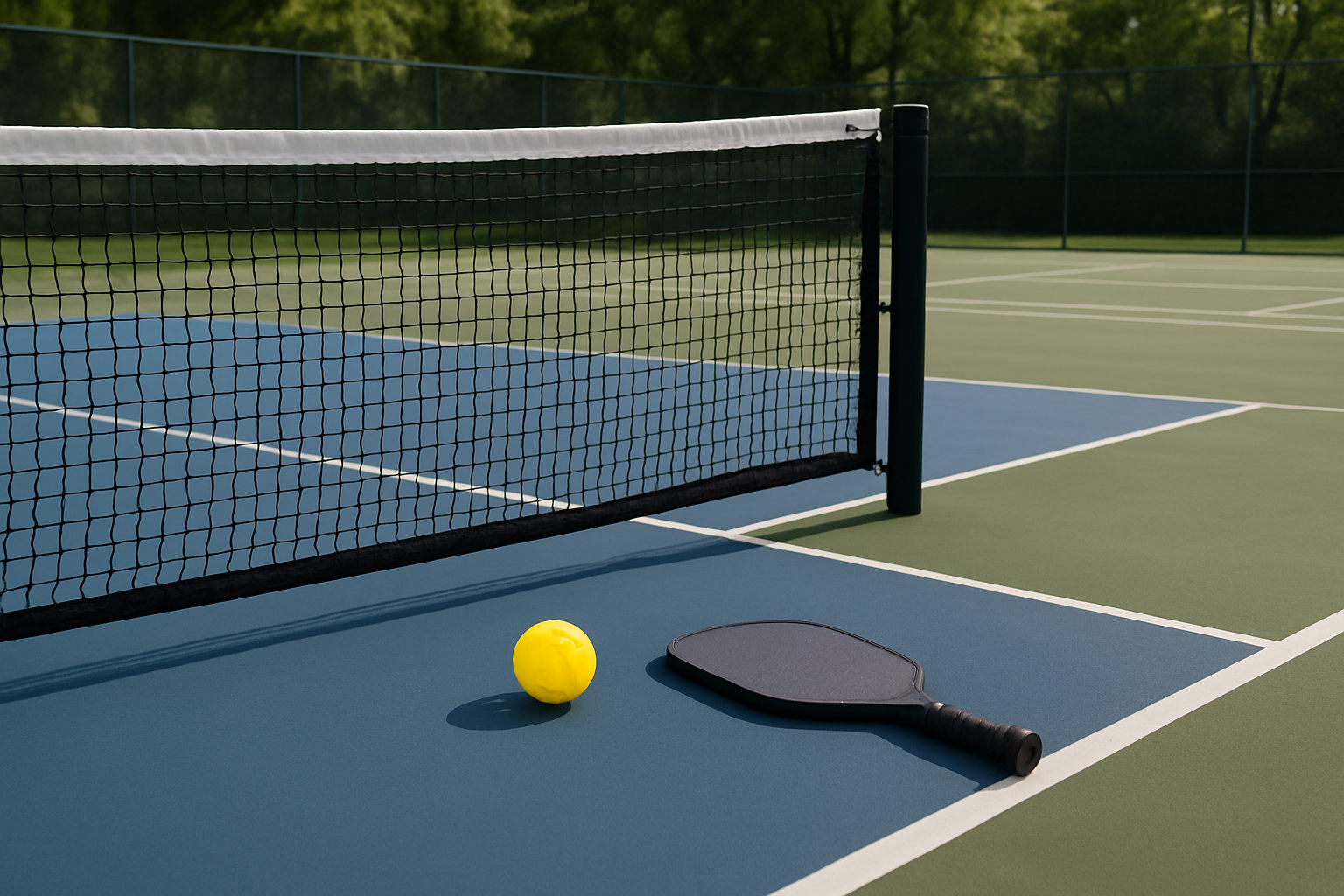
A standard tennis court measures 78 feet long by 36 feet wide for doubles play. A standard pickleball court measures 44 feet long by 20 feet wide. This means a single tennis court can comfortably accommodate two pickleball courts placed side by side. You can even fit up to four with careful layout planning and enough net equipment.
The size difference creates one practical challenge most beginners do not anticipate: visual confusion. When you’re standing inside a pickleball court drawn on a tennis court, the larger court lines are still visible around you. It’s easy to misjudge your own boundaries mid-rally, especially when you’re learning the game.
Experienced players recommend using a visually distinct tape color. Bright yellow or orange work best. These colors make the pickleball boundaries clearly stand out from the existing white or green tennis lines.
Here is a quick breakdown of the key dimensional differences:
| Measurement | Tennis Court | Pickleball Court |
|---|---|---|
| Total length | 78 feet | 44 feet |
| Total width (doubles) | 36 feet | 20 feet |
| Net height at center | 36 inches | 34 inches |
| Net height at posts | 42 inches | 36 inches |
| Kitchen/Non-volley zone | Not applicable | 7 feet from net |
| Service boxes | Yes | No |
The net height difference of two inches at the center sounds minor. However, it has real implications for the game. A pickleball net sits at 34 inches at center and 36 inches at the posts. A tennis net sits at 36 inches at center and 42 inches at the posts.
If you use a tennis net without lowering it, the ball will travel over a net that is two inches higher at the center. This shifts the ideal shot trajectory, particularly for dinks, drops, and third-shot sequences. For casual recreational play, many players accept this difference without adjustment. For competitive or structured play, you will want a portable pickleball net system.
How to Actually Set Up Pickleball on a Tennis Court
Setting up the court correctly takes about 15 to 30 minutes the first time. After that, it takes much less time. Here is the standard approach used by players at public parks and school courts across the country.
Step 1: Choose your court orientation for pickleball play.
You have two main options. First, set up one pickleball court running the same direction as the tennis court, using the existing net. Alternatively, set up two courts running perpendicular to the tennis court, which requires two portable nets but allows more players to participate simultaneously.
Step 2: Mark your boundaries for the pickleball court.
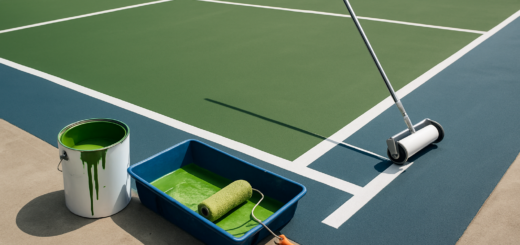
Use blue painter’s tape or court marking tape for temporary lines. Do not use permanent paint unless you have explicit permission from the facility. Mark the sidelines at 20 feet wide and the baselines at 44 feet from net to net. Mark the non-volley zone, also called the kitchen, at 7 feet on each side of the net.
Step 3: Adjust or replace the net to proper pickleball height.
If you are using the existing tennis net, you can lower the center by attaching a net strap or center strap. This pulls the net down to the correct 34-inch height. These straps retail for around $10 to $20 on Amazon or at sporting goods stores like Dick’s Sporting Goods. For the most accurate setup, bring a portable pickleball net that sets to the correct post height as well.
Step 4: Set out the balls and confirm player positions.
Standard outdoor pickleball balls like the Dura Fast 40 or Franklin X-40 work well on hard court surfaces. Check that all players understand which lines are in play before starting, since the surrounding tennis court lines will still be visible.
Fitting Multiple Pickleball Courts on One Tennis Court
One of the most practical advantages of using a tennis court is the ability to run multiple pickleball games at the same time. This is how community centers, recreation departments, and organized clubs manage large groups efficiently.
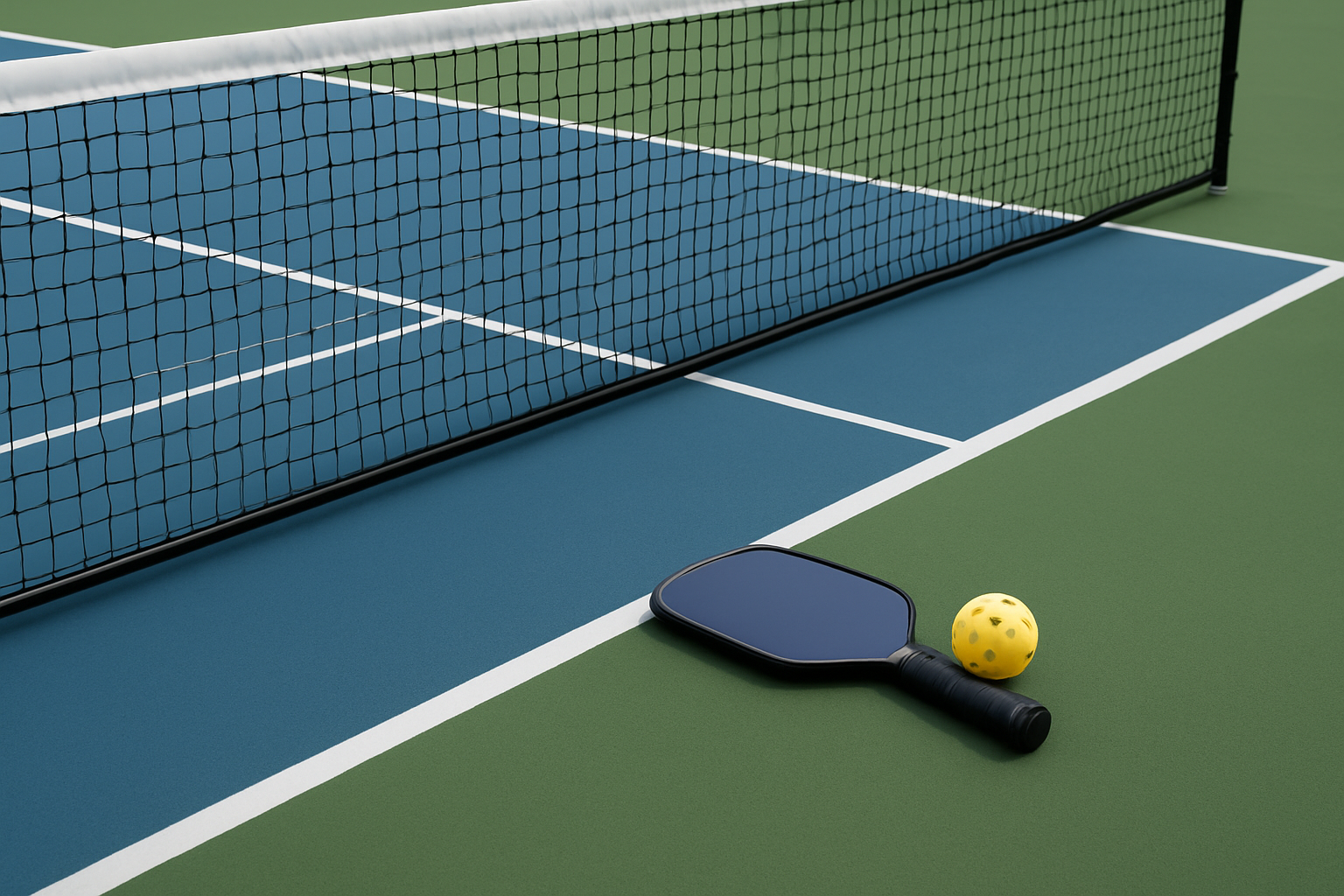
Two-court layout for pickleball: Place one pickleball court on each side of the tennis net, running perpendicular to it. Each court uses its own portable net. This layout works well for groups of 8 players and requires approximately 88 feet of court length, which fits within a standard 78-foot tennis court if you allow for small buffer zones.
Four-court layout for pickleball: Some facilities use a four-court layout, which places two courts on each half of the tennis court in a parallel configuration. This requires four portable nets, extensive taping, and a bit more coordination, but it is achievable at larger multi-court tennis facilities. The USA Pickleball Association provides official layout diagrams for exactly this type of conversion on their website.
For ongoing club use, many facilities invest in semi-permanent painted lines alongside the existing tennis markings. Municipalities like Boise, Idaho, and Scottsdale, Arizona, have already done this at multiple public parks, marking the pickleball boundaries in a contrasting color like blue or orange to reduce visual confusion.
Things to Know
- Tennis court surfaces vary. Older asphalt courts with cracks or uneven patches can affect ball bounce and player safety. Walk the court before setting up.
- Not all parks allow temporary tape or chalk markings without prior approval. Check with your local parks department before setting up on a public court.
- Wind affects outdoor pickleball balls more than tennis balls. Lighter plastic balls can drift significantly on windy days, which matters more when you’re playing on an open tennis court than in an enclosed facility.
- The kitchen rule, which prohibits volleying from within 7 feet of the net, does not exist in tennis. New players transitioning from tennis often make this mistake repeatedly in their first few sessions.
- USA Pickleball recommends court surfacing with a coefficient of friction between 0.5 and 1.0 for safety. Most standard hard tennis courts fall within this range.
- Indoor tennis courts often have lower ceilings than you might expect. Lob shots and high overheads can become impractical or unsafe in some indoor venues.
Net Systems and Equipment Worth Investing In
If you plan to convert a tennis court for pickleball on a regular basis, a portable net system is worth the upfront cost. Here is a comparison of popular options:
| Net System | Price Range | Setup Time | Weight | Best For |
|---|---|---|---|---|
| Onix Portable Net | $100 – $130 | 5-10 min | 22 lbs | Casual play |
| PickleballCentral Pro Net | $140 – $170 | 5-10 min | 28 lbs | Clubs/leagues |
| Rally Meister Net | $80 – $100 | 5 min | 18 lbs | Beginners |
| Franklin Sports Net | $60 – $90 | 5 min | 15 lbs | Youth/casual |
| Gamma Sports Net | $110 – $140 | 8 min | 24 lbs | Recreational |
The PickleballCentral Pro Net and the Gamma Sports Net are widely considered solid mid-range options. These work best for groups that use courts multiple times per week. For players who only play occasionally, the Franklin Sports or Rally Meister options provide enough stability at a lower price point.
Frequently Asked Questions
Q: Does the net height on a tennis court ruin pickleball games?
A standard tennis net is two inches higher at the center than a pickleball net. This affects shot trajectories but does not make the game unplayable for casual sessions.
For recreational play, most players adapt quickly and find the difference manageable. However, if you are practicing for a tournament or trying to develop accurate dinking technique, using a proper pickleball net or a center strap will give you a more authentic experience.
Q: How many pickleball courts fit on a tennis court?
One tennis court can typically fit two pickleball courts side by side. Up to four courts are possible with careful layout planning and enough portable nets.
The exact configuration depends on the court dimensions, buffer space between courts, and how many nets you have available. USA Pickleball provides official multi-court layout templates for reference.
Q: Do you need permission to set up pickleball on a public tennis court?
In most U.S. cities, public tennis courts are open-access. However, applying temporary tape or chalk lines may require approval from your local parks department.
Some parks have designated pickleball hours or already have dual-use markings in place. Checking your city’s parks and recreation website or calling ahead avoids potential conflicts with tennis players or facility staff.
Q: What type of tape is safe to use on tennis court surfaces?
Blue painter’s tape is the most widely used option because it adheres well to hard court surfaces. It’s clearly visible, and it peels off cleanly without damaging the court.
Avoid duct tape or electrical tape, which can leave sticky residue and potentially peel up sections of the court’s acrylic surface coating. Some players also use temporary chalk lines for outdoor courts where paint is inappropriate.
Q: Is the game of pickleball harder to play on a tennis court?
Pickleball played within properly marked boundaries on a tennis court is nearly identical to playing on a dedicated court. The main challenge is visual distraction from the surrounding tennis court lines.
The extra surrounding space does not affect gameplay within the pickleball boundaries. The bigger adjustment for most players is learning to ignore the tennis lines and focus only on the taped or painted pickleball boundaries.
The Bottom Line on Can Pickleball Be Played on a Tennis Court
Can pickleball be played on a tennis court? Absolutely. It is the most common way millions of Americans access the sport right now. With the right tape, a center net strap or portable net, and a clear understanding of the boundary differences, a tennis court becomes a fully functional pickleball venue in under 30 minutes.
Your next step is straightforward. First, find your nearest public tennis court. Next, check your local parks department’s scheduling rules. Finally, grab a set of court marking tape and a net strap before your first session. If you plan to play regularly with a group, investing in a quality portable net system will pay off quickly. You’ll enjoy both faster setup time and improved gameplay accuracy.