Sharpen Your Pickleball Skills Without Leaving the Driveway
Learning how to practice pickleball at home means working on your dinks, serves, volleys, and footwork using walls, nets, and solo drills right in your own space. You don’t need a full court or a partner to make meaningful progress between games. In fact, many intermediate and advanced players credit solo home practice with closing the gap between casual recreational play and competitive club-level performance.
Key Takeaways
- A simple concrete wall or garage door can replace a hitting partner for most solo drills
- Footwork and reaction speed can be trained entirely indoors with no equipment
- A portable net costs between $80 and $150 and turns your driveway into a functional practice court
- Consistent 20-minute home sessions can close the gap between casual play and competitive club-level performance
- Dink rallies against a wall build the soft-touch feel that most recreational players never fully develop
- Tracking your progress with a simple drill log accelerates improvement faster than random hitting
Why Home Practice Actually Moves the Needle
Many players assume that improvement only happens during open play or organized drills with a group. That assumption leaves a lot of progress on the table. The reality is that pickleball mechanics respond very well to repetitive solo work.
Consider how a college tennis athlete might spend hours hitting against a wall before stepping onto a court with a coach. The same principle applies here. When you are the only person in the drill, every repetition is intentional. There are no bad shots from a partner to chase. There’s no social distraction. There’s no waiting for your turn.
The skills that matter most in recreational and competitive play are:
- Third-shot drop consistency
- Dink control from both sides
- Serve reliability and placement
- Reset mechanics under pressure
- Court positioning and split-step timing
All five of these can be trained at home with the right setup and the right approach.
Setting Up Your Home Practice Space for How to Practice Pickleball at Home
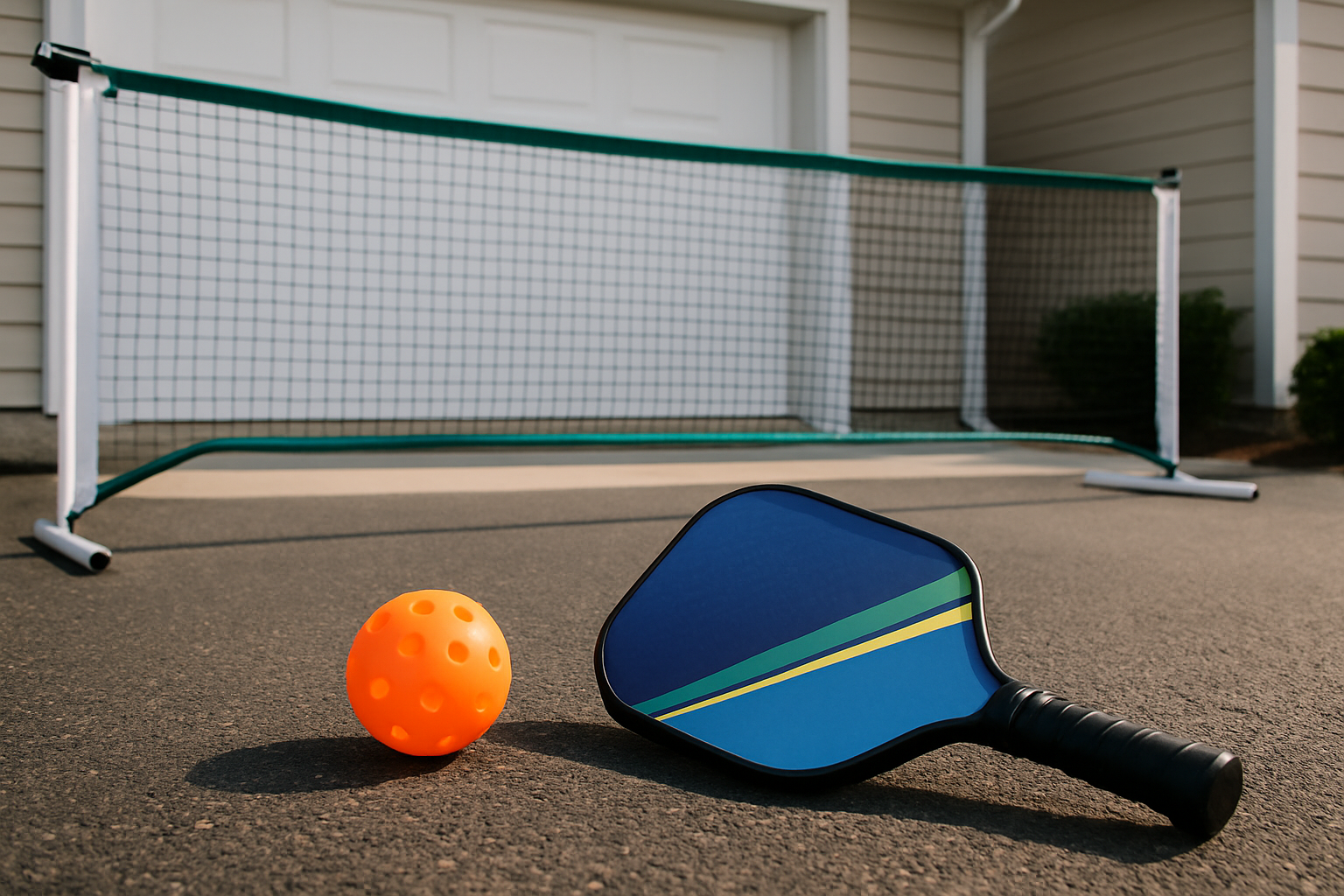
You don’t need much space to run effective drills. Here’s what works depending on what you have available.
The Wall Setup
A flat wall, a garage door, or even a sturdy wooden fence works well. The surface should be smooth enough that the ball bounces back predictably. Mark a horizontal line with painter’s tape at 34 inches from the ground. That represents the top of the net at center court. Consider marking a line at 36 inches for the sideline posts if you want added realism.
Stand 7 feet back from the wall to simulate non-volley zone (kitchen) distance. Practice hitting the ball below your tape line and letting it come back to you. This simulates a dink exchange with an opponent standing at their own kitchen line.
The Driveway Court
A standard pickleball court is 20 feet wide by 44 feet long. Most American driveways range from 18 to 20 feet wide. This means you can fit a close approximation with tape or chalk markings. You only need half the length, around 22 feet, to practice serve mechanics and third-shot drops toward the kitchen.
A portable net is a practical investment for this setup. Here is a comparison of popular options available in the U.S.:
| Net Brand | Price (USD) | Weight | Setup Time | Best For |
|---|---|---|---|---|
| Onix Portable Net | $89 | 22 lbs | 5 min | Driveway and backyard |
| Franklin Sports Net | $79 | 18 lbs | 4 min | Casual home practice |
| USAPA Regulation Net | $149 | 29 lbs | 8 min | Serious competitive prep |
| Amazin’ Aces Net | $84 | 20 lbs | 5 min | Budget-friendly option |
None of these require permanent installation. You can store them in a garage when not in use.
Indoor Options
If you have a basement, long hallway, or open living room, you can still get useful reps in. Use a foam or low-compression ball to reduce bounce height and keep the noise down. Knee-height volleys and wrist control drills work perfectly with just 10 feet of clearance.
The Best Solo Drills for How to Practice Pickleball at Home
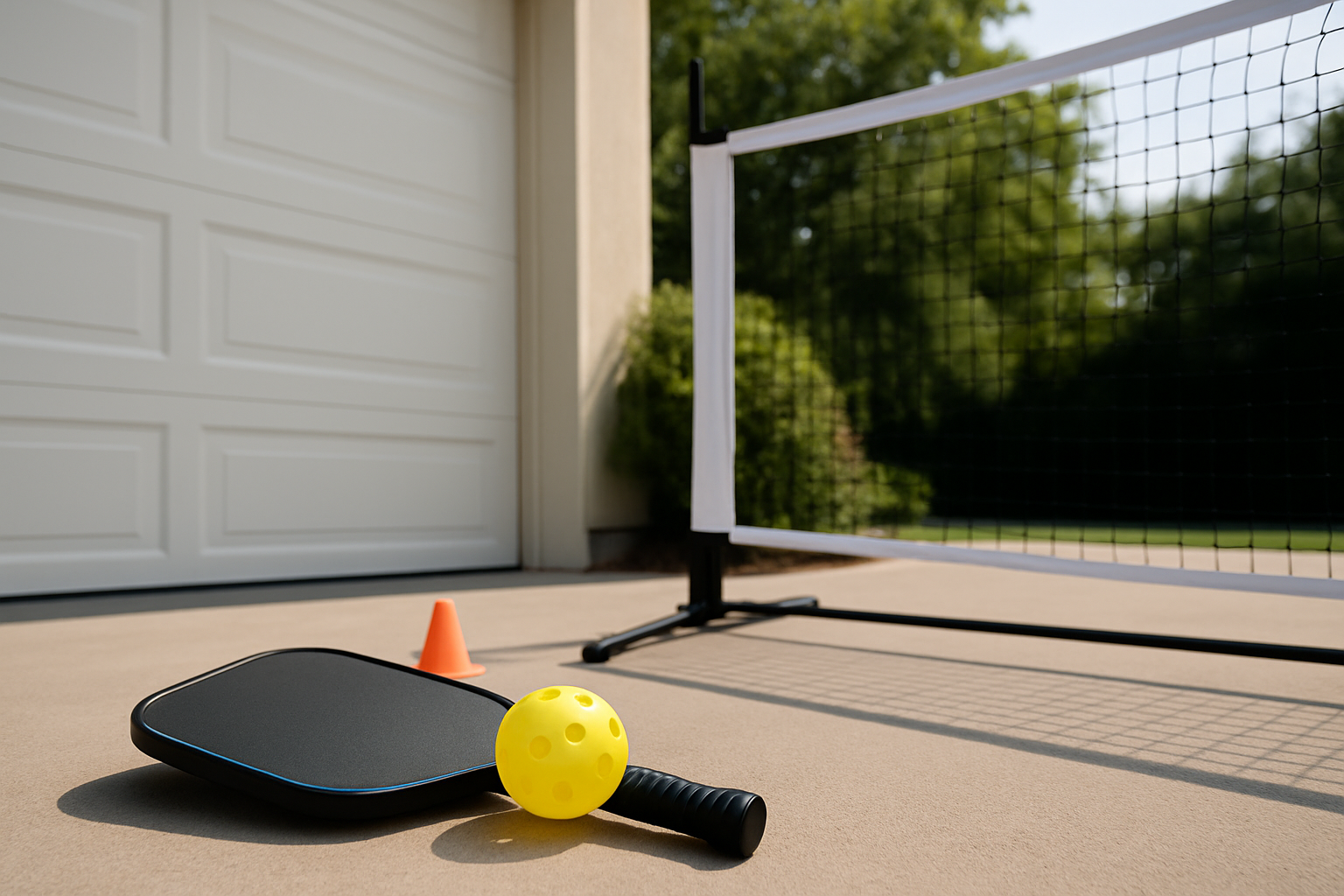
This is where knowing how to practice pickleball at home really pays off. Structure your sessions around skill categories so you build a complete game, not just one strong shot.
Dink Wall Drills for Home Practice (15 Minutes)
Stand at kitchen distance from your wall. Hit soft dinks below the tape line and focus on:
- Keeping your grip pressure at 3 out of 10 (loose but controlled)
- Using your shoulder and elbow, not your wrist, to generate the shot
- Letting the ball drop below net height before contact
Start with your forehand side for 3 minutes. Then switch to backhand for 3 minutes. Next, alternate sides each shot for 5 minutes. Finally, finish with 4 minutes of random rhythm, mixing in a harder drive occasionally to simulate an opponent attacking.
Serve Target Practice for Home Training (10 Minutes)
Place a target on your driveway court—a hula hoop, a cone, or even a folded towel. Position it in the deep backhand corner and the deep middle of the service box. Serve 10 balls to each target. Track your hit percentage each session in a small notebook.
Most club players hit their target around 40 to 50 percent of the time. Intermediate players can reach 70 percent with two weeks of focused practice.
Third-Shot Drop Simulation (10 Minutes)
This requires a bit more imagination without a partner, but it works well. Stand at the baseline and drop the ball, letting it bounce once. Then hit a soft arcing shot that peaks quickly and falls steeply toward the kitchen line area on the other side of your net. You are training the upward stroke and soft touch rather than full trajectory in a real game. However, the muscle memory translates directly.
Footwork Ladder Drills for Home Practice (10 Minutes)
Use a speed ladder or paint one on your driveway with chalk. Run these patterns:
- Two feet in each rung, forward and back
- Lateral shuffle through every rung
- In-out pattern simulating a split step into a sidestep
- Crossover step through the ladder for recovery movement
Do each pattern twice at moderate speed. Then do each pattern twice faster. Pickleball footwork is about quick, short adjustments, not long sprints. The ladder trains exactly the right movement pattern.
Reaction Ball Drills (5 Minutes)
A reaction ball (a small, oddly shaped rubber ball that bounces unpredictably) costs around $8 to $12 at sporting goods stores. Drop it from waist height and try to catch it after one bounce. This trains your hands and eyes to respond to the irregular bounces common in real pickleball exchanges, especially on outdoor courts with cracked or uneven surfaces.
Training Your Mental Game at Home
Physical repetition is half the equation. The other half is pattern recognition and decision-making, which you can genuinely train off the court.
Video Study
Watch footage of pro players like Ben Johns or Anna Leigh Waters and focus specifically on one element per session. Watch only their feet for 10 minutes. Then watch only their paddle position during the kitchen exchanges. Next, watch their reset technique on balls that pull them wide.
Most players who do this for even two weeks report that their in-game decision-making noticeably sharpens.
Visualization Practice
Sit in a quiet room and run through a full rally in your mind, from the serve to the third-shot drop to the dink battle to the attack opportunity. Research in sports psychology, including work from U.S. Olympic training programs, consistently shows that mental rehearsal activates the same neural pathways as physical practice. Just ten minutes of visualization before bed is a low-effort, high-return habit.
Things to Know
- Outdoor pickleballs and indoor pickleballs are different. Outdoor balls have 40 smaller holes and are heavier. Practice with the type you actually play with.
- Cement and asphalt surfaces are harder on your joints than sport court tiles. If you practice daily on a hard driveway, wear proper court shoes with cushioning.
- The non-volley zone rule applies even in solo drills. Build the habit of stopping your footwork before the 7-foot kitchen line on every simulated approach.
- Grip pressure is one of the most undercoached elements in recreational pickleball. Most beginners grip 30 to 40 percent too tightly, which kills touch shots.
- Weather affects your ball significantly. Below 50 degrees Fahrenheit, pickleballs become brittle and bounce inconsistently. Adjust expectations or move indoors in winter.
- A 20-minute focused home session three times per week will typically produce more improvement than one 2-hour open play session where you are not deliberately working on a skill.
Frequently Asked Questions
Q: Can I actually improve my pickleball game by practicing at home without a partner?
Yes, solo home practice absolutely improves your game, particularly your soft game, serve accuracy, and footwork. Wall drills specifically build the muscle memory and touch control that separate recreational players from intermediate and advanced ones. Most of the mechanical habits you form or break happen in solo repetition, not during chaotic open play.
Q: How much space do I need in my backyard or driveway to practice pickleball at home?
A space of at least 10 by 20 feet gives you enough room for wall drills, footwork training, and serve practice. You don’t need the full 20-by-44-foot court for most solo drills. A half-court setup is sufficient for serve mechanics and kitchen-line simulation. A flat wall with 10 feet of clearance covers dink drills entirely.
Q: What equipment do I need to start home pickleball practice?
The bare minimum is your paddle, three to four balls, and a flat wall or surface to work against. Adding a portable net ($79 to $149), court tape or chalk, a speed ladder ($15 to $25), and a reaction ball ($8 to $12) dramatically expands what you can practice. A full home setup typically runs under $200 total if you already own a paddle.
Q: How often should I practice pickleball at home to see real improvement?
Three focused sessions per week, each 20 to 30 minutes, is enough to produce noticeable skill gains within two to three weeks. Consistency matters more than session length. Short, daily repetitions of a specific skill, such as dinking or serving, build faster and more durable muscle memory than infrequent long sessions where you jump between too many things.
Q: Are there any apps or tools that help with home pickleball training?
Yes, apps like Pickleball Tournaments and SwingVision can help you track progress, analyze your stroke mechanics via video, and find structured drills. SwingVision, popular among tennis players and increasingly used by pickleball players, uses your phone camera to analyze swing speed and contact point. Pair it with a tripod and your phone for a low-cost video coaching setup at home.
The Bottom Line on How to Practice Pickleball at Home
Knowing how to practice pickleball at home gives you a real competitive edge when you show up to open play, league nights, or tournaments. The players who improve fastest are not always the ones with the most court time. They are the ones who use their off-court hours deliberately and consistently.
Start with your wall, your tape, and 20 minutes. Pick one drill category per session and track your numbers in a notebook. Watch your game shift noticeably within a month. Your next step is to set up your wall target today, even just with masking tape. Run 15 minutes of dink practice before your next scheduled game and start your journey to becoming a better player.