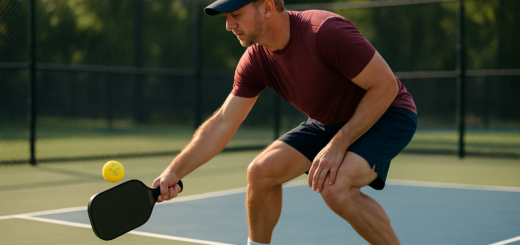
Pickleball Paddle Weight: What Every Player Needs to Know Before Buying
Choosing the right paddle weight directly impacts your control, power, and risk of injury on the court. A paddle that is too heavy or too light for your skill level and physical condition can hold your game back more than any technique flaw. Understanding paddle weight is essential to creating a solid pickleball paddle weight guide tailored to your needs.
Key Takeaways
- Pickleball paddle weights typically range from 7.3 oz to 8.5 oz, divided into three main categories: lightweight, midweight, and heavyweight.
- Midweight paddles (7.5 to 8.3 oz) are the best starting point for most recreational and beginner players.
- Heavier paddles produce more power but reduce control and increase injury risk, particularly for players prone to arm fatigue.
- Swing weight, not just static weight, determines how a paddle actually feels during play.
- Players managing tennis elbow or similar conditions should target paddles in the 7.8 to 8.0 oz range.
- Lead tape customization is widely used, even at the professional level, to fine-tune weight distribution without replacing the paddle entirely.
Why Paddle Weight Matters in Your Pickleball Paddle Weight Guide
Most new players fixate on grip size or surface texture when shopping for a paddle. However, weight is arguably the single factor with the biggest effect on your overall performance. The difference between a 7.3 oz paddle and an 8.5 oz paddle may sound minor, but on the court, especially during long rallies or dinking sessions at the kitchen line, you’ll notice it immediately.
Weight influences four core areas of your game:
- Power: Heavier paddles generate more momentum on contact, driving the ball deeper and harder.
- Control: Lighter paddles allow faster hand speed and more precise placement, which is critical during soft-game exchanges.
- Arm fatigue: A paddle that strains your wrist and forearm over a two-hour session increases the risk of chronic injury.
- Reaction time: At the non-volley zone, milliseconds matter. A lighter paddle swings faster and lets you react to quick exchanges.
Understanding these trade-offs is the foundation of any solid pickleball paddle weight guide. It starts with knowing which weight class suits your playing style.
The Three Weight Classes: Lightweight, Midweight, and Heavyweight
Lightweight Paddles in Your Pickleball Paddle Weight Guide: 7.3 oz and Under
Lightweight paddles are built for players who prioritize agility and a soft touch over raw power. Players who spend most of their time at the kitchen line, working the dink game, or engaging in fast-twitch volley exchanges tend to gravitate toward lighter options.
The benefits are clear: faster swing speed, reduced arm fatigue, and better feel on touch shots. However, the trade-off is significant. You must generate power through your footwork and mechanics rather than relying on the paddle to do the work for you. If your technique is not refined, a lightweight paddle can make your drives feel underpowered and inconsistent.
These paddles are especially popular among players managing existing arm conditions. Additionally, pickleball is one of the fastest-growing sports in the United States. Unfortunately, injuries are growing alongside participation rates. USA Pickleball has noted that improper equipment is among the most common causes of recreational arm pain. This puts paddle weight firmly at the center of injury prevention.
Midweight Paddles in Your Pickleball Paddle Weight Guide: 7.5 to 8.3 oz
This is where most players belong. Midweight paddles offer a balance between paddle speed, control, and power that makes them practical for a wide range of playing styles, skill levels, and physical conditions. Roughly 80% of players on courts across the country would benefit most from a paddle in this range.
For beginners, midweight paddles are particularly valuable. They do not demand perfect mechanics to deliver a consistent result. You get enough mass to push the ball through the court without the wrist strain that comes with heavier options.
Intermediate players often stay in this range even as they advance. Furthermore, the midweight category is broad enough to accommodate both power-oriented and control-oriented play styles depending on where within the range you land.
Heavyweight Paddles in Your Pickleball Paddle Weight Guide: 8.3 oz and Above
Heavy paddles are for players who want maximum power off the baseline. These players are willing to sacrifice some hand speed to achieve it. At the professional level, paddles between 8.2 oz and 8.6 oz are common. Elite players have the physical conditioning and technical precision to manage the reduced agility.
If you watch pro matches, you’ll notice how comfortably top players absorb pace and redirect drives. Part of that comes from their equipment. A heavier paddle resists vibration more effectively and naturally counters the momentum of a hard-driven ball. However, for recreational players without that conditioning base, daily use of an 8.3 oz or heavier paddle dramatically increases the risk of tennis elbow, shoulder strain, and wrist fatigue.
Static Weight vs. Swing Weight: The Distinction Most Buyers Miss
Here is something the packaging will not tell you: the number printed on a paddle’s label is its static weight, measured while the paddle sits completely still. Swing weight is a different measurement entirely. It describes how heavy a paddle actually feels when you swing it.
Two paddles can share an identical static weight of 7.9 oz and feel dramatically different during play. This happens because of how their mass is distributed. A paddle with more weight concentrated in the head will feel heavier and more powerful. Meanwhile, the same weight distributed toward the handle will feel more maneuverable and control-oriented.
This distinction matters enormously at the net. During fast exchanges, swing weight, not static weight, dictates how quickly you can bring your paddle back into position after each shot. When evaluating any paddle, especially online without the ability to demo it, look for swing weight data from independent testing sources. Some manufacturers have started listing swing weight alongside static weight, which is a positive trend for informed buyers.
The practical takeaway is straightforward: never judge a paddle on weight alone. If possible, demo several paddles in the same static weight range. Notice how different they feel in motion.
Paddle Weight and Injury Prevention: A Practical Framework
Arm injuries are a real concern in pickleball, particularly among recreational players aged 50 and above. This group makes up a significant portion of the American pickleball community. The repetitive motion of volleying, combined with improper equipment, creates conditions where tennis elbow, shoulder impingement, and wrist tendinitis develop quickly.
For players dealing with tennis elbow, the optimal paddle weight typically falls between 7.8 oz and 8.0 oz. This range provides enough mass to absorb vibration, which reduces the jarring impact felt through the arm on off-center hits. Additionally, it avoids being so heavy that it strains the tendons during extended play.
Here is a quick reference table to help match weight to player profile:
| Player Profile | Recommended Weight Range | Primary Reason |
|---|---|---|
| Beginner or recreational | 7.5 to 8.0 oz | Balance and ease of use |
| Control-focused player | 7.3 to 7.8 oz | Soft game and hand speed |
| Power-focused player | 8.0 to 8.5 oz | Drive depth and pace |
| Tennis elbow management | 7.8 to 8.0 oz | Vibration absorption without overload |
| Professional competitor | 8.2 to 8.6 oz | Counter-punching and pace resistance |
| Senior recreational player | 7.3 to 7.8 oz | Reduced arm fatigue |
If you are brand new to the sport, you might also benefit from brushing up on the basic rules. Understanding how to keep score in pickle ball before your first session will help you focus on your equipment. You’ll avoid scrambling to understand the scoring system mid-game.
Customizing Weight With Lead Tape in Your Pickleball Paddle Weight Guide
You do not have to accept a paddle’s factory weight as final. Lead tape customization is standard practice at the professional level. Moreover, it is completely legal under USA Pickleball equipment rules. It gives you fine control over weight distribution that no manufacturer can replicate for every individual player.
Here is how players typically use lead tape:
- Adding tape to the top edge (12 o’clock): Increases head-heavy feel, adds power to groundstrokes.
- Adding tape to the sides (3 and 9 o’clock): Widens the effective sweet spot, increases stability on off-center hits.
- Adding tape near the throat: Creates a handle-heavy balance, improving maneuverability and feel on touch shots.
Lead tape rolls are widely available at sporting goods stores and online retailers for under $15 per roll. A single strip weighs approximately 3 to 5 grams, so even a small addition can shift how the paddle performs. The key is to add small amounts, test the paddle, and adjust incrementally. Avoid making large changes all at once.
If you enjoy the history and lore of the sport as much as the game itself, it is worth exploring what was pickleball named after. This gives context to how this uniquely American sport got its unusual identity.
Things to Know About Pickleball Paddle Weight
- The listed weight on a paddle is the static weight, measured at rest. Swing weight, how the paddle feels in motion, is a separate and equally important measurement.
- Adding just 0.3 to 0.5 oz via lead tape can noticeably shift a paddle from feeling control-oriented to power-oriented.
- Grip size affects perceived weight. A grip that is too small causes you to squeeze harder, which accelerates arm fatigue even with a correctly weighted paddle.
- Paddles stored in extreme cold (common if you leave them in your car during winter) can feel temporarily stiffer and heavier until they warm to room temperature.
- There is no universal “best” weight. The right choice depends on your skill level, playing style, physical condition, and how many hours per week you play.
- Heavier paddles are not inherently better for stronger players. Even athletes with strong forearms may prefer lighter paddles for the precision advantage in soft-game exchanges.
Frequently Asked Questions
Q: What paddle weight is best for beginners?
Most beginners perform best with a midweight paddle between 7.5 and 8.0 oz.
This range provides enough mass to return hard shots without demanding perfect mechanics. It remains light enough to swing quickly during net exchanges. Starting within this range gives you room to adjust once you understand your playing style better.
Q: Can the wrong paddle weight cause pickleball-related injuries?
Yes, using a paddle that is too heavy for your conditioning level is a leading cause of arm injuries in recreational pickleball.
USA Pickleball recognizes improper equipment as one of the main contributors to arm pain among recreational players. If you are experiencing discomfort after playing, switching to a lighter paddle in the 7.8 to 8.0 oz range is often one of the first adjustments a sports therapist will recommend.
Q: How do I know if my paddle is too heavy for me?
If your arm, wrist, or shoulder feels fatigued or sore within the first 30 minutes of play, your paddle may be too heavy.
Other signs include slower reaction time at the net compared to when you first started playing with a lighter paddle. You might also experience a tendency to push shots rather than drive them cleanly. Fatigue-driven form breakdown is a reliable indicator that your equipment is working against you.
Q: Does paddle weight matter more for singles or doubles play?
Weight matters differently in each format, with doubles favoring lighter paddles for net speed and singles often benefiting from slightly heavier options for baseline power.
In doubles, the majority of competitive points are decided at the kitchen line. Fast hands and a light paddle provide a clear advantage. In singles, where baseline rallies are longer and court coverage is more demanding, the extra pace from a heavier paddle can be valuable. You must have the endurance to manage it.
Q: Is swing weight listed on pickleball paddles when you buy them?
Not consistently, but the trend toward including swing weight data is growing among premium paddle brands.
Most budget and mid-range paddles still only list static weight. For accurate swing weight data, independent testing publications and pickleball-specific equipment review sites are currently the most reliable sources. Always check whether the weight listed is static before making a purchase decision.
The Bottom Line on the Pickleball Paddle Weight Guide
The right paddle weight is not a minor detail. It shapes how you experience every point, from dinks at the kitchen line to drives from the baseline. Furthermore, it directly influences your long-term joint health. This pickleball paddle weight guide breaks down into one core principle: start in the midweight range, test how your body responds, and adjust from there using lead tape or a different paddle entirely.
Your next step is to demo at least two paddles in different weight categories before committing to a purchase. Many local pickleball clubs and specialty retailers in the United States offer demo programs for $5 to $25, often with the fee credited toward a purchase. Investing an hour in testing is worth far more than returning a $200 paddle because the weight was wrong from the start.